


Jesus has exited the temple fresh from speaking the publicly repeated refrain, “Woe to you, scribes and Pharisees, hypocrites!” and lamenting over the city of Jerusalem that “kills the prophets.” We join him now in a private space with the disciples.
The landscape speaks
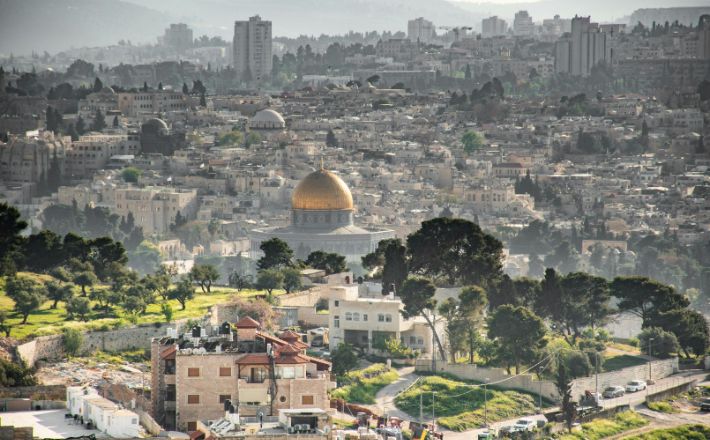
While this passage begins Jesus’s fifth and final discourse in Matthew, the often-overlooked voice in this text is that of the landscape: “When he was sitting on the Mount of Olives, the disciples came to him privately” (24:3). The landscape speaks throughout the biblical text, and this is a prime example. The Mount of Olives is an apocalyptic topography, a place of divine revelation, harkening to Zechariah 14:4. It is the geological kin of prophets of old.
It is no coincidence that the Mount of Olives is located, as Mark notes, “opposite the temple” (Mark 13:3). Topographically, it is higher than the Temple Mount. Chronologically, the Mount of Olives has known the sacredness of this land from before the temple was built, and destroyed, and built again.1 Jesus pronounces doom for the temple, then takes the disciples and ascends an even higher mountain opposite the Temple Mount and begins to teach.
In our over-spiritualization of the teachings of Jesus, we often miss the very earthy ways they are rooted for Jesus’s first hearers. Our relationship to the landscape, to our ecological and geological kin within the realm of God, matters to our living of the Good News. Pay attention to where you place your feet along this Palm Sunday Path. Learn to listen to the language of the land and its multi-species inhabitants.
Apocalyptic vision
We get apocalyptic material wrong when we imagine it as simply predictive of future events. Ernst Käsemann argues that the basic question of apocalyptic material is this: “To whom does the sovereignty of the world belong?”2
Eschatological and apocalyptic discourse sheds divine light to read the past, present, and future all at once. These statements do not simply “predict” coming events but perceive our collective lives in revelatory ways intent on encouraging our faithfulness, even amid trial and tumult. In the light of God’s rule and reign, the past-present-future events of our lives—personal and political—become relativized by the revelation of God’s sovereign, cosmic reign.
Wars and rumors of wars, nation rising against nation, famines and earthquakes, torture and persecution are all laid bare as the circumstances of our life in the world, then and now. But don’t miss the fact that words of warning about the world’s woes are imbricated throughout with exhortation and encouragement for disciples following the way of Jesus.
The point of these prophetic words is not prediction, or even the events themselves. It is to call the community of disciples together in persevering faithfulness and persistent watchfulness—centered amid chaos—because the sovereignty of the world belongs to God. Our ministry of love and justice depends upon this centeredness in God’s rule and reign.
Threats from within
In response to the disciples’ question about when and what signs of Jesus’s coming and the end of the age they should look for, Jesus’s first words in reply were these: “Beware that no one leads you astray” (24:4).
Apart from the violence of the Roman Empire—which Matthew’s community has already experienced in the 70 CE destruction of the temple prior to the Gospel’s writing—a primary threat addressed by Jesus in these verses is internal rather than external. “For many will come in my name, saying, ‘I am the Messiah!’ and they will lead many astray” (24:5).
In Matthew’s time, these false messiahs may have been any number of figures known to his community and named by Josephus. But in our day the threats from within our own wider Christian communion are more likely not coming as pseudo-messiahs but are coming in Jesus’s name with the cross draped in the American flag, with messages of anti-empathy eroding the possibilities of love, with fear of neighbor supplanting solidarity.
The threat to the living out of the Good News of Jesus often comes from within as we distort the teaching of Jesus to bolster Christian nationalism, foment anti-trans hatred, encourage the turn inward in self-centeredness rather than outward in neighbor-love, or even simply ignore the enfleshed concerns of our day in service to our own spiritual comfort.
Our Christian imaginations are often so tuned to see the possibility of persecution all around us that we fail to notice that the erosion of our faithfulness more often comes from the slow, persistent distortions of faith emanating from within the Christian community.
The faltering of love
Unlike the Markan and Lukan accounts of this scene, Matthew includes a unique line: “And because of the increase of lawlessness, the love of many will grow cold” (24:12). Preaching this verse might be aided by harkening back two chapters in Matthew to when the Pharisees asked Jesus to name the greatest commandment in the law. Jesus replied, “‘You shall love the Lord your God with all your heart and with all your soul and with all your mind.’ This is the greatest and first commandment. And a second is like it, ‘You shall love your neighbor as yourself.’ On these two commandments hang all the Law and the Prophets” (22:37–40).
Love takes shape in practice, in relationship, in the flesh. For a community like Matthew’s—or a community like ours—attempting to root our lives in the greatest commandments of loving God and loving neighbor, the faltering of love is a grave threat to our mission as disciples of Jesus. If we are led astray amid chaotic and volatile times, our love will grow cold, and our mission will grow thin.
+ + +
This commentary is a piece of a larger series. The preaching series “Walking the Palm Sunday Path in Lent” can be helpful to congregations looking for instruction and motivation to participate in the Palm Sunday Path. That’s a movement calling Christians to put their faith into visible action, processing together during the afternoon of Palm Sunday (March 29, 2026) in state capitals and other cities across the United States. That and other scheduled events will allow believers to join their Christian kin in a hope-filled, visible proclamation of Jesus, who rejected the false glory of domination and retribution and declared that God has a better way, a path of love. You can learn more about the movement on the Palm Sunday Path’s soon-to-be-launched website; around the end of January, search online for “Palm Sunday 2026” or direct your browser to palmsunday2026.com.
Notes
- Readers interested in the landscape’s function in the Gospels should see Elizabeth Struthers Malbon, Narrative Space and Mythic Meaning in Mark (San Francisco: Harper & Row, 1986).
- Ernst Käsemann, New Testament Questions of Today (Philadelphia: Fortress, 1969), 135.