

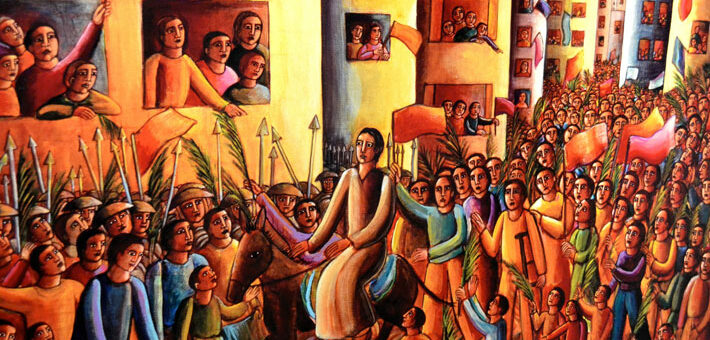
This Lenten series began with Luke’s version of Palm Sunday, where joyful acclamation fills the air. Luke 19:28–40 gives us a procession so hope-filled that at any moment even the stones may cry out. For many preachers—especially those serving in divided contexts—Luke feels like an easier entry into Holy Week, one that does not immediately stir the political tensions already present in our pews.
But the series concludes with Matthew’s account, and Matthew is different. Where Luke invites us to sing, Matthew invites us to see—to see the truth about authoritarian power and what happens when God’s mercy and love confront it. Matthew sets Jesus’s humble entry against a familiar imperial spectacle: the military show of force that embodied Rome’s false promise of stability—not the peace of God, but a brittle order secured through fear and domination; one that feels solid, yet is always on shaky ground.
When Jesus enters the city, Matthew tells us, the whole city is shaken. The verb used in verse 10 is related to the noun seismos, an earthquake (see also Matthew 27:51; 28:2, 4). In Matthew’s vision, it is mercy, not force, that makes the powers tremble. Jesus brings no army; he comes vulnerable and unguarded. Not atop a war horse, but humble and riding on a donkey. And remarkably, it is this simple, vulnerable procession that unsettles a city mesmerized by the empty promises of coercive power. Jesus’s way teaches that authentic authority is never built on fear.
Speaking truth without deepening division?
As a bishop serving preachers across a politically mixed region—congregations that include red, purple, and blue—I find this contrast especially poignant. Our people are not villains; they are faithful, hard-working neighbors who genuinely want to do what is right. Yet they arrive at worship shaped all week by voices they trust, fears they carry quietly, and competing stories about what “stability” requires—stories that speak far more loudly and persistently than the 20 minutes, if that, they hear in a Sunday sermon.
Preachers feel this pressure acutely. They know the vulnerability of stepping into a pulpit where every word is weighed. They long to proclaim the gospel truthfully while preserving trust—to care for people across the spectrum and to avoid placing already vulnerable neighbors at greater risk. Many quietly ask, “How do I speak truth without deepening division?”
This is where Matthew becomes a gift rather than a burden. He does not require the preacher to become a political pundit. Instead, he offers a theological vocabulary for talking about power without centering who holds it. Matthew helps us see that domination is not the same as authority, spectacle is not the same as truth, and fear can never bring stability.
Naming this—whether in a pulpit, in a coffee shop, or in the streets—does not require shaming. It calls instead for compassion and clarity. Many parishioners are navigating complex pressures and conflicting narratives, often without realizing how deeply those stories shape them. This is not to suggest that people lack agency or intelligence in forming their convictions. Still, in an information-saturated environment, exposure matters, and sustained engagement with theologically rich biblical teaching is often scarce.
Interrupting competing narratives
Matthew invites us to interrupt competing narratives—not by attacking them, but by placing Jesus’s own satirical display of power before the congregation, allowing other stories to be questioned, not directly, but subtly and artfully.
In our own time, Matthew’s narrative helps us recognize patterns that echo the dynamics Jesus exposes. These are not abstractions, but lived realities affecting neighbors whom God loves: cruelty functioning not as an accident of law enforcement but as a feature of it; public humiliation used as political theater to signal strength; racial profiling treated as an acceptable tactic rather than a moral failure; economic systems in which harm flows downward while wealth flows upward; and, at times, the name of Jesus invoked to defend such practices.
Matthew’s aim, however, is not condemnation but revelation—to help us see that systems built on fear and dehumanization can never deliver the stability they promise. They may project strength, but they cannot create peace. They claim to secure order, yet in Jesus’s presence they are the ones that shake.
This is why Matthew’s Palm Sunday is such a gift in polarized contexts. It offers unveiling rather than accusation. Matthew helps shift the sermon away from blaming people toward clarifying our vision. His account becomes a kind of sacred theater in which the nature of power is revealed, enabling congregations to discern without weaponizing the pulpit.
From this foundation, a preacher might take several homiletical directions:
- Contrast: Set Jesus’s procession beside the parades of fear in public life and allow the contrast to speak for itself.
- Invitation: Ask which procession we want to join—not with judgment, but with hope. The question is never about rendering a verdict, but about taking the next step in following Jesus.
- Consolation: For those exhausted by conflict, proclaim that Jesus’s gentler, steadier way offers freedom from the anxious stories that dominate our imagination.
Each approach honors the humanity of those we serve while sharpening our capacity to see. And here we circle back to where we began. Luke helps us hear the peace Jesus brings. Matthew helps us recognize the forces that threaten that peace—and how Jesus meets them. He calls to us: Look at Jesus. See how he enters the city. Watch how he uses power.
This—not fear, not spectacle, not force—is the power that can make cities tremble with hope.
+ + +
This commentary is a piece of a larger series. The preaching series “Walking the Palm Sunday Path in Lent” can be helpful to congregations looking for instruction and motivation to participate in the Palm Sunday Path. That’s a movement calling Christians to put their faith into visible action, processing together during the afternoon of Palm Sunday (March 29, 2026) in state capitals and other cities across the United States. That and other scheduled events will allow believers to join their Christian kin in a hope-filled, visible proclamation of Jesus, who rejected the false glory of domination and retribution and declared that God has a better way, a path of love. You can learn more about the movement on the Palm Sunday Path’s soon-to-be-launched website; around the end of January, search online for “Palm Sunday 2026” or direct your browser to palmsunday2026.com.