

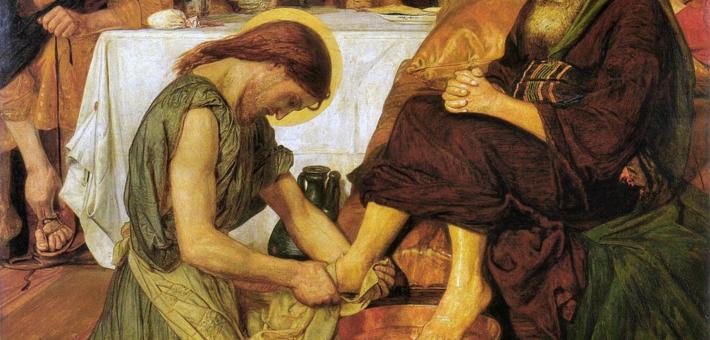

Of all the things Jesus could have done on his last night with his followers before his arrest, trial, and death—indoctrination, suggestions of insurrection, encouragement to incitement—he washes their feet.
The opposite of payback
But not just the feet of his allies. He also washes the feet of the one who will betray him before the meal is even over, Judas (John 13:30), and the one who will deny being one of his disciples, Peter (John 18:17, 25, 27). In fact, at the very same time Jesus is on trial before the high priest and is slapped across the face when he speaks truth, Peter denies the truth. “Aren’t you one of that man’s followers?” and Peter responds, “I am not” (John 18:17).
You see, Jesus does not reward his faithful or penalize the faithless. He does not make false promises or offer grandiosities in the face of what the disciples will surely witness. And the “love commandment” (John 13:31–35) is not some quid pro quo edict or transactional theology. That is not how Jesus’s kingdom works. No, Jesus shows his disciples abundant love exactly when faithfulness is and will be the most difficult. He shows them love to the nth degree when they will no doubt wonder how love can possibly win. Jesus loves his disciples to the end (13:1) with an outpouring of grace upon grace, not as a go-and-do-likewise “last stand” kind of directive, but as an action that will literally save their lives. Love will keep them together.
Not about Jesus—it’s about them
Jesus’s last night with his friends is not about him but about them—and what life on the ground and in the world without him will look like. Jesus neither loves the disciples so as to be adored or adulated in return, nor come to this night looking for a “love me back” loyalty. And the Farewell Discourse (chapters 14–17) is not a strategic plan or a bold projective outline for carrying out the “mission” of the Jesus movement.
Instead, at the center of it all, is a theology of humility. Hospitality takes on new meaning when Jesus hosts a meal of welcome into his home—the abode of relationship with him and God. Jesus reveals that in his realm, hospitality is no mere meal or subscription to a new social etiquette; it is intimate communion—that we may all be one. “As you, Father, are in me and I am in you, may they also be in us” (17:21). The disciples are then charged with an invitation to oneness in the face of all the principalities and powers that would tear them apart.
Loving as Jesus was loved
Washing the feet of his disciples is an act that can so easily be turned into an abstraction, where love is reduced to command. Which is why we have to consider again that of all the things Jesus could have done on the last night with his friends—he loves as he was loved. When Mary anoints Jesus’s feet (John 12:1–8) with abundant love—an extravagance matched only by Jesus’s own acts of abundance—Jesus then takes Mary’s love, holds on to her love, so that the next day, he can ride on a donkey, fanned with palm fronds and hosannas, toward the inevitability of empire’s threatened ego.
Jesus loves without condemnation, without expectation, because he has been lavishly loved into the future he knows must happen. According to John, love is what makes Palm Sunday possible.
Jesus then showers the love he has received and the love he knows on his disciples so they may share this love with each other and with the world God loves. Love is what will get the disciples through it all, as it will Jesus. Because love is the very heart of the incarnation.
Incarnation as an experience of love
The incarnation is not, in the end, a doctrine to defend or a proclamation in search of proof. The incarnation is the experience of love, being in the presence of love, a love that incorporates the entire cosmos. “For God so loved the world” is not a euphemism or pithy saying we get to put on a plaque and hang wherever it makes us feel good. Love is everything. Love is “In the beginning was the Word, and the Word was with God, and the Word was God” (1:1). And love is “And the Word became flesh and tabernacled among us” (1:14).
It is love who bends down to wash the feet of those who will need to remember what unconditional love feels like—now, as they watch a friend walk away and hear of another’s denial, and when the police come to execute an unjust arrest.
It is love who goes to the garden, to his arrest, to his trial, and to the cross.
It is with love and because of love that, from the cross, Jesus can look down at his tear-filled mother and the disciple whom he desperately loves. And his words from the cross are not about a great reckoning or retaliation. There is no judgment and there can be no judgment, because “God did not send the Son into the world to condemn the world but in order that the world might be saved through him” (3:17).
Only love can see how communities bound together in and through love will be the light of the world (9:5) when Jesus returns to the Father. The disciples will need to love each other so as to bear the betrayal of their closest friends, to watch Jesus exit the garden willingly, handing over his life for their lives, and to witness what empire does: kill those who give life. Because nothing can be borne without love.
We love one another to survive in a world where unchecked power and its minions are hellbent against love.
A simple act transformed
It is such a simple act: to wash the feet of a guest at your table. But Jesus takes a standard, societal display of welcome and transforms it into the deliberateness of servanthood. It is an act that upends all notions of power and status. It embodies a way of being in the world in which revenge and retribution are replaced with reciprocal love.
For John, the pathway to Palm Sunday is not possible without mutual love. And not a love in word alone, but in acts that require presence and physical touch. Acts that risk misinterpretation and misappropriation. Acts that result in resistance and disbelief. Because few can believe how much love can and will motivate communities to be love in and for the world.
+ + +
This commentary is a piece of a larger series. The preaching series “Walking the Palm Sunday Path in Lent” can be helpful to congregations looking for instruction and motivation to participate in the Palm Sunday Path. That’s a movement calling Christians to put their faith into visible action, processing together during the afternoon of Palm Sunday (March 29, 2026) in state capitals and other cities across the United States. That and other scheduled events will allow believers to join their Christian kin in a hope-filled, visible proclamation of Jesus, who rejected the false glory of domination and retribution and declared that God has a better way, a path of love. You can learn more about the movement on the Palm Sunday Path’s soon-to-be-launched website; around the end of January, search online for “Palm Sunday 2026” or direct your browser to palmsunday2026.com.