


Our passage is set on a road but also comes at the end of a journey.
Since Luke 9:51, Jesus has been on a journey of teaching and healing and provoking the powers. The Travel Narrative—as scholars have dubbed Luke 9:51–19:28—contains some of Luke’s most memorable storytelling, including distinctly Lukan parables like the Good Samaritan and the Prodigal Son. That means, for Luke’s Jesus, the road is not a mere conveyance but a vital context for proclamation and teaching, the proliferation of life and the confronting of empire’s power. The road is where Jesus embodies the grace that marks the reign of God. The road is where we learn the shape of that grace, its contours in a world full of beauty while at the same time riven with injustice. The road is where we learn to be followers of Jesus. The road is also where we encounter our limits and thus the deep need we have for God’s grace.
A road to hope
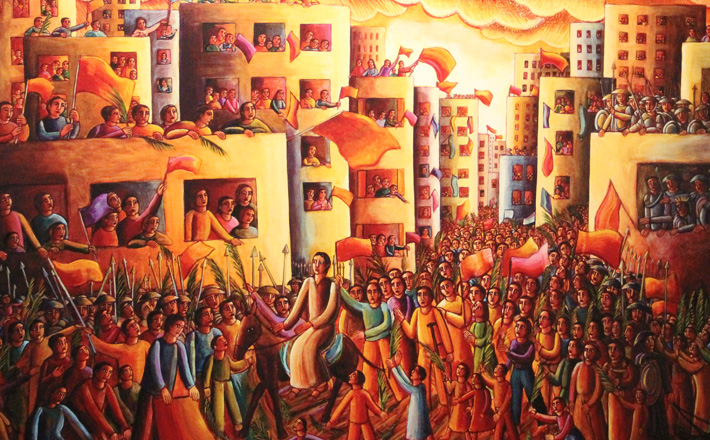
Our passage is widely known as Jesus’s Triumphal Entry. That subheading is probably in the Bible you are reading. And we often celebrate it as such on Palm Sunday, with children marching into a sanctuary, waving palm branches and acclaiming the arrival of Jesus. It is triumphant in a sense, to be sure, but I wonder if some of our current contexts mean that we miss the tragedy that pervades the scene as well. I worry that triumph and victory and winning are mixed up in a stew of political aggression, the economic logic of zero-sum accomplishments, the martial imagination of shock and awe, and the deploying of borders as rigid markers of belonging and safety.
These deceit-filled, fear-based pseudo-values have primed us to imagine triumph as singular. Triumph too often means for us that victory for some means loss for others, that winning is a singular purpose, that triumph belongs to the powerful, the bellicose, the arrogant.
The scene Luke narrates imagines triumph otherwise. Jesus enters the city on a borrowed colt. He does not have an army at his back, but the rising voice of a people. He enters the city not surrounded by the markers of imperial aggression but praised because of a different kind of power. “The deeds of power” named in verse 37 are those very powers that puzzled Herod in Luke 9:7, perhaps because the power of empire is not the same as that which Jesus wields. Empire can pacify through the threat of violence. Jesus deploys a power that brings life, good news to the poor, release to the captives, healing for those who most need wholeness. Perhaps, too, this is the faithfulness Jesus sees in a centurion in Luke 7:1–10, a centurion who can see that the kind of power Jesus wields is like and unlike his own. This is not the bold triumph of a conqueror; Jesus walks into Jerusalem buoyed by the proliferation of life.
The scene Luke narrates imagines also the tragedy that accompanies Jesus’s entry. After all, it is these same crowds who will cry for the cross (Luke 23:13–25), who will come out to bear witness to a cruel spectacle of deadly violence (23:44–49). This is also the same crowd that will leave the foot of the cross in grief (23:49) for having witnessed the cruel terror of the innocent sacrificed at the altar of imperial aggression. Human hope tends to be fickle. So, in the midst of the triumph, it is worth inviting a community to wrestle with their own fickle hopes, their own propensity to turn from the life Jesus offers to the fragile, deceptive promises of empire.
The road to hope runs through triumph reimagined but also through an all-too-familiar tragedy. It also runs through danger.
Dangerous hope
“Blessed is the king,” the crowd voices. Here we can begin to imagine the swelling of expectation, the abounding of hope. Finally, finally the ancient promises of God are coming true, for the king is here. Finally, finally the oppression we have known is about to be lifted from our shoulders, for the king is here. Finally, finally the world is about to turn, for the king is here.
The joy is evident as is the hope. Evident also is a deadly risk.
After all, the voiced concerns of the Pharisees in verse 39 are reasonable, even wise. We do not need to turn to rivalry or jealousy or misunderstanding as preachers are often wont to do when the Pharisees step on stage, when we treat them as mere foils to Jesus, when we imagine them only as villains in a story rather than folks living in a complex world dominated by imperial powers that would not hesitate to crush the hopes of a people. It is not as if the empire eschews violent reprisal against those who hope for revolution. The Pharisees here are speaking out of concern for the people.
First, if the Romans were to hear of these revolutionary songs as Jerusalem fills to the brim with faithful pilgrims, as tensions rise, and as the Roman peace is threatened, the Pharisees know the Romans would not hesitate to make an example or two of these otherwise innocent neighbors. Arrest a few, execute a few, the empire might reason, and others will hesitate to follow yet another regal pretender. But, second, and worse in the eyes of the local leaders, is that these people might actually believe that Jesus is the king God has promised. If the people believe that this Galilean peasant can somehow call down the power of God and end imperial rule, then the wrath of Rome will know no end. In their calculations, even more dangerous than an empire might be a people who begins to hope that the world can change.
Jesus’s response is one rooted in grief-filled hope, sorrowful expectation. If the crowds were to remain quiet, the very stones would cry out. Why? Because the devastation of oppression has been generational. The promises made by God through the prophets have nursed the people, and now they are daring to trust that this time things will be different. Such hope is voiced not just by the people but by the very ground of creation. The stones cry out because the tears and blood spilled upon them may have dried, but the witness they bore resonates still.
The stones would shout out. They still do.
Resistant hope
Following Jesus on this well-trod homiletical road can still shape our own walk of faith, especially in this moment of political crisis. No matter the partisan leanings of our communities, a deep sense of unrest is settling among us. The triumphs promised to us by human actors are being revealed daily as pale imitations of the life-giving promises God has made to us through Christ. As it turns out, no human—no matter how seemingly powerful or bombastic—can deliver on our most resonant hopes. And so, as we also must do, we turn again to the Jesus who arrives on a colt under the watchful eye of the empire. We acclaim him, as do the crowds who dared to hope that this time would be different. And, yes, we so often turn on Jesus as we grow impatient and experience the devastation of dashed expectations.
And on the other side of that betrayal is not divine vengeance or the demand for humiliated supplication. On the other side of our many betrayals is a grace made tangible in Jesus’s resurrection. If that’s the case, then the road before us is not just open; it is populated by neighbors near and far whose care is our joyful duty, whose hopes can remake us, whose lives might just show us the next faithful steps to take.
+ + +
This commentary is a piece of a larger series. The preaching series “Walking the Palm Sunday Path in Lent” can be helpful to congregations looking for instruction and motivation to participate in the Palm Sunday Path. That’s a movement calling Christians to put their faith into visible action, processing together during the afternoon of Palm Sunday (March 29, 2026) in state capitals and other cities across the United States. That and other scheduled events will allow believers to join their Christian kin in a hope-filled, visible proclamation of Jesus, who rejected the false glory of domination and retribution and declared that God has a better way, a path of love. You can learn more about the movement on the Palm Sunday Path’s soon-to-be-launched website; around the end of January, search online for “Palm Sunday 2026” or direct your browser to palmsunday2026.com.