

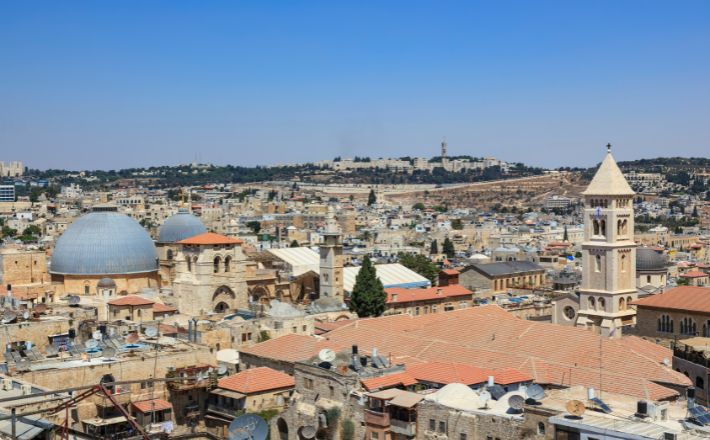

For almost as long as people have called themselves “Christians,” they have undertaken pilgrimages to biblical lands. Interest in relics and communing with the legacies and holiness of saints associated with specific sites encouraged those journeys. If you read the famous letter written by Egeria near the end of the fourth century, you’ll notice her conviction that the scriptural locales she visited possessed, in and of themselves, an enduring sacred quality.
Having had the privilege to lead study tours in Israel, the West Bank, Greece, and Türkiye, I’m always fascinated by the various ways in which seminarians, preachers, and churchgoers explore their notions of what might make a place or an experience holy. How might it be sacred not just for themselves but for others, too? Visiting popular sites in those lands usually puts a person in the company of believers who represent numerous nations, denominations/communions, and pieties. Those multicultural experiences alone make these kinds of trips worthwhile.
Places matter. Geography matters. Climate matters. Topography matters. Vegetation matters. As a biblical scholar and a preacher, I love teaching in biblical lands, because groups get to experience those material realities in person. Places they’ve read about in The Book expand and become three-dimensional.
- You get an unforgettable sense of the looming imperial presence projected by the new city of Tiberias as you see how visible it was for people dwelling in countless villages around the Sea of Galilee.
- You feel the wide horizon of opportunity and risk created where the Mediterranean Sea meets the western sky, as viewed from Caesarea Maritima.
- You smell the meats and spices in the crowded agora of Corinth, where an itinerant leatherworker named Paul told anyone who would listen about a man God raised from the dead.
- You touch the olive trees that kept vigil during the night when an armed posse raided the hillside to seize Jesus of Nazareth.
“The world of the Bible” becomes easier for us modern folk to inhabit. Some places are nearer to each other than you assumed, while others are more distant. You become attentive to the presence and absence of water and opportunities for irrigation. In the valleys around the temple you can see where armies encamped and where the Psalms of Ascent once rang out.
Obviously, soaking up the landscape benefits preachers, just as it does any other Bible readers. The experience helps us situate scripture’s stories and people in real physical space and real historical time.
Yet there are still additional—and I think better—things that a preacher can learn from their pilgrimages, if they are fortunate enough to be able to take them.
In saying that, I don’t want to undersell the importance of intelligent, historically informed biblical interpretation that pulls others into the sprawling collection of stories the Bible tells. Preachers do necessary work when they usher congregations into scripture’s memories from distant lands and cultures.
But that’s hardly the sum of preaching. A sermon that functions primarily as a time machine—“Come with me and let me help you encounter Ruth, Jesus, Paul, or Lydia in their native time and place”—falls short. That’s because it risks keeping the gospel imprisoned in the past. A sermon like that can leave the impression that divine wonder or the power of God remains forever foreign, consigned to an ancient and lost world. Faith then becomes an exercise in transcending time by leaving our own world and experience behind.
Instead, our preaching can bring a congregation into an encounter with a history that continues. And thoughtful travel confronts us with enduring history.
Through my own travels I’ve learned that visiting biblical sites requires travelers to contemplate the human elements of what we call “holiness.” That quality we call “sacredness,” like our own connection with God, is wrapped up with ourselves, our values, our longings, and our piety. By “our” I mean more than you, me, and others in a tour group. I mean the ways in which those overseas locations accumulate significance through time. They are gathering places that become reservoirs of experiences. They hold on to the religious practices that our predecessors brought to them. There are layers upon layers there. They prompt us to think like archaeologists, inviting us to dig through the levels they contain.
- See that church by the pool of Beth-zatha? It used to be a madrasa, and before that it was a church.
- Here’s where someone carved the image of a cross into a column in the marketplace. Was it a kind of secret communication to their siblings in the city?
- Why do you think this ancient synagogue’s mosaic floor contains symbols taken from other religions?
In other words, there is a diversity inscribed onto the land, its structures, and its ruins. That’s because people have been there. And they brought themselves.
Because people have been there, things don’t stay the same; there is more than one way to celebrate the holiness of a site. And the holiness of a God. One reason a place may be considered holy is simply because other people have found it to be so. And their attempts to honor that holiness remain.
There’s never a single story. To understand history, and to grasp the power of holiness, you have to listen to all the stories. To do so, you might have to let competing narratives and conflicting symbols stand side by side—unresolved. Your job isn’t necessarily to adjudicate among them as much as it is to bring your full self to the place and ask: What do this location and its history mean for you, here and now?
Preaching involves testimony about the past, of course, but preaching must also usher congregations into the present and future. That’s because sermons set the stage for folks to encounter the living word of God. To guide people along that journey, preachers benefit from learning to be ever attentive to how others have experienced God and have interpreted texts, contexts, histories, and locations.
When we learn to live as pilgrims spurred by curiosity and attentiveness, we become better guides.