

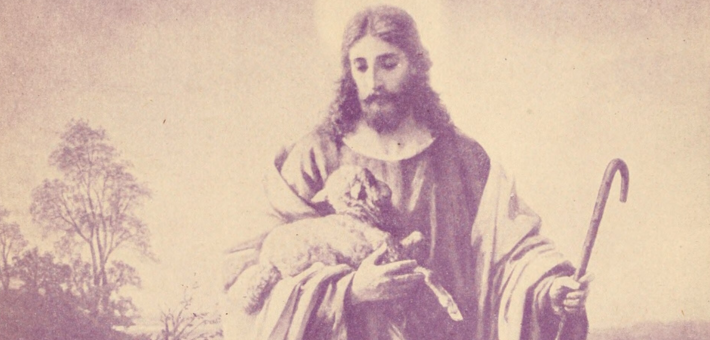
Commentary on John 10:1-10

Throughout the Synoptic Gospels of Matthew, Mark, and Luke, we frequently see Jesus using parables to describe the reign of God. Yet the opposite is true in the Gospel of John: Jesus does not use parables in John’s Gospel at all and rarely talks about the kingdom of God (only in John 3:3, 5). Nevertheless, at the beginning of John 10, we hear something that seems a lot like a parable. The narrator calls it a paroimia, an extended figure of speech (10:6).
As with the vine and the branches later in this Gospel (15:1–17), Jesus uses a central image, a sheepfold with sheep, a shepherd, a gate and gatekeeper, and the threats to the well-being of these figures, to illuminate aspects of his own identity and relationships with God and others, especially his followers. In that sense, this passage is unusual in John’s Gospel, and yet it feels familiar to students of Jesus’s teaching from the Synoptic Gospels.
In another sense, though, this passage is very typical of John’s Gospel. While it is easy to read this passage as simply beginning a new section of Jesus’s teaching, the beginning phrase, “Very truly (amēn amēn),” functions something like a “therefore.” There’s an adage that, in Paul’s letters, if a reader encounters a “therefore,” they should ask what it is there for. Similarly, “very truly” connects this passage back to the one before, a lengthy narrative about the healing of a man born blind and the questions that ensue (9:1–41). Readers of John’s Gospel are familiar with the pattern that a miraculous sign from Jesus is then followed by a discourse in which Jesus explains the sign’s significance (see 5:1–18; 5:19–47; 6:1–15; 6:22–59).
There are two primary points of connection between this passage and the healing sign in John 9: the senses (seeing/hearing) and the question of leadership. John 9 appears to be entirely focused on the sense of sight. A man who was blind is now healed (9:7, 15, 25) and thus can see Jesus (9:37).
Jesus goes on to teach that he “came into this world for judgment so that those who do not see may see and those who do see may become blind” (9:39)—a point directly applicable to the Pharisees who overheard it, who are essentially leaders who see but do not see. Sometimes that lack of sight looks like seeing the wrong thing; in John 9, it is described as not seeing what is before their eyes. They hear the formerly blind man’s testimony, but it does not change what they see. Neither their hearing nor their seeing guides them to the conclusion that the formerly blind man proclaims (9:38).
The image of the sheepfold, gate, and shepherd in John 10 addresses these ideas of seeing and hearing and their connections to leadership. In this context, it is unsurprising that the negative examples—a thief and a bandit—are the first mentioned (10:1). The thief and bandit, in this image, are the ones who are seeking to take what is not rightfully theirs.
The gate is the divider between one who has the right to enter the sheepfold—the shepherd (10:2)—and those who do not (10:1). This is consistent with the images of gates and doors throughout the Bible; they are often dividing lines, between what is inside and what is outside (Exodus 12:2; Judges 9:44; Luke 13:24–25; Revelation 3:20; 4:1), or places of revelation (Exodus 12:23; Psalm 78:23; Matthew 27:60; John 20:19, 26). The gate and the gatekeeper reveal who has the right to enter the sheepfold: It is only the shepherd, who knows the sheep’s names and whose voice they hear.
It is tempting to treat this figure of speech as an allegory, labeling each role. The following passage, where Jesus declares that he is the good shepherd, tends to encourage this (10:11, 14). However, it is helpful at that point to recall that Jesus says that he is the gate too (10:7, 9). If we try to read this straightforwardly, it seems almost humorous: How is Jesus both gate and shepherd? These are not static images in search of one allusion or answer. Instead, they are a figure of speech together, and the focus is on their interactions with the sheep and the sheepfold.
Shepherds have been an image for leaders of God’s people since Moses (Exodus 2:17–3:1) and David (1 Samuel 16:11). The prophets describe good shepherds and bad shepherds, and Ezekiel 34:11–16 describes God as shepherd. This echoes other passages in the Synoptic Gospels too. For example, in Mark 6:30 Jesus sees a hungry crowd as sheep without a shepherd, and he has compassion on them. This is in contrast to tetrarchs like Herod Antipas, who feed their courtiers and kill God’s prophet (John the Baptist) instead of tending to the needs of the people (Mark 6:14–29). Such “thieves and bandits,” in the imagery of this sheepfold metaphor, “only steal and kill and destroy” (10:10). Such death-dealing actions by leaders go directly against the life that the gate leads to.
When imagining Jesus as “the gate” (10:7, 9), it is easy to think of the gate as literally and metaphorically penning in the sheep and restricting their movements. However, the purpose of the gate is twofold: It protects the sheep from those death-dealing forces described above. It also provides access for the sheep to the pasture (10:9). The expansiveness of this pasture is captured in Jesus’s final words in this passage: “I came that they may have life and have it abundantly” (10:10).
This abundant life has been glimpsed in images of abundant wine at a wedding celebration (2:6–7) and so much bread and fish on a Galilean hillside (6:13), and will be seen in a love that reaches beyond death (13:2; 20:11–20) and a life that does not stay dead. Jesus not only is life (11:24; 14:6), but he also brings that life to others: a life that is abundant in its amount, like the bread and fish, and in its quality, like the wine. This life is available through this gate and this shepherd, who will lay down his own life for the sheep (10:15).

_(14797179453).jpg)
April 26, 2026