

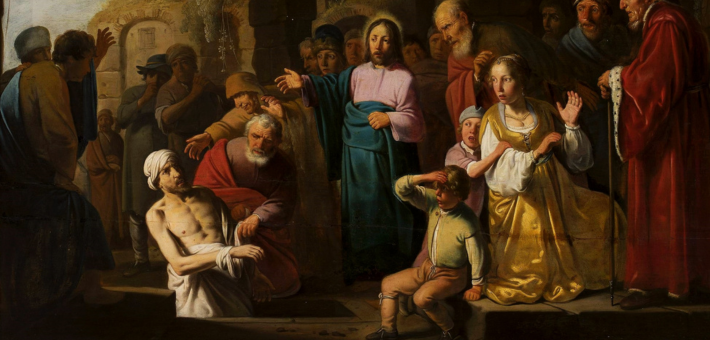
Commentary on John 11:1-45

The story of the resurrection of Lazarus begins in a very human place: Two sisters tell Jesus that one “whom you love” is sick (John 11:3). They do not tell him what to do; they tell him what they know. And then they wait.
In the Gospel of John, it makes sense that Jesus delays coming to these sisters and Lazarus not because he does not care (11:5) but because Lazarus’s resurrection will reveal the glory of God (11:4) and therefore lead directly to Jesus’s own death (11:45–53). Because of that context, this story does not answer the questions on our hearts: Why does Jesus delay—for Martha and Mary, or for us? Why does a healing need to wait, or never come?
In the face of those important questions, this story simply proclaims Jesus’s love, even in his absence. It is that same love that undergirds his presence when he arrives. As Jesus initiates this journey with his disciples (11:7), Thomas tells the others that they should go with him, “that we may die with him” (11:16). John’s audience will meet Thomas again (John 14, 20). Here, Thomas’s words seem in good faith: He understands the risks of Jesus’s return to Judea, where others have sought Jesus’s life before (7:44; 8:59; 10:31–39). He is saying they should follow Jesus to the end. Later, readers hear that it is Jesus’s love that sustains to the end (13:2). This love creates the context for the ways that Martha, Mary, and Lazarus react to Jesus, each modeling different types of faithful responses.
Faithfulness and proclamation: Martha
Martha does not wait at home when she hears that Jesus is coming; she goes to meet him (11:20), and she speaks first. She addresses Jesus as “Lord,” claiming that his presence with Lazarus would have prevented her brother’s death, and that she does not doubt that God will give Jesus whatever Jesus asks for (11:21–22). This remarkable statement combines grief for her brother’s death and faith in Jesus’s relationship to God. As Jesus does with other interlocutors throughout John’s Gospel, he makes a statement (“Your brother will rise again”) that is both true in the context of the narrative (11:44) and also easy to interpret in ways that are different from that meaning (11:24).
Martha’s response leads to Jesus’s disclosure: “I am the resurrection and the life” (11:25). Jesus proclaims “I am” statements in 14 passages in John’s Gospel. Nowhere else does someone respond to the proclamation with a statement of belief. Martha not only says, “Yes, Lord, I believe,” but she places that language of belief in the context of the Gospel’s proclamation about Jesus: Jesus is the Messiah (3:28; 4:26; 9:22, 35–38), the Son of God (1:34, 49; 3:16–18), “the one coming into the world” (1:9; 3:31; 6:51; 8:23; 18:37).
Martha’s confession of belief is one of the three central confessions in John’s Gospel, joining Peter (“You are the Holy One of God,” 6:69) and Thomas (“My Lord and my God!,” 20:28). Her courageous faith in the face of grief and disappointment is remarkable in this proclamation.
Faithfulness and mourning: Mary
Mary quickly goes to Jesus, who is calling for her (11:28), as a sheep hears the voice of the shepherd (10:4). Mary greets Jesus with the same words as Martha: “Lord, if you had been here, my brother would not have died,” but she is in a different posture, kneeling at Jesus’s feet (11:32).
John’s narrative introduced Mary at the beginning of the account of this family: “Mary was the one who anointed the Lord with perfume and wiped his feet with her hair” (11:2). Even though that story is yet to come in John’s Gospel (12:1–8), Mary’s posture is the same in both stories: She is at Jesus’s feet. Mary’s faithfulness is characterized not by what she says but by what she does. She kneels at Jesus’s feet, and she weeps publicly for her brother (11:33).
While Mary’s words begin in the same way that Martha’s did, she does not follow them with statements of belief but, rather, with actions of faith. She draws near to Jesus in her grief, even though she attributes her brother’s death to Jesus’s absence. It is Mary’s grief that provides an opportunity for Jesus to respond differently. Jesus loves Lazarus (11:3, 5, 36) but is “greatly disturbed in spirit and deeply moved.”
Often, the Greek word translated as “deeply moved” is used in contexts to communicate anger (see Mark 1:43; 14:5). Jesus could be angry about the presence of the crowd of mourners, or at death itself, but it is also possible that to isolate emotions surrounding death is a fool’s errand. Jesus is deeply moved due to Mary’s response and his own. In this way, Mary’s actions show her devotion to Jesus, and his mirroring of her response illustrates how he values her faithfulness.
Faithfulness and listening: Lazarus
Each of the siblings indicates something about what faithfulness to Jesus looks like. This seems profoundly difficult for Lazarus, who spends most of the story in a tomb. This tomb sounds like it is very much like Jesus’s own tomb, with a stone that could be positioned in front of its cave-like opening (11:38; 20:1). Similarly, people approach the tomb expecting death (20:1–2) and finding life.
Lazarus demonstrates his faithfulness to Jesus by emerging from the tomb when Jesus calls him (11:43–44), because a sheep hears the voice of the shepherd (10:4). Of course, this makes an additional theological point: Jesus is the resurrection and the life, and therefore, death has no hold on him or those who are his (11:25–26).
There is one final difference between Lazarus’s resurrection and Jesus’s resurrection. John’s Gospel emphasizes that Jesus’s linen grave clothes (loose wrappings, not mummification) are left in the tomb on Easter morning (20:5–7). Lazarus’s grave clothes, on the other hand, emerge from the tomb with him. Of course, this could signal that death will come again for Lazarus. However, given Jesus’s command (“Unbind him, and let him go,” 11:44), the focus here is on the community gathered. Jesus gives them work to do to welcome Lazarus. Resurrected life needs a community; Jesus restores Lazarus to his, and Lazarus will provide them an opportunity to grow in their trust in God (11:45).



March 22, 2026