

Commentary on Isaiah 60:1-6

At the time this poem was composed, Jerusalem was a conquered, depopulated city struggling to reestablish itself but apparently destined to remain on the edges of history, a backwater of the great Persian empire.1 This poem is addressed to that city.
With its rousing opening line, “Arise, shine, for your light has come,” it encourages Jerusalem to see itself differently. Her God has appeared; she is now bathed in God’s glory, while all other nations, including, presumably, her enemies, are shrouded in darkness.2 Commanded to lift her eyes and look around, she sees these nations streaming from the darkness toward her city’s light (verse 4). With her children and their nurses leading the procession, she sees vast caravans of kings and camels from north, south, and west, all bearing precious gifts.
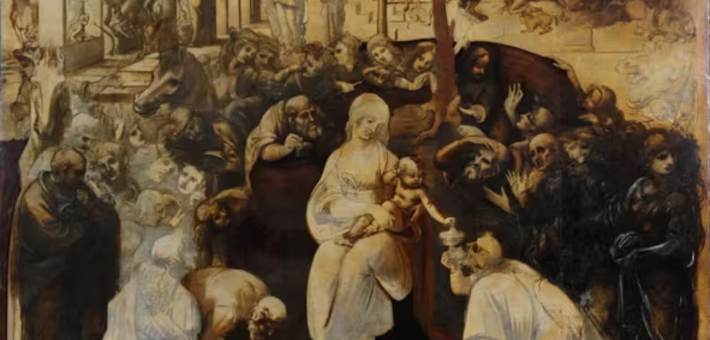
This is a beloved text for so many reasons. As a child, I was one of thousands of girls in my denomination who memorized the first line of Isaiah 60:1 as the motto of our girls’ organization, a sort of mission-focused equivalent to the Girl Scouts. For many Christians, the reference to kings bearing gifts of gold and frankincense has so shaped our memory of the wise men in Matthew 2 that we remember them as kings, not wise men following a star, as Matthew portrays them.3 Isaiah 60:1–6 reminds us of what the kings and camels bring to the Christian celebration of Epiphany: They are the emblems of God’s self-revelation as the light of all the world.
Scholars have long noted transformations in Isaiah 60:1–6 of such biblical motifs as divine epiphanies and the tributes of the nations. Notably absent is military conflict, as caravans and kings come to Jerusalem voluntarily. Moreover, the steadily shining light of divine presence differs markedly from the often-destructive lightning flashes of older storm theophanies (see, for example, Judges 5:4; Psalm 29; Ezekiel 1).
Until recently, it was suggested that these developments indicated the author’s detachment of concepts of salvation from historical events as he projected them into a distant future.4 More recently, Brent Strawn has suggested that the ahistorical imagery of Isaiah 60:1–6 is more likely the result of an acquaintance with Persian ideology, which envisioned a world at peace through the voluntary submission of the nations to the Persian king and his god, who is represented in Persian iconography as the winged sun-disk. Isaiah 60 appropriates and subverts that ideology in its portrayal of Jerusalem as the center of the cosmos, with the God of Israel supplanting the god of Persia as the light of the world.5
As preachers contemplate this text in the liturgical context of Epiphany, they may wish to experiment with the various points of view made possible by the text. The initial line invites hearers to stand where Jerusalem stands. From this viewpoint, it becomes possible to ask where Christians fit into the story, since nearly all of us are gentiles and therefore, as St. Paul would say, members of the family of God by adoption, not by birth. What would it be like for those of us who so often feel like insiders to this story to see ourselves making our way out of the darkness of what we thought was the center of the cosmos to an utterly new (and strange) source of safety on the margin of things? What kinds of revelatory destabilization might result?
Preachers might also wish to consider the presence of Jerusalem’s children at the head of this procession. One might ask how the poet thought to include them since, after all, the children are not (or should not be) possessions like gold or frankincense that foreigners can give away. They are Jerusalem’s children, after all; they already belong to her.
The image of children at the head of the procession is probably an allusion to an earlier verse in Isaiah 49:22, in which kings and queens serve the children as “foster fathers” and “nursing mothers.” Submitting to the command of God, they bow to the ground before Jerusalem to lick the dust of her feet. Isaiah 60 scrubs away that humiliation but, nevertheless, includes the children as if everything else hinges on their return. As a metaphor, the nations’ return of Jerusalem’s children conveys a form of restitution or reparation for a city on the verge of disappearing from history and signifies their willing participation in the city’s restoration to wholeness and vibrancy.
The metaphor works as well as it does because it evokes the suffering not just of the children but of human mothers and families enduring the helplessness of forced family separation. The power of this image sheds light on a grim fact of human life, ancient and modern. According to data collected by UNICEF, children are disproportionately and unjustly affected by conflict and war. As of the end of 2024, nearly 50 million children made up more than 40 percent of the world’s population displaced by conflict and violence.6 And these are the ones who survived the conflict. Jerusalem sees her children coming home, and I wonder: Who among the nations will bring our children home?
Notes
- For the broad consensus that Isaiah 60–62 forms the nucleus of Third Isaiah and is to be dated to the Persian period (circa 520–450 BCE), see Brent A. Strawn, “‘A World Under Control’: Isaiah 60 and the Apadana Reliefs from Persepolis,” in Approaching Yehud: New Approaches to the Study of the Persian Period, Semeia Studies 50 (Atlanta: SBL, 2007), 86. For the historical context of Jerusalem in the late sixth to mid-fifth century, see Christopher M. Jones, “‘The Wealth of Nations Shall Come to You’: Light, Tribute, and Implacement in Isaiah 60,” Vetus Testamentum 64, no. 4 (September 2014): 615. For the literary analysis of Isaiah 60 and its historical context, see Claus Westermann, Isaiah 40–66: A Commentary, Old Testament Library (Philadelphia: Westminster, 1969), 295–298, 352–358.
- Jones, “Wealth of Nations,” 618–619.
- John F. A. Sawyer, Isaiah Through the Centuries, Wiley Blackwell Bible Commentaries (Hoboken, NJ: John Wiley & Sons, 2018), 364.
- See, for example, Westermann, Isaiah 40–66, 356–357.
- Jones, “Wealth of Nations,” 618–621, citing Strawn, “World Under Control,” 115–117.
- “Displacement,” UNICEF Data, accessed October 9, 2025, https://data.unicef.org/topic/child-migration-and-displacement/displacement/.


January 6, 2026