

Commentary on John 20:19-23

If we allow John’s Gospel to guide us into the celebration of Pentecost, our sense of the Spirit’s coming is shaped differently than liturgical expressions formed around Acts 2. John’s scene is an intimate proximity of bodies and breath, fright giving way to peace, signs of death bespeaking new life, and a renewed mission for those whose world had seemingly come to an end.
Grief and fear
We enter this text alongside those original disciples of Jesus, behind locked doors, in fear and grief. Their world has collapsed with the crucifixion of Jesus. Their sense of purpose is dashed. They’ve lost their beloved friend and teacher to a gruesome state execution. And they’re afraid they may be next.
There’s no indication that those gathered were just the inner circle but perhaps included many of Jesus’s friends and followers. And we can invite our congregations to place themselves in that locked room too, if we help them to enter the affective dimension of the text shaped around grief and fear. (Notably, the only disciple not present is Thomas, who, for some reason, isn’t afraid for his life enough to remain locked inside with the others.)
Jesus witnesses their grief and fear and twice speaks to them the words “Peace be with you.” These words harken back to an earlier scene in the Gospel, where Jesus tells the disciples that God will give them “another Advocate,” the “Spirit of truth” (14:16–17, 26), and says, “Peace I leave with you; my peace I give to you” (14:27).
It’s easy to imagine that this was a familiar and comforting refrain that they’ve received from the lips of Jesus many times when they needed it most, as he spoke words of peace into hearts gripped by fear.
Death and life
Jesus meets the fear of the disciples by laying bare the marks that death has carved into his body. The one who was dead now lives, but the signs of death are not erased. “He showed them his hands and his side. Then the disciples rejoiced when they saw the Lord” (20:20).
In this singular verse is the Gospel encapsulated: Christ has died, Christ is risen, Christ will come again. In this moment of witnessing death unambiguous and resurrection life unmistakable, Jesus comes again to them.
In their grief, he gathers with them. Into their fear, he speaks words of peace. In his body, he gives them a glimpse of resurrection life in the living body of one crucified.
Breath and Spirit
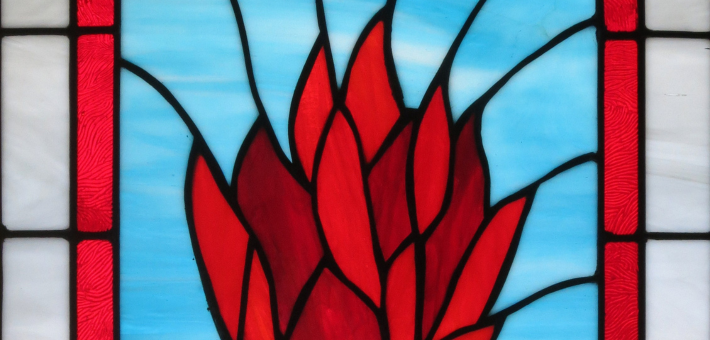
“When he had said this, he breathed on them and said to them, ‘Receive the Holy Spirit’” (20:22). In contrast to our typical Pentecost scene, with “the rush of a violent wind” (Acts 2:2), the Spirit arrives with more intimacy and sensuality in John’s Gospel. Not with tongues of fire, but with warm breath upon skin.
Theologians and ethicists Laurel Schneider and Thelathia Nikki Young say, “Breathing is a profoundly physical reality, an exchange of elements carried mostly below or beyond the scope of human vision. Made of air, breath is not empty; it is laden with molecules, moisture, and the breath of other creatures. Pumped by lungs, breathing is muscular and emotional. … Breath and breathing are physicality and sensuality at their most elemental.”1
Jesus’s breathing the Spirit upon the disciples harkens back to the intimacy of creation, in which God breathed into the nostrils of the first human the breath of life (John’s “breathed” is the same Greek word used in the Septuagint translation of Genesis 2:7).
Take this opportunity to help those likely far more familiar with Pentecost’s awe and wonder in Acts to attend to the intimacy of John’s scene: breath of new life breathed upon those huddled in the shadows of death; Spirit received into bodies tensed in fear, now releasing into possibility.
Forgiving and retaining
Verse 23 is the first mention of forgiveness in John’s Gospel, and it’s a strange one. The first part seems straightforward enough: “If you forgive the sins of any, they are forgiven them.” (This is the scriptural rooting for the Lutheran concept of the “Office of the Keys” to administer the forgiveness of sins.)
But the second half of the sentence provokes unease: “If you retain the sins of any, they are retained.” Interestingly, the word “sins” does not appear in the second part of this sentence. It is inserted for clarity by the translators, but it also shapes the interpretation in unnecessary ways. Nor is “retain” the only option for translating this half of the sentence.
Mary Coloe provides a more literal translation: “If of anyone you hold, they have been held.”2 And Sandra Schneiders offers this alternative translation: “Whoever you hold, they are held fast.” She argues, “The community that forgives sins must hold fast those whom it has brought into the community of eternal life.”3
The preacher has important work to do in this final verse of the passage, as forgiveness is one of the most vital, yet problematically preached theological notions in the Christian tradition. Absolution of sin is not a word of erasure for the consequences or responsibility for harms done. But if we take seriously the alternative translation of verse 23, the assurance of forgiveness necessitates that we make a way for the repentant to return to communion—to be held fast by the community—assured of their place of intimate relationship with God, by grace alone, and with the community of faith, even amid the consequences of actions that have harmed others, and the responsibility of repair.
In this passage, Jesus comes and stands among the disciples frightened and locked away in fear. But he does not depart. There is only a coming portrayed in this scene, no going. We know they left the locked room eventually. They do so because they are invited into a renewed mission. “As the Father has sent me, so I send you” (20:21). But when the scene ends, they are all still there, with Jesus.
How might you help your congregation imagine their way into the next minutes, hours, and days in the disciples’ lives? John leaves ample imaginative space between verse 23 and verse 24. Don’t waste it.
Notes
- Laurel C. Schneider and Thelathia Nikki Young, Queer Soul and Queer Theology: Ethics and Redemption in Real Life (New York: Routledge, 2021), 52.
- Mary L. Coloe, John 1–10, Wisdom Commentary (Collegeville: Liturgical Press, 2021), 524.
- Sandra M. Schneiders, “The Resurrection (of the Body) in the Fourth Gospel: A Key to Johannine Spirituality,” in Life in Abundance: Studies of John’s Gospel in Tribute to Raymond E. Brown, SS, ed. John R. Donahue (Collegeville: Liturgical Press, 2005), 186.


_-_stained_glass,_The_Holy_Spirit_as_fire.jpg)
May 24, 2026