

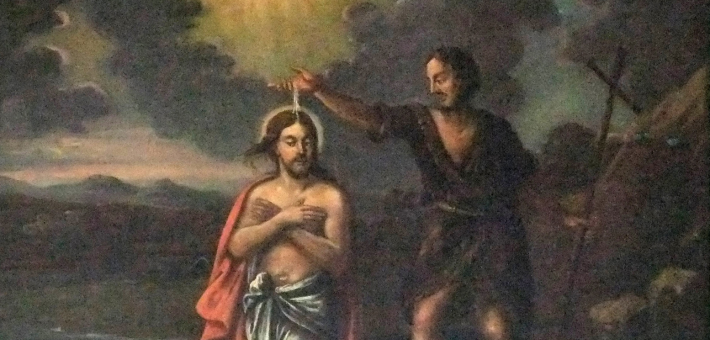
Commentary on Matthew 3:13-17

Jesus’ baptism marks the first time we experience Jesus as an adult. No longer a child under the care of his parents, Jesus comes to John the Baptist on the precipice of his public ministry. While the five short verses of the gospel reading focus attention on Jesus’ baptism, it is important to honor the many people who made it possible for Jesus to arrive at this point. For Jesus would not have made it to adulthood, much less his baptism, without individuals and communities attuned to listening to God and protecting the vulnerable.
Children in the first century CE experienced high mortality rates, with up to 50 percent dying before they reached the age of 10.1 Disease, poverty, infanticide, war, and malnutrition all threatened children growing to adulthood. In addition to these threats, Jesus faced additional targeted imperial actions that could have led to his death. Yet his family—past and present—alongside complete strangers, with the guidance of the divine, protected him. Today’s gospel narrative invites us to reflect on the communal nature of Jesus’ baptism along with our own. It calls us to reflect on communities who have nurtured our faith journeys and the ways we are called to support others as the body of Christ.
The ancestors
Matthew’s gospel opens with a genealogy. This genealogy roots Jesus in the story of the people of Israel from the beginning, unlike Luke, whose genealogy follows Jesus’ baptism. Matthew’s account provides Jesus with a lineage traced through Abraham and David. Ultimately, this affirms Jesus’ role as the Messiah.
But the genealogy does more than merely trace lineage; it serves as a reminder of the stories and experiences that shape a culture, a faith, and a people. It provides reminders of stories of resilience, like Ruth’s, and those of violence, like Tamar’s. It also memorializes collective experiences such as the Babylonian deportation. It reminds readers of the stories we know much about, like Abraham’s, and little about, like Achim’s. These generations, complete with historical anomalies, remind Jesus that as he enters the Jordan River, he does so guided by the faith of ancestors who came before him. Similarly, our baptism connects us to Jesus along with the broader genealogy of creation. Lutherans recount in our baptismal liturgy:
We give you thanks, O God, for in the beginning your Spirit moved over the waters and by your Word you created the world, calling forth life in which you took delight. Through the waters of the flood you delivered Noah and his family, and through the sea you led your people Israel from slavery into freedom. At the river your Son was baptized by John and anointed with the Holy Spirit. By the baptism of Jesus’ death and resurrection you set us free from the power of sin and death and raise us up to live in you.2
Joseph
Joseph is acutely attuned to protecting and caring for Jesus multiple times, leading to his baptism. First in Matthew 1:18–25, Joseph follows the instructions of an angel of the Lord, taking the pregnant Mary as his wife despite societal pressures. He again listens to an angel’s instructions in Matthew 2:13–15, fleeing with his young family to Egypt, protecting Jesus from Herod’s massacre of children under two years old. Finally in Matthew 2:19–23, following guidance through a dream, Joseph settles his family in Nazareth rather than Judea, keeping a safe distance from the rule of Herod’s son, Archelaus.
Joseph serves as a reminder of the many family members—chosen and biological—whose actions ensure the safety and support of the most vulnerable. Joseph’s actions invite us to pause and honor the often overlooked prayers and guidance from aunties, babas, elders, and others that are integral to our development. These individuals ensure that we, like Jesus, are able to live into the fullness of our call. In baptism, sponsors, alongside parents, give voice and commit to these actions, promising “to nurture these persons in the Christian faith as [they] are empowered by God’s Spirit.”3
Magi
The magi highlight the protection of and care for Jesus provided by broader society. The magi are unknown to Mary and Joseph; nevertheless, these wise strangers protect and celebrate their child. The magi ignore Herod’s request and evade him on their return home, refusing to share Jesus’ location with him. Such an act makes them vulnerable to imperial retribution. They understand the dangers of empire but choose to do what they can to honor this child and ensure his ability to grow into his role as the Son of God.
As the saying goes, it takes a village to raise a child. So, too, we remember this in our baptisms as the congregation promises to “support … and pray for” the newly baptized.4 It is an acknowledgment of the commitment that the body of Christ makes to care for everyone within it.
As witnessed by those who supported Jesus, this is not only a spiritual practice, but a political one as well. As we recount Jesus’ baptism, it is a time to honor the many people who aided in getting him to the Jordan River that day despite the threat of imperial violence and the power of cultural norms. May it invite us in a time when children are being violently separated from their parents over immigration, and when transgender youth are being denied access to gender-affirming care, to consider the role of the church and community to protect the vulnerable and support them in living into who God has called them to be.
Notes
- Warren Carter, The Roman Empire and the New Testament: An Essential Guide (Nashville: Abingdon, 2006), 116.
- “Holy Baptism,” Evangelical Lutheran Worship Pew Edition (Minneapolis: Augsburg Fortress, 2006), 230.
- “Holy Baptism,” 228.
- “Holy Baptism,” 228.


January 11, 2026