

Commentary on Acts 10:34-43

We used to host traveling evangelists in our home, each one coming at the invitation of my father. As a pastor of the Baptist Church, he was charged with inviting a preacher and song leader to come to our church and conduct revival meetings once or twice a year.
They were quite a cast of fascinating characters, each one having a slightly different style. One was a Powhatan chief, another was a quiet professorial type, still another modeled his message and style after Billy Graham.
Once, one came who was a much younger man. As I remember him, he was rather stern and standoffish in his demeanor. Hoping for some conversation, I timidly asked him that question I’d asked all the others: “What are you going to preach about?” He looked up from his coffee. “Jesus,” he said, then returned to his coffee. That was it—Jesus.
Peter is the traveling evangelist in this text. He receives an invitation to preach, but it comes under the strangest of circumstances. When the invitation comes, Peter is struggling with the meaning of a dream he’s just had. He had gone up to the roof of his host Simon the Tanner’s house to pray. Then he became hungry and asked for something to eat. While the meal was getting prepared, he became drowsy, took a nap, and dreamed.
In his dream, heaven opened up and something like a large sheet came down, somehow held by its four corners. All kinds of birds, snakes, and other animals were moving around on the sheet. Then a voice said to him, “Peter, get up! Kill and eat!” But Peter didn’t wake up. Instead, he heard his dreaming self say, “Absolutely not! Those are unclean and not fit to eat!” Then the voice said, “When God says it’s fit to eat, don’t say it isn’t!” To make sure he got the point, that dream happened three times!
Needless to say, the dream and the command he heard in it are a shock to Peter’s theological system, which, at its core, teaches that the Jews, Peter’s own people, are God’s “chosen,” to whom God shows partiality. Jesus was sent by God to his fellow Jews, Peter believes, and his words were for them! After the dream, Peter learns that three strangers have arrived at the front gate requesting an audience. Now the prime mover of the story, the Holy Spirit, tells him what to do. “Go greet them and go with them.”
When Peter does greet them, he learns that these three have come from a man named Cornelius, a centurion with the Italian cohort. That means they have come from a household in the very heart of the Roman oppressors’ realm—the Roman capital of Judea! The three men must sense his apprehension because they rush to assure Peter that Cornelius is “well-spoken of by the whole Jewish nation” as a “God-fearer” and “alms-giver” (10:22).
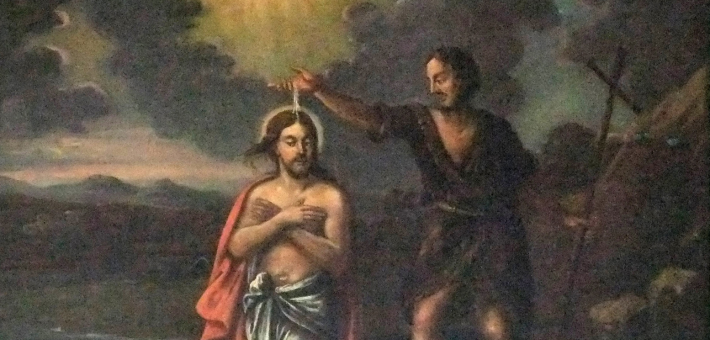
For Peter, when the Spirit says go, you go! Along the way, he must have been thinking, “What will I preach about to these gentiles?” The text for today makes that clear—Jesus. Peter’s focus is on the conviction that Jesus is “God’s anointed” (verse 38), meaning that God “was with him” as he went about healing, delivering those oppressed by “the devil,” and restoring people’s relationship with God by forgiving sins. Jesus’ resurrection from the dead is God’s profound “YES!” to Jesus’ life and ministry. Matthew’s gospel text for today remembers the beginning of that ministry—Jesus’ baptism by John.
Peter’s sermon to Cornelius and his household serves this liturgical occasion by providing an overview of the story into which each Christian is baptized. It also suggests how becoming part of that story can change us. Peter begins his sermon with a testimony about how the Spirit changed him. “I truly understand that God shows no partiality,” he says, “but in every nation anyone who fears him and does what is right is acceptable to him” (verse 34).
Baptism ritualizes this gospel of acceptance and inclusion. Whether it is a child brought by her parents to the font or a teenager or adult stepping down into a pool, baptism offers a glimpse of the far-reaching effect of God’s grace. The text that follows this one in Acts opens the lens even further. Even before Peter is finished speaking, the Holy Spirit is “poured out even among the gentiles” (verse 45). Imagine that! Those thought to be outside of God’s grace “get it” and are included in God’s story.
Imagine yourself preaching a sermon this week on how the Holy Spirit used the story of Jesus and his ministry to change your life. When was it that you finally “got it”? What was it that led you to take the vows that you did when you were baptized? Or what led you to confirm the vows that were made on your behalf? How has living into the promises God made to you when you were baptized changed the way you look at the world?
This story from Acts tells us that something was stirring in the mind and heart of Cornelius that led him to call for Peter to come. When Peter arrived, Cornelius asked the questions that many of our congregants are too shy to ask us: “What is it that you believe, and why do you believe it?” Peter might have worried about how he would be received. Would he be getting too personal with these strangers? Would he be misunderstood? Then what? Nevertheless, he took the risk and decided to preach about what Jesus meant to him. Perhaps it’s time we do the same.



January 11, 2026