

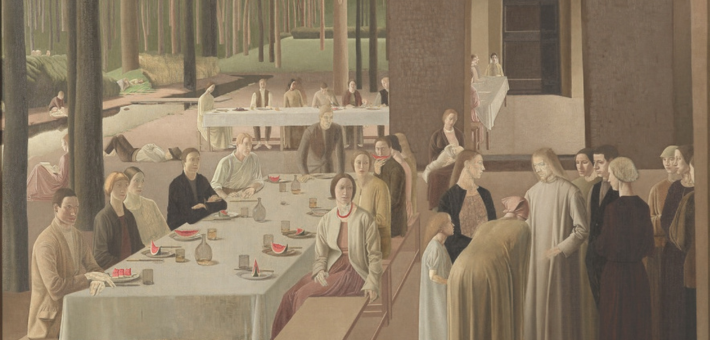
Commentary on John 2:1-11

The movement in John’s gospel does not detail Jesus’ baptism, and one is left to infer that it has taken place based on John’s testimony that “I saw the Spirit descending from heaven like a dove, and it remained on him” (1:32). This gospel simply offers a day-by-day account of the important details of Jesus’ movement leading to the ultimate messianic responsibility.
This text, touted as the first miracle performed by Jesus, is recorded as being performed on the third day. The timing is ambiguous since it seems inconceivable that within two days of stepping out and stepping into his role as the Messiah, before all the disciples named in the Synoptics are gathered, Jesus and his disciples would have already become a recognized group worthy of being invited to such an important social event in the culture as a wedding feast. Thus, the significance of this report so early in this gospel record seems more about revealing the Messiah for who he is in the context of community.
The gospel writer calls Jesus’ action in turning water into wine “the first of his signs” that “revealed his glory” and states that because of this event, “his disciples believed in him” (2:11). So one is left to wonder why the disciples needed a definitive sign in order to believe in Jesus as the Messiah. It begs the question about what is necessary to inspire belief in Jesus. What does it take to inspire faith in Jesus as the Messiah, the Christ? How does a preacher convince those who hear the message of Christ that Jesus is the One, the only One they should follow for their soul’s salvation? If the disciples who walked with Jesus needed a tangible sign in order to believe in him, what is required in this present time to inspire those who hear the message to believe in him?
The specifics of the text give light to many questions. Why did Jesus’ mother approach him when it was discovered that the wine had run out? Why did Jesus respond to her the way he did? And why, given that response, did his mother inform the servants to follow his direction? What does it say to those who come in times of need to Jesus? Is this a model of how Jesus can be expected to respond to our requests of him? Additionally, the actions by the servants and the results of their specific actions—what do they exemplify to those who have come behind? The conclusion of the story, as stated in the text, is that the result of following Jesus’ directives is that his glory is revealed. In what way, and why was that necessary?
This text has been used to show that in advising the servants how to proceed despite first rejecting his mother’s plea, Jesus exemplified the type of honor one needs to pay to one’s parent. It has also been interpreted as showing honor to and blessing ordinary persons, such as the bridegroom and the servants, and that the revelation of Jesus’ glory comes from the way in which he cared for all the people involved in the situation. However, as one considers the actions of Jesus in this text, I believe the message it portrays above all is Jesus’ willingness and readiness to participate with us in all the changing scenes of life.
This first miracle of Jesus gives evidence to the readiness and the willingness of our Savior to stand with us, ordinary persons, in the challenges of life. His presence is assured, as is his willing involvement with ordinary human beings, as we face expected and unexpected issues. And not only does he stand with us, but this miracle assures us that if we listen and obey his directives, Christ will see us through the worst of times, as he will be there in the best of times also. But it also reminds us that we must do what Christ tells us to do.
We must trust that the way of Christ is the right way or, better yet, the only way to total success in our endeavors. With that trust to guide us, we must follow Christ’s directives in the way Christ specifies. The challenge for us is ensuring that the way we take is truly what Christ has determined for us and for the particular situation.
Since Jesus no longer walks with us in human form, we are left to consider what Jesus Christ would have us do in both the ongoing and the special times of our lives. We communicate with Christ by prayer, and we are also guided in many ways by the word of scripture, but the definitive way to ensure that we are doing as Christ requires is to check the impact or influence of our actions on others.
The way of Christ is the way of honor and justice. We know we are doing what Christ requires by the way in which our action honors others and does no harm to others. We might well call it the way of love, but since “love” has become such an overused word, I find honor and justice more appropriate and more favorable to ensuring that the actions we take do no harm, and in fact bring honor to those involved.
Jesus’ first miracle took place in a setting that involved the community. It was a social gathering, not religious, a fun time that brought together people in an informal setting. I think it is a good reminder that our Christian faith is expressed in our ordinary relationships and not only when we gather as the church. Jesus’ engaging with his community in a fun activity and taking action that revealed his glory cues us to consider our Christian witness as being appropriate to all aspects of life and worthy of being carried out in ways that give glory to God whenever, wherever, and however we gather in community. May it be so.
PRAYER OF THE DAY
God of revelation,
You made your son known at a wedding, a public celebration of love. Celebrate love with us by revealing Jesus in our midst. Amen.
HYMNS
Oh, worship the king ELW 842
Jesus shall reign ELW 434, H82 544, UMH 157, NCH 300
Earth and all stars ELW 731
CHORAL
O God, beyond all praising, Gustav Holst



January 11, 2026