

Commentary on Luke 24:13-35
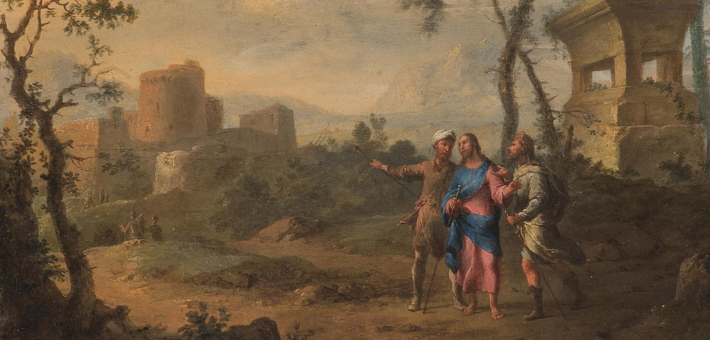
In Luke’s gospel, the first sighting of the risen Christ occurs on a seven-mile walk between Jerusalem and Emmaus during a debate between two disciples, one of whom is named Cleopas.
A vision of angels
In Luke 24, Cleopas and the other disciple—his wife?—are debating the events of earlier that morning, the third day since the crucifixion. They have heard reports from the women who claim to have had a vision of angels (24:23)
Astute readers of Luke will recall that this gospel begins with the vision of angels, one angel at first, later the entire heavenly host. The reader already believed the reports of those who have seen visions of angels: Zechariah, Mary, the shepherds. The women at the tomb join Luke’s band of witnesses testifying to the inbreaking of the holy, to visions of angels, in the everyday affairs of life.
The faithfulness of questions
But it is one thing for an angel to testify to childbirth, yet another to declare the resurrection of a man from the very public death of crucifixion. By making the debate on the Emmaus Road the first sighting of the risen Christ in this gospel, Luke acknowledges the legitimacy of these questions. Even as Jesus, perhaps uncharitably, chastises the Emmaus walkers, it is notable that he walks with them, engaging their questions, helping them to wrestle with what and how to believe. Jesus honors this conversation, these questions and debates that disciples have. Luke’s story suggests that Jesus also walks with us as we question and debate, honoring us as our faith seeks understanding.
A risky conversation
Note also the risk involved in the conversation between Cleopas, the other disciple, and Jesus. Without knowing who Jesus is, they reveal to him that they considered Jesus a prophet. They confess that they hoped he would “redeem Israel,” a desire for a change of leadership that the Romans would certainly have found treasonous. Political conversations are risky even in contemporary times, but in the ancient world, such conversations could get you crucified.
Moreover, the travelers reveal to him their disappointment with their religious leaders, because of their collaboration with the occupying power. Today, many within and notably outside of organized religion are asking exactly these kinds of questions of their own religious leaders. These, also, are risky conversations because they may uncover painful truths to which the church and other religious institutions must be held to account.
Readers should remember, here, that Luke is not recording a verbatim conversation in real time. Luke is constructing a story to respond to the hopes that the coming of the Messiah would lead to the reestablishment of the Davidic kingdom. Nevertheless, the conversation Luke provides would have been risky, even foolhardy, for those fleeing town after the execution of their leader. Yet Jesus engages with this risky conversation, walking with those who dare to speak openly of their political and religious concerns. Might the riskiness of the conversation on the road to Emmaus encourage contemporary readers toward their own risky conversations?
Jesus paroikos
In 24:18, Cleopas asks the question, “Are you the only stranger in Jerusalem who does not know the things that have taken place there in these days?” The word “stranger” doesn’t quite capture the Greek here. Cleopas uses the word paroikeis, a participle of the verb paroikeō. Students of Greek will recognize the word oikos, “home,” embedded in this verb, and in its cognate noun paroikos. A paroikos was a migrant, a resident foreigner, someone who comes from another place. Notably, Cleopas pegs the risen Jesus as an outsider, a foreigner, a migrant from somewhere else. Why else, he reasons, would Jesus be unaware of the events of the past few days?
What might it mean to us in the 21st century that the risen Christ appears to us as a paroikos, a migrant, a resident foreigner? How might this story have ended if Cleopas and his companion had refused the company of one whom they identified as “other”?
Reframing the story
Readers will note that Jesus does not deny the events described by the Emmaus walkers. Instead, he reframes them. He places them in the context of ancient prophecy and of other scriptures of the people, including the Law. In reframing the story, Jesus casts the crucifixion as only a part of a larger divine narrative. This is not an attempt to deny the pain, the violence, or the anguish of the past three days, but to put them in perspective.
When one is experiencing trauma, denying the truth of the trauma can be damaging. However, the community of faith can help survivors reframe the story as part of a larger story and, in so doing, help them find their place within the whole people of God. What might it mean to reframe the stories we face today?
The table
The Emmaus table differs significantly from the institution of the Lord’s Supper found earlier in the gospels (Matthew 26:26–29; Mark 14:22–25; Luke 22:17–20). Notably, there is no cup mentioned, and Jesus does not speak the words of institution at the table. Instead, Luke simply tells us that he blesses the bread and breaks it, likely in a precursor of the hamotzi blessings spoken at Jewish tables at the beginning of a meal with bread. Of note is the intimacy of the moment. Jesus is not standing apart from these disciples, as though untouchable. In ancient Mediterranean fashion, they are reclining at table, a physical closeness that would likely be uncomfortable for 21st-century diners.
Luke’s story reminds us that our relationship with the resurrected Christ is a relationship of long walks, risky conversations, reframed traumas, and quiet dinners—an intimate relationship between Christ and the church, of words shared and bread broken.


April 19, 2026