

Commentary on Matthew 9:9-13, 18-26
The second Sunday after Pentecost brings us into the heart of Jesus’s ministry, where we encounter two key themes: the calling of the unlikely, and the power of healing. These passages—Matthew 9:9–13 and 9:18–26—show us a Christ who moves toward those in need, who upends social expectations, and who embodies mercy in ways that challenge religious structures. The stories of Matthew’s call and Jesus’s healing acts emphasize restorative mercy. This mercy is not simply words, not just words of forgiveness or absolution, but tangible acts of restoration that show what the kingdom of God ought to be like.
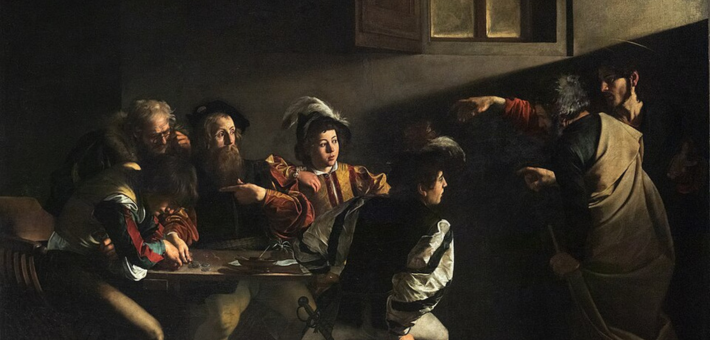
The call of Matthew (9:9) is striking for several reasons. First, tax collectors were viewed as traitors within Jewish society. Working for Rome, they were associated with economic oppression, often collecting excessive taxes to benefit the empire and themselves. Matthew’s presence at a tax booth signifies his active role in this system—yet Jesus sees him, calls him, and invites him into his circle. The response is immediate: Matthew leaves everything and follows.
The next scene (9:10–13) reveals the radical nature of Jesus’s mission. While sharing a meal with tax collectors and sinners, Jesus is questioned by the Pharisees, who ask why he associates with such people. His response reveals a relational ethos: “Those who are well have no need of a physician, but those who are sick. Go and learn what this means: ‘I desire mercy, not sacrifice.’” This statement is a direct challenge to the religious order. The Pharisees emphasize purity and sacrifice, but Jesus reorients the discussion toward mercy, toward healing, and toward relationship.
As an Indigenous Christian, I see resonance with Indigenous spirituality. Indigenous practice often prioritizes relational healing over ritual correctness. Indigenous ceremony is central in Indigenous spirituality, and many ceremonies are open and welcoming to others. While there are protocols around ceremony, they are often not so rigid that relationship is sacrificed. Laughter brings us together and connects us in these moments. Just as Jesus calls Matthew into a new life, Indigenous traditions recognize that love and restoration happen through inclusion, not exclusion. A person is not cast out for past failures but invited to walk a new path.
The second part of this reading (9:18–26) brings us into two intertwined healing stories—a synagogue leader’s daughter and a woman suffering from chronic bleeding. These two individuals stand at opposite ends of the social spectrum: The synagogue leader is prominent, while the woman is unnamed and ostracized. The synagogue leader is confident enough in himself to walk directly up to Jesus, while the woman lives in a state of shame and desires to move unnoticed. For both people, Jesus responds with equal compassion.
The woman’s faith is remarkable. She believes that simply touching Jesus’s cloak will heal her. Again, I see deep resonance with Medicine Men and Women in Indigenous cultures. Medicine People recognize that healing is both physical and spiritual. Jesus, like a traditional healer, perceives the woman’s act of faith and affirms her: “Take heart, daughter; your faith has made you well.” This is not just a physical restoration—it is a social and spiritual reintegration. She is no longer unclean, no longer cut off from her community. Her restoration stretches beyond the physical ailment. Her healing is holistic. Jesus is good medicine, for body and soul. And his healing brings communal restoration, as she no longer needs to hide herself and walk unnoticed.
It is good and right as Jesus-followers to look to Jesus as our example and seek to emulate his life. We certainly need to embrace compassion as a relational ethic. But I want to also suggest that we need to use our sanctified imaginations to see ourselves within the other characters in these stories. After all, life is not easy. We continue to need the healing work of Jesus and the Holy Spirit, in both body and soul.
And for those of us who live in North America, we must reckon with the fact that we may be the tax collectors of our society, profiting off current and past injustices, and globally speaking, we occupy the richest sectors of society. Do we recognize how much we ourselves are in need of mercy and the healing touch of Jesus? And are we ready to respond to his call?
Or perhaps today you feel like that dead girl. Life has been sucked out of you, or perhaps you feel you are spiritually dead, in a dark night of the soul. As hard as it may be, can you trust that others are seeking Jesus on your behalf, and that Jesus has the power to revive?


June 7, 2026