
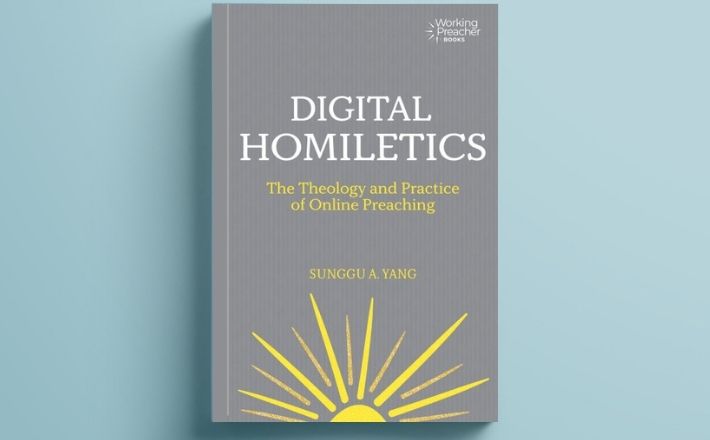

The Covid-19 pandemic threw a lot of preachers into the deep end of online preaching, without resources for how to think about it or any kind of description of “best practices.” Sunggu Yang’s book in the Working Preacher Books series, Digital Homiletics, aims to provide both, asking:
- What is your theology of digital preaching?
and
- What are effective practices for online preaching?
A theology of online preaching
Podcast co-host Karoline Lewis reminds us that Karl Barth proposed a threefold definition of the Word: written (Scripture), revealed (Christ), and proclaimed (preaching). But Yang proposes a fourth dimension: the digitalized Word. Is the shift to digital culture really that big? Yes, yes it is.
Like the printing press in Luther’s time, the emergence of the internet as a technology has precipitated a revolution in how we can share and receive the Word of God. The pandemic made even the smallest churches adapt to online preaching. Now access to preaching and the ability to share one’s preaching has become democratized. Even if you don’t have a congregation of people following you, you can put preaching content online and it is much more accepted as mainstream than previously. The tables have turned and congregations without an online presence are now seen as suspicious.
Different styles of online preaching
Yang explores 10 different styles of online preaching, including podium style, conversation style, reporter style, artist style, drama style, interview style, rock concert style, and more.
Preachers face different cultural and congregational expectations regarding the content and delivery of their preaching. The online format opens new opportunities to explore different styles and develop one’s own voice, apart from the in-person preaching experience. Special occasions or certain texts might also prompt such experimentation. Podcast co-host Rolf Jacobson notes an example from one of his friends that reinforces this idea: filming an Easter sermon from the graveyard when we couldn’t gather in buildings because of the pandemic. Another example is how the reporter style of online preaching can show—by “on location” scanning with the camera—what is happening “out there” in the world. Showing is better than telling!
Embodied preaching?
How then do we talk about embodiment or incarnation, when our bodies are not in the same space (or even time due to asynchronous sharing of recordings) during preaching? First, all forms of preaching are embodied preaching, since we preach from our bodies. Even though online preaching is transmitted through screens, preaching is still highly multisensory, incorporating sound, visuals, and even touch. We can even integrate taste and scent with some intention. Online preaching should recognize the congregation as sermon “viewers” (not only “listeners”). The proclamation is physically embodied through multiple senses. We learned early in the pandemic that what makes for engaging online preaching is not simply speaking well into a fixed camera. It takes gestures and movement and attention and maybe editing to shape the kind of content we are sharing. Online preaching should be an artistic enterprise.
The need for online preaching didn’t go away when Covid-19 became endemic. Churches now have a way to worship even when they must close the building for extreme weather events. People now expect livestreamed worship, and can stay connected even while traveling or staying home for illness. Consider the relationship between pastoral care and providing online connection for people going through situations that make in-person participation impossible. We have the means to connect with these folks, so why would we not?
If we can believe that Jesus is both 100 percent human and 100 percent divine, why can’t we believe that the church is 100 percent in-person and 100 percent online, and act out this belief faithfully?
For more on this volume in the Working Preacher Books series, Digital Homiletics: The Theology and Practice of Online Preaching, listen to a podcast episode or watch it on YouTube, in which Rolf Jacobson and Karoline Lewis discuss the book with author Sunggu Yang.