

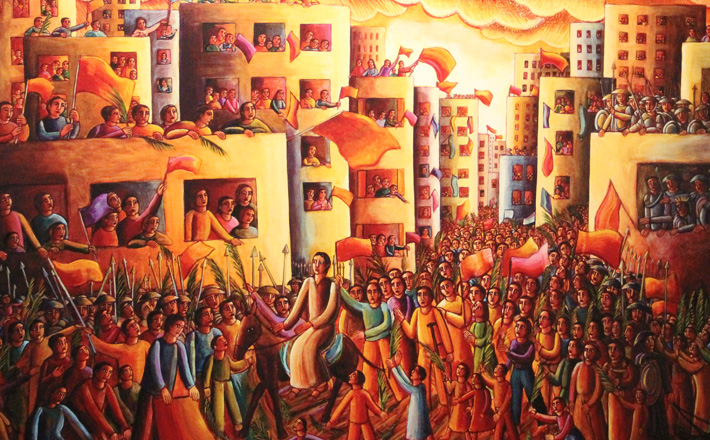
Commentary on Luke 22:14—23:56

The Gospels’ passion narratives press us to consider multiple realities regarding Jesus’ prosecution and death
- We see the politics of human society. On one level, it’s an all-too-familiar story. Powerful and privileged people conspire with Roman officials to engineer the destruction of someone whose message and popularity pose a serious threat to the business-as-usual abuses perpetuated by religious and imperial systems.
- We see God behind the scenes. On another level, it’s a story of cosmic significance. Having relinquished himself to his Father’s will (Luke 22:42), Jesus embraces a fate that mysteriously aligns–somehow–with a divine design (Luke 22:37; 24:25-27; Acts 4:24-28). Luke’s Gospel declares that Satan also plays a role (Luke: 22:3, 53).
- We see reflections on human responsibility. There are marked differences across the accounts of Jesus’ trial that we find in the four Gospels. These differences draw attention to the questions of “how?” and “why?” that the post-Easter church asked. Anonymous Jewish “crowds” and “people” play roles in Jesus’ rejection. In this way, the evangelists attribute theological significance by assigning blame more widely (see Acts 2:22-23; 13:27-28). At the same time, historical analyses of these scenes convincingly conclude that Jesus’ movement from Gethsemane to Golgotha would have involved a speedy, clandestine process carried out at the highest levels of Judean sociopolitical power. Common folk probably had very limited involvement, if any.
These three currents flow as a single stream. The Gospels and Acts show no interest in trying to parse the relationship between divine will and human activity, at least not with the precision that would satisfy our philosophical questions. The mixture of realities proclaims that Jesus’ execution was the result of willful opposition and tragic ignorance, and yet this ugly death was somehow totally understandable and even purposeful.
(This seems as good a place as any to mention that I’ve just published a book–titled The Trial Narratives: Conflict, Power, and Identity in the New Testament–which explores Jesus’ trial in the Gospels and the trials of Peter, Paul, and others in Acts. What I have to say here about Luke’s passion narrative is developed in greater detail in chapter 5 of the book.)
The Passion in Luke: A Contest of Wills
Luke’s passion narrative frustrates many interpreters. The crucifixion lacks the raw agony of Mark’s and Matthew’s versions, and there isn’t the clearly scripted theological emphasis like John’s. Elements of the Lukan trial scenes are bewildering, for it isn’t clear what motivates Pilate, Herod Antipas, and “the people” (whom Pilate summons for the first time in 23:13) to act as they do.
In many ways, it’s a story about whose “will” or intentions will hold sway, and how.
It’s a story that insists that, at the end, God’s will is accomplished. Moreover, this will is accomplished by manipulating other powers and the structures of human society. No matter how corrupt or bent on self-preservation those forces are, God’s will nevertheless perseveres.
- Luke 22:14-46. Jesus prepares his followers and Luke’s readers by speaking knowingly and confidently of what is to befall him. Submission, warning, and reassurance are dominant themes.
- Luke 22:47-71. The priestly aristocracy of Jerusalem finally have their “hour” (see 22:52-53), and Peter is overcome. The temple-based authorities railroad Jesus toward execution. His words to them indicate that dialogue or persuasion is pointless in the face of their calculated intentions.
- Luke 23:1-12. Roman authorities refuse to allow the Jerusalem aristocracy to presume upon Roman muscle to secure their desired outcome. Pilate and Herod mock Jesus, the notion of Jewish kingship, and the priestly prosecutors who breathlessly pursue their case. Roman power plays a game to discredit and humiliate the whole lot of them.
- Luke 23:13-25. In a shocking scene, Pilate overplays his hand. He assembles residents of Jerusalem along with the aristocracy, presumably to embarrass the latter in the eyes of the former. But as soon as he broaches the idea of releasing Jesus, “the people” resist. They restart the trial by clamoring for Barabbas, a man with perhaps a more impressive track record of pursuing social change. Suddenly the emperor’s representative can no longer control the scene. Luke depicts a showdown between what Pilate wants (see thelō in 23:20) and the will of the temple authorities and people (see thelēma in 23:25). In the background, readers remember Jesus’ prayer about his Father’s will being accomplished (see thelēma in 22:42).
- Luke 23:26-56. As soon as the crucifixion begins, Luke begins to mitigate the role of “the people” by distinguishing them from their priestly leaders. Many of “the people” lament in 23:27. “The people” watch Jesus die while “the leaders” scoff (23:35; compare 23:48). Later, in 24:20, Jesus’ followers blame only their “chief priests and leaders.” As for Jesus, he continues to do what he came to do: accomplish salvation. Witness the criminal who turns to him in their final hours.
Luke offers a political drama in which truth and justice are overwhelmed by the will of those who reject Jesus and by the will of a governor bent on exploiting Jesus for political gain.
But Pilate cannot fully control the venue that he is supposedly empowered to control. When the story is done, neither the imperial machinery nor the temple establishment are the agents who ultimately manage (or thwart) justice, at least not in Jesus’ case. Nor, really, are the strangely fickle “people.”
And so, Luke also offers a theological drama in which God’s will accomplishes itself through the course of human misperception and political maneuvering. In the strange coexistence of these two dramas, Luke declares that God’s salvation actualizes itself even within the apparatuses of opposition.
The Passion Narrative, God’s Will, and Preaching
Although it is the heart of the Christian story, the passion narrative is not the totality of that story. Luke’s account of Jesus’ demise compels preachers to consider the passion in light of God’s wide-ranging design for the world’s salvation.
For Luke, the passion is the pinnacle of the inevitable rejection of God’s specially anointed prophet. It is also the route that this Messiah must take toward his eventual glorification.
Jesus’ rejection is messy. The participants exhibit behavior that is both familiar and improbable, highlighting the misperception and fear behind it.
By asserting that God accomplished God’s design through Jesus’ passion, even through the messy power struggles waged among those human beings who brought about Jesus’ death, Luke hardly fixes everything or makes the passion palatable.
- These assertions raise difficult questions about God and God’s ways–questions that must drive us, with preachers’ help, to accept mystery. Then we can render praise in response to the clearer statement that God’s saving will is done.
- These assertions characterize the world as resistant to God and God’s ways. This leads to calls for repentance (see Acts 2:36-39; 3:17-19).
- They rightly give comfort to people who are beaten down by such power struggles on a regular basis, promising them that Jesus’ death and resurrection will one day mean the end to such oppression.
- They warn people who presume that they can find security from God in their institutions and in the trappings of power. They likewise warn those who think that they can create their own social and institutional systems that will align with God’s purposes.
God cares too much about the work of saving the world to leave it in our hands. Salvation required God’s incursion into all aspects of our existence. It still does.
March 28, 2010