

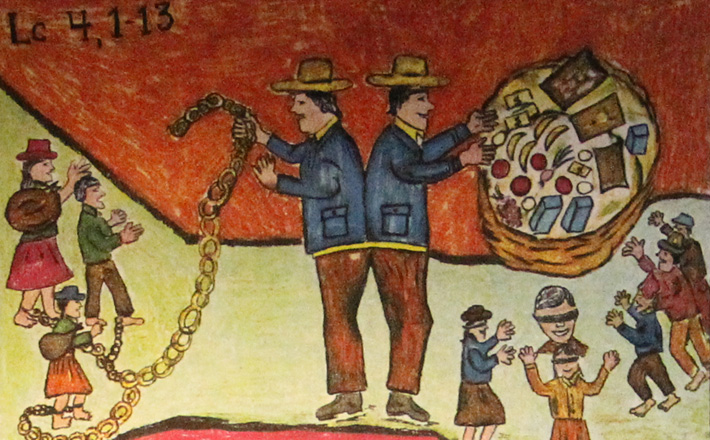
Commentary on Luke 4:1-13

Accounts of the Temptation in the Wilderness appear in all three Synoptic Gospels.
The story in the Gospel of Mark is notoriously brief, consisting of only two verses (1:12-13). The accounts in Matthew and Luke are much longer in comparison, and they are very much alike (Matthew 4:1-11//Luke 4:1-13). On the basis of the two source theory, they are considered to have come from the document known as Q. In terms of wording, they are much alike, but they differ remarkably in their sequence of the second and third temptations.
Matthew has the sequence of events at the Temple as the second of the three, and the third for him is the viewing of the kingdoms of the world upon a high mountain. In Luke the viewing of the kingdoms of the world is the second scene, and the Temple event is the third. Whether Matthew and Luke had two different versions of Q, each with its own sequence, or whether one of the evangelists altered the sequence from a common version, cannot be known. If the latter is the case, interpreters differ on which gospel writer is more likely to have retained the sequence of Q more closely.
Since an account of the temptation is the Gospel for the Day on the First Sunday in Lent for each of the three years in the lectionary, the preacher might do well to say to the congregation gathered, that with the coming of Lent, we make a dramatic shift in the church year. Lent is a time to get back to basics of the faith. In the ancient church it was a time for instructing new converts about the faith, followed by baptism on Easter. Our Gospel text is about who Christ is, and it also gets into some things concerning us directly.
The story presupposes the Baptism of Our Lord, celebrated on the First Sunday after the Epiphany (Luke 3:15-17, 21-22), where Jesus is declared by God to be his Beloved Son, in whom he is well pleased (3:22). The words of that address to Jesus are taken up in the temptation story, but this time they are on the lips of an adversary. Twice in the temptation narrative, the devil recalls God’s address to Jesus and, in fact, calls it into question with the taunt, “If you are the Son of God….” (4:3, 9), followed by specific tests to find out whether he truly is such–from the devil’s point of view.
The story contains three moments of testing, and all have to do with the identity of Jesus as Son of God. What kind of Son of God is he? Or what kind of Son will he be? The title “Son of God” can be interpreted in various ways. In the ancient world a son represents his father, and in the Old Testament the king is sometimes called God’s son (Psalms 2:7; 89:26-27; 2 Samuel 7:14), meaning that he represents God on earth, and at best he is obedient to God.
As son of God, the king has earthly power. In Psalm 2 the king, as God’s anointed one (the messiah, 2:2), is addressed with the words from God spoken at his enthronement: “You are my son; today I have begotten you. Ask of me, and I will make the nations your heritage, and the ends of the earth your possession” (2:7-8). The meaning of the words “You are my Son,” spoken to Jesus at his baptism, are at issue in the temptation narrative.
The three temptations have to do with earthly power and glory. In each case Jesus responds by quoting from Deuteronomy:
- Temptation One (4:3-4): To turn stones into bread.
Response: Deuteronomy 8:3: “It is written, ‘One does not live by bread alone.'”
Context in Deuteronomy: Moses reminds the people of Israel that God tested them in the wilderness by hunger, but he fed them with manna in order to make them understand that one does not live by bread alone. - Temptation Two (4:5-8): To rule all the kingdoms of the world.
Response: Deuteronomy 6:13: “It is written, ‘Worship the Lord your God, and serve only him.'”
Context in Deuteronomy: Moses addresses the people of Israel prior to entering the land of promise. He calls upon the people to fear and love the Lord always. He provides a creed for them, the Shema, “Hear, O Israel….” (6:4), tells them not to forget who gave the land, and admonishes them to worship and serve the Lord. - Temptation Three (4:9-12): To throw himself down from the pinnacle of the Temple in Jerusalem. Here the devil quotes Psalm 91:11-12.
Response: Deuteronomy 6:16: “It is said, ‘Do not put the Lord your God to the test.'”
Context in Deuteronomy: The setting is the same as the previous episode (Deut 6:13). Moses exhorts the people not to test the Lord as they did at Massah, a place of quarreling, where the people of Israel demanded water from Moses, which he finally obtained by striking a rock (Exodus 17:1-7).
The three temptations of Jesus are set in a wilderness, and they recall the testing of the people of Israel in the wilderness. Even the forty days of testing in the case of Jesus recalls the forty years of Israel’s testing in the wilderness.
But there is a contrast. Israel was not always faithful and therefore did not pass the testing satisfactorily. Jesus, on the other hand, completed the time of testing, remaining true to his vocation as Son of God.
By refusing to follow the temptations of the devil, Jesus remained faithful to his vocation, given to him at his baptism. He would not be the messiah that some would have wanted, including the devil. All three of the temptations have one thing in common, and that is to be a messiah of unequalled power on earth–one who could provide food in abundance, reign over the kingdoms of the world, and be capable of demonstrating that he is so invincible that nothing can harm him, for God will protect him from any and all dangers.
Since the English word “temptation” has so many connotations, often referring to human appetites for things that bring pleasure, it is helpful to think of the temptation of Jesus as “the testing of God’s Son.” The Greek word in question is peirazomenos, which has to do with testing. That means that the wording of 4:2 could read: “[Jesus] was tested by the devil.”
That can help in the construction and delivery of a sermon. Jesus was tested concerning his baptismal vocation as the Son of God. He was obedient to the course upon which he had been set at his baptism by John at the Jordan. Likewise, those who are his followers are tested concerning their baptismal vocation. Through baptism, we are called to be obedient and to serve the Lord alone. But our faith is tested in the course of our lives, from birth to death. There is comfort in knowing, however, that God remains faithful, even if we fail (Romans 3:3-4; 2 Timothy 2:13).
The connection between Jesus’ testing and our own was recognized by the author of the Letter to the Hebrews: “For we do not have a high priest who is unable to sympathize with our weaknesses, but we have one who in every respect has been tested as we are, yet without sin” (4:15).
The connection between Israel’s testing and our own is summed up beautifully in the Prayer of the Day:
O Lord God, you led your people through the wilderness and brought them to the Promised Land. Guide us now, so that, following your Son, we may walk safely through the wilderness of this world toward the life you alone can give, through Jesus Christ, our Savior and Lord, who lives and reigns with you and the Holy Spirit, one God, now and forever. Amen.
February 21, 2010