

Commentary on Exodus 24:12-18

I have stood looking onto the horizon at sunset in Sedona, Arizona. I saw what looked like “clouds on fire,” the shimmer of the sunset on the edge of cumulus clouds that blurred the boundary between heaven and earth. The clouds seemed ablaze. I wonder, as I reread this pericope, whether what I saw in Sedona was anywhere near what Moses, the elders, and the people saw as they looked up at Mount Sinai, encased in clouds at the summit—clouds that gleamed with the glory of God.
The context for this pericope is important and is one of canonical scripture’s oddities. Moses, Aaron, Nadab, Abihu, and 70 elders seal with a meal the covenant sealed in blood at the beginning of Exodus 24:3–8. A covenant is made before rules are in place. The covenant precedes law and commandments. In other words, God seeks renewed relationship before God teaches the people how to be in relationship with the divine.
What makes it odd for me is the setting for the meal at the foot of the mountain, where the meal is “with God,” and where they “saw the God of Israel. Under his feet there was something like a pavement of sapphire stone, like the very heaven for clearness. God did not lay his hand on the chief men of the Israelites; they beheld God, and they ate and drank.” (24:10–11).
Given that readers are told later in the canonical text, “You cannot see My face, for no man can see Me and live!” (Exodus 33:20) and that later in the New Testament, in the Johannine corpus (John 1:18; 5:37; 6:46; and 1 John 4:12, 20), the phrase in this pericope, “God did not lay his hand on the chief men of the Israelites,” makes sense. God chooses to let them live even after seeing the Holy One of Israel. Such texts lead us to reflect on the fact that being “with God” and God “being with us” can be both comforting and disconcerting. To be in God’s presence should come with a fearsome awe.
This covenant meal in the very near presence of God would have been, itself, worth quaking about. It is the quintessential “God is with us” moment. This beatific wonder happens even before Moses ascends further up the mountain to await the stone tablets bearing the law and the commandment, about which the editors say God says, “I have written [them] for their instruction” (24:12). I don’t imagine the preacher can address this oddity of God’s writing finger, but I do want to acknowledge it. This phrase is a part of what makes scripture seem untouchable and unquestionable for some people—God’s own Self wrote these words.
In fact, after Moses receives the law and commandment in the time he is on the mountain, later in Exodus 31:18 we read, “When God finished speaking with Moses on Mount Sinai, he gave him the two tablets of the covenant, tablets of stone, written with the finger of God.” When Moses descends, the writer emphasizes, “The tablets were the work of God, and the writing was the writing of God, engraved upon the tablets” (32:16). And again, after the golden calf debacle when Moses, in his anger, broke those tablets, God calls Moses back up Mount Sinai so that God can write on a new set of tablets (34:1).
This anthropomorphic description of God writing connotes God’s authority and power, both of which are to be considered when reading Torah. As earlier Jewish scholars like Maimonides noted, we should be careful to take the anthropomorphic language about God as anything other than a metaphor of this authority and power.
The text has a shifting set of characters, which provides another oddity. Moses ascended the mountain with his assistant Joshua, not mentioned in the earlier gathering (24:13), and left Aaron, mentioned before, and Hur, not mentioned in the earlier group, to attend to any disputes that might arise among the elders, who were to wait at the base of the mountain where they had the meal (24:14). It may be an indication that the account reflects more than one tradition of this story, but the editors see no reason to amend it. Such willingness to let the traditions live together in the same space often unnerves especially Western sensibilities. But stories of encounters with God are unnerving.
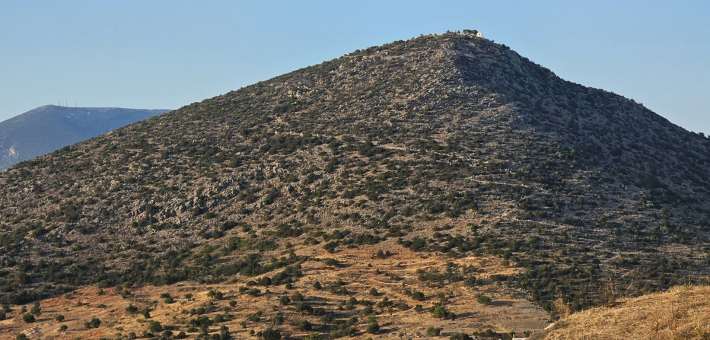
Moses goes up—I assume without his assistant, because Joshua is not mentioned again—and enters into the region of the mountain where clouds are at the summit. I have never climbed Mount Kilimanjaro, but I have friends who have. The most consistent story from them is how thin the air is, and how hard it is to breathe when you are surrounded by clouds. The air is thin; the temperature is cold. It seems that God gave Moses six days to acclimate to breathing in thin air and being surrounded by the cold temperature before speaking to him.
While Moses, his crew, and the elders saw God at the foot of the mountain, at this level on Mount Sinai, Moses encounters the glory of the Lord “like a devouring fire on the top of the mountain in the sight of the Israelites” (24:17). This cloud—the devouring-fire one—is the one Moses enters for a long time, which is what the phrase “forty days and forty nights” (24:18) means, to commune with God and to receive and understand the law.
In this transfiguration moment in the Old Testament, the experience is the holy on the mountain itself. Mountains as sites of holy mystery and encounters are a recurring theme throughout the ancient world, and into our time. As Edwin Bernbaum notes in his book Sacred Mountains of the World, “Summits can reveal our world as a place of unimaginable mystery and splendor. In the fierce play of natural elements that swirl about their summits—thunder, lightning, wind, and clouds—mountains also embody powerful forces beyond our control, physical expressions of an awesome reality that can overwhelm us with feelings of wonder and fear.”1
Perhaps as the people looked up from the foot of Mount Sinai and watched Moses ascend into the fiery clouds, fear and wonder gripped them. They had already seen terrifying displays on Mount Sinai and trembled as thunder, lightning, and a thick cloud engulfed the mountain and the people had a sonic experience of loud trumpet blasts that made them afraid. The mountain was “wrapped in smoke, because the Lord had descended upon it in fire; the smoke went up like the smoke of a kiln, while the whole mountain shook violently” (Exodus 19:18).
Moses goes up and down the mountain several times to meet with God, get instructions, and return to tell the people. Before the covenant, Moses was getting communal and traveling directives. No wonder the people quaked.
As preachers approach these verses, as I have noted, there are a number of oddities, and perhaps choosing one or the other would be helpful. Or another way is to focus on the role of “mountaintop experiences” and the awe, and sometimes dread, they bring. Of course, considering that God is with us, close and far, near and ethereal, but with us, is also a plan. As we honor the Transfiguration, seeing the ways God glistened for humans long before Jesus met with the ancestors, Moses and Elijah makes this text available for preaching.
Notes
- Edwin Bernbaum, “Introduction,” Sacred Mountains of the World, Second Edition (Cambridge University Press, 2022), 1.


February 15, 2026