

Commentary on John 9:1-41
How do we know what we know about ourselves and about each other? Who gets to tell the story about who we are and what we’ve been through? And who can narrate God’s story for our lives? These questions swirl through this text, as all the participants banter about God’s sovereignty, the authority of testimony, and what serves as our basis for knowing.
This passage contains a lot of different people with a lot of competing narratives that provide an apt picture of how the hearers of our sermon will come to the preaching moment. Everyone comes to our sermons with their own life experiences, their own testimony about God’s activity or inactivity in their lives, and their own sense of what can convince them to change their mind about what they have already concluded. This miracle story provides a unique opportunity to create space for people to wrestle with their understanding of God’s action in the world and their own testimonies.
This narrative begins with an admission that the disciples were still holding onto a story that they had received about sin being the cause of blindness at birth. It’s worth noting that, even after witnessing Jesus healing others, their question is not about whether this man can be healed, but instead about the seeming source of his malady. Far too often we disciples find ourselves more concerned about the machinations of God’s mercy than about being a source of that mercy ourselves.
Jesus promptly corrects the disciples, letting them know that sin was not the cause of this man’s blindness but that instead, his blindness was a prompt for God’s power to be displayed to the masses. Jesus’ story is intended to be a righteous counternarrative to the story that the disciples held, a kind of righteous rebuke to their misguided understanding of blindness’s origin, but Jesus’ answer creates as many problems as it solves.
Are we to understand that this man’s condition, one that would have greatly hindered his ability to participate in community, and one that would have brought him much struggle over the course of his life, was a cosmic prompting for God’s miraculous power to be displayed? There must be a different story told here that will allow people to think through their understanding of why bad things have happened in their lives, one that does not leave people thinking their struggle is merely a setup for God’s power to be put on display for others.
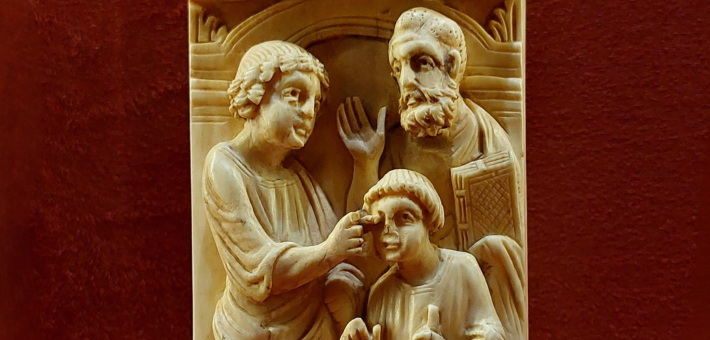
Jesus creates a mud mask from his own spit that heals the blind man. And after witnessing that this once-blind man can now see, the people in the neighborhood have conflicting stories about whether this now-seeing man is the same man they’d seen before! The self-disclosure of the healed man is not enough to convince them. They summon the one who supposedly performed this miracle, presumably for more evidence.
How unsettling it must be for this man’s own testimony, his own story, to be inadequate evidence for his neighbors. The neighbors have a story in their minds about who this man is, and even his own words aren’t enough to convince them.
I’m unsure whether (a) these neighbors had paid such little attention to the man that they were unsure of his identity with as subtle an outward physical change as him now receiving his sight, or (b) if the very idea of one being healed of blindness was beyond what they could fathom. Regardless, the testimony—and even, in many ways, the humanity—of this now-healed man had been marginalized by his own community. I suspect that many in our congregations know this feeling of their stories being minimized so much that they feel unseen. Certainly, something about Jesus’ action in this text speaks life to those who feel this burden.
The unsure neighbors now go to the Pharisees, seeking some kind of clarity. The Pharisees recognize that he has been healed, but after hearing the story, their story of the Sabbath overrides the story of the miracle that is right in front of them. The evidence in front of them is a counternarrative to what they’ve known and understood about God and how God operates. And as much as our impulse might be to ridicule the Pharisees for their antagonism to the healing work of Jesus, their dilemma is one worth examining. This new story of God’s action in front of them conflicts with the story of God they have known and the story they feel has been revealed to them in their sacred scripture.
We will regularly experience testimonies that push against our understanding of how God has been revealed to us through scripture or through our own experience. What will we do with that tension? How will we handle these conflicting narratives in our lives? How does Jesus’ healing work provide salve for this tension?
The parents confirm the man’s identity and the longevity of his ailment but are unwilling to confirm who Jesus is because of fear of communal abandonment. The crowd turns to the healed man again, and they push him to testify again the One who healed him. Angered by the entire ordeal, the man refuses to speak against Jesus and instead utters one of the most oft-used phrases from the Christian lexicon: “I once was blind but now I see!”
With all the unknowing that is present in this story, the firmness of this declaration speaks to how one certainty can be our ground of knowing amid everything else. There are questions all through this text, but this is one experience he’s had that no one else can take from him; he is sure about how his life has changed.
His testimony prompts our own testimonies of God’s grace in our lives, and even if our testimonies aren’t convincing to those around us, this text reminds us that our own miracles can be the foundation of our faith journeys. Holding onto one thing, with clarity and purpose, can hold us amid the uncertainty that will inevitably abound, especially in a world where our collective understanding of truth and trust of sources is ever eroding.
PRAYER OF THE DAY
God of miracles,
Sometimes we are slow to believe in your power, even when your miracles occur all around us each and every day. Open our eyes to see and our hearts to believe. Amen.
HYMNS
I’ve just come from the fountain (trad.)
On my heart imprint your image ELW 811
Go, my children, with my blessing ELW 543
CHORAL
There is a balm, trad.



February 15, 2026