

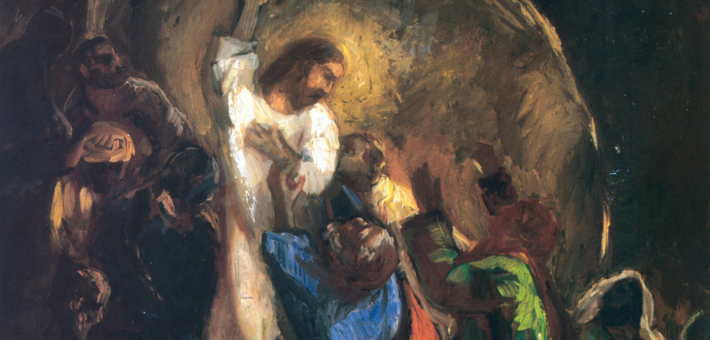
Commentary on John 20:19-31

This week’s passage, John 20:19–31, concludes the main section of John’s Gospel, although an extended chapter 21 follows. In this passage, we see Jesus appearing to the disciples with greetings and messages, showing his hands and side, engaging with the doubting Thomas, and addressing his followers. The Gospel concludes with a statement of its purpose.
Jesus appears to the locked-in disciples, who are inside because they are afraid of the Jewish authorities. Several times, John emphasizes this motif of fear (7:13; 9:22; 12:42; 16:2). This fear is connected to their confession that Jesus is the Messiah; publicly declaring this could lead to expulsion from the synagogue, making faith an act with significant social risk. While it’s unlikely that actual expulsion was happening at this stage due to Jesus’s movement still being small, the Gospel reflects the tension faced by the Johannine community. It interprets these stories as reflecting their experience of alienation and conflict with the Jewish authorities.
In this context, the Gospel’s message is more clear. The community members felt shaken and marginalized because of their faith and confrontation with the Jewish establishment. The Gospel narratives respond to this experience. For example, in John 14:1, Jesus comforts the disciples: “Do not let your hearts be troubled. Believe in God; believe also in me.” He assures them they will not be orphaned after his departure (14:18) and promises the coming of the Holy Spirit, the “Advocate,” who will remain with them forever (14:16).
When Jesus appears to the disciples in today’s reading, his first words are “Peace be with you”—spoken twice—accompanied by showing his hands and side. This greeting offers reassurance to the frightened disciples and the community. Then Jesus declares, “As the Father has sent me, so I send you.” This statement is central in the Johannine Gospel, which emphasizes “the Word,” or Logos, becoming flesh (1:14).
God sent his Son to save the world (3:16), and Jesus embodied the divine Word, demonstrating divine love, even at the risk of death. His act of service was exemplified in washing the disciples’ feet, and he prayed for their sanctification (John 17:18). On the cross Jesus’s final words were “It is finished” (19:30), signaling the completion of his work. As he is resurrected, he reminds the disciples that they are also sent into the world, continuing his mission of love and salvation.
Jesus then breathes on them and says, “Receive the Holy Spirit,” empowering them for their ongoing work. While the full coming of the Advocate will happen later, at this moment Jesus blesses them with the Spirit. Whether this Spirit is identical to the Advocate or not, it signifies God’s presence and guidance. In Jesus’s absence, the Spirit will be crucial for guidance, remembrance, and empowerment.
Jesus further instructs them, “If you forgive the sins of any, they are forgiven; if you retain the sins of any, they are retained” (20:23). This echoes the themes of forgiveness in Matthew and Luke’s Lord’s Prayer, emphasizing the importance of forgiving others, following God’s example of love. However, forgiveness does not mean condoning evil or injustice; it involves offering grace and mercy, with genuine repentance and justice from those who have wronged others.
Mutual forgiveness rests on the foundation of God’s love and forgiveness, which believers experience first. Humans love and forgive because they are loved by God and understand their worth through divine love. This attitude influences how believers relate to others—with mercy, empathy, and compassion—although forgiveness does not erase consequences or negate justice. It is an act of offering understanding and grace, not dismissing wrongdoing.
The scene shifts to Thomas, who doubts Jesus’s resurrection because he was not present during Jesus’s first appearance. Thomas demands to see and touch Jesus’s wounds in order to believe. Later, Jesus appears again, greeting him, “Peace be with you,” and showing his hands and side. Jesus then urges Thomas, “Do not doubt but believe” (20:27). Thomas responds, “My Lord and my God!” (20:29), recognizing the reality of Jesus’s flesh and the truth of his resurrection. Jesus emphasizes that belief is more important than sight, highlighting faith as perceiving truth beyond physical evidence.
The Gospel concludes with its purpose statement: “But these are written so that you may continue to believe that Jesus is the Messiah, the Son of God, and that through believing you may have life in his name” (20:31). This underscores the Gospel’s goal—encouraging ongoing faith in Jesus as the Christ and Son of God, sent by God to embody divine truth. Following Jesus’s example leads to an abundant life, fulfilling the central message for the Johannine community.
The final statement in John 20:31 serves as the summary and overarching purpose of the Johannine Gospel. Its central theme revolves around Jesus’s true identity and his works of God, which are inseparable from his role as the Messiah. His primary mission is to embody and reveal the truth—specifically, the Word of God—which is fundamentally rooted in divine love. This truth is not merely an intellectual concept but an experience to be encountered through faith.
Importantly, the Gospel emphasizes that this faith is distinct from simple knowledge; it involves a trusting relationship with Jesus and a commitment to follow his teachings and example. Believers are called to walk in his way, embody his truth, and live his life. Such a lifestyle enables them to partake in the abundant life Jesus promises—life filled with meaning, purpose, and divine blessing.
However, this abundant life requires more than passive belief; it demands active participation in the way of Jesus. As Jesus declares in John 14:6, “I am the way, and the truth, and the life.” His words underscore that he is the path to the Father and the embodiment of divine truth and life itself. To follow Jesus is to walk in his footsteps, embody his love and truth, and live out his mission in the world. This dynamic relationship with Jesus leads to a transformative, abundant life—one that reflects the very nature of God’s love and truth, guiding believers into deeper communion with God and with one another.



April 12, 2026