

Commentary on Luke 24:44-53

Although the church reads these last verses of the Gospel of Luke several weeks after Easter, Luke tells this story as though it takes place within a day of the resurrection, immediately following the Emmaus story. Right before this passage, Jesus has suddenly appeared to the disciples as they are speaking to the Emmaus walkers. He shows them his wounds and eats a piece of fish in front of them.
So, it is confusing when, in his final words, Jesus says to the disciples, “These are my words that I spoke to you while I was still with you.” One can hear those gathered wondering to themselves, “But aren’t you with us right now?”
Luke seems to open an in-between, liminal space with these words, a borderland between the world that the disciples still inhabit and the resurrected reality of Jesus. This small phrase indicates that they, and we, are moving into a new relationship with Jesus. Jesus is no longer with them as he was; his presence and their relationship are about to change. Might the church lean into this liminal borderland, this changed relationship with the earthly Jesus and the Christ of the resurrection? What might it mean to live with this reality in mind?
Scripture fulfilled, future tense
As Christians, we walk a tricky theological line when it comes to the Hebrew Scriptures. We confess that God was speaking to God’s covenant people long before the events of the life, death, and resurrection of Jesus; we also claim that, somehow, these ancient writings illuminate the events of Jesus’s life, and especially his suffering death and resurrection. Luke does not attempt to make an apology for this claim; his is a bold declaration of faith, and one that has been stated twice already in the Gospel (18:31; 24:25–27).
But here Luke does not stop with this declaration, as he does earlier in the Emmaus narrative (24:13–35). In Jesus’s final words, Luke paints a vision of future fulfillment, a vision of repentance for the forgiveness of sins that will be preached to the Gentiles, to those outside of the covenant people of God.
Careful readers of Luke will hear an echo here, for we have heard preaching for the repentance of sins before, when John was in the Galilee (3:3). Now, the past is prologue; the mission of John becomes the mission of the church, and it overflows the banks of the Jordan to water the God-beloved world.
How might we invite one another to lean into the promise of the future tense, to trust that fulfillment points us not only to the past but to the unseen future, toward God’s ongoing work of fulfillment?
Wait for the promise
The final words of Jesus’s last speech in Luke’s Gospel are not a rallying cry or a declaration of power. Instead, Jesus tells those gathered with him to wait. They will not fulfill the scriptures by taking matters into their own hands. Their part in this new future depends on God. They must wait for the promise of God, the power of God. Without this, they may be in danger of fulfilling their own fantastic ideas, but they will not be living into the vision that Christ has unfolded before them. So, Jesus tells them, “I am sending upon you what my Father promised, so stay here in the city until you have been clothed with power from on high.”
The disciples do not grumble at this command to wait, but for contemporary Christians, waiting for God’s direction and empowerment can sometimes seem too passive in a world with so much need. Luke here invites us to interrogate whether our ministries and missions rely on God’s promise and God’s power. Where are we tempted to get ahead of God’s timeline, to force God’s hand, to remake God’s future tense in our own images? What might it mean to wait faithfully for God to empower the church?
A final blessing and a new beginning
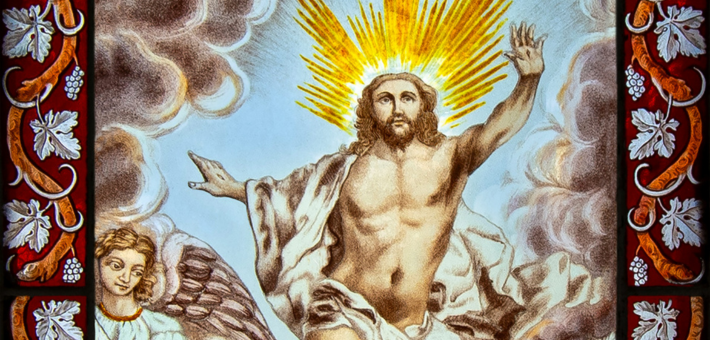
In Luke’s Gospel, Jesus is blessed by Elizabeth (1:42) while still in the womb. He commands the disciples to bless and not to curse those who curse them (6:28). Twice he blesses and breaks bread (9:16; 24:30). But only in 24:50 does Jesus raise his hands and bless people. In this Gospel, the ministry of Jesus moves from the angelic announcements in the first chapter toward this final benediction, this invocation of God’s blessing upon God’s people. Luke’s retelling of the story of Jesus does not end at the cross or the empty tomb. It ends with the blessing of God being poured out on God’s people even as Jesus ascends. Luke invites us to hold out for the benediction.
With this benediction, the story begins again. For the disciples return, like the shepherds did in 2:20, blessing God in their turn. And just as the angel announced in 2:10, so now the disciples are filled with “great joy.” So, they return to the temple, to the place where this Gospel began, where we met Zechariah in chapter 1, and where Zechariah met the angel of the Lord. The benediction takes them, and us, back to where we began; but they return changed, filled with joy and awaiting God’s power.
What if receiving Christ’s benediction does not require us to scatter to the winds? Could this same blessing carry us home again, filled and changed and praising God?


May 14, 2026