

Commentary on 1 Kings 3:4-9 [10-15] 16-28

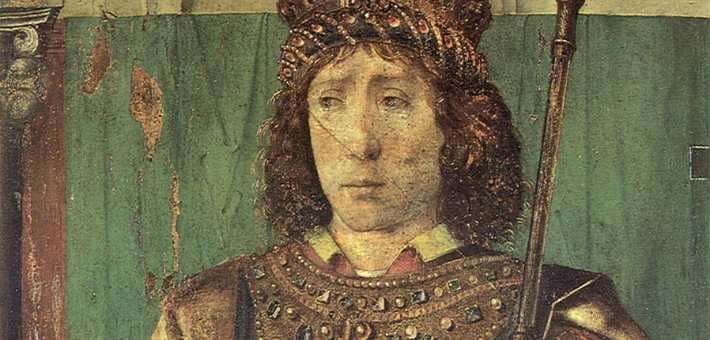
The wisdom of Solomon is legendary, both in the biblical tradition and beyond it. The biblical authors imagine him as the royal voice behind the common-sense daily adages of Proverbs as well as the deep and often skeptical reflections on the meaning of life found in Ecclesiastes. The aptly named Wisdom of Solomon extends the idea to the deuterocanonical books. The tradition of Solomon’s wisdom hearkens back to two stories from the beginning of Solomon’s reign.
Solomon’s first move after securing the throne and a favorable marriage alliance is to travel to the worship site of Gibeon to sacrifice to God. There he has a dream: The Lord appears to him and invites him to ask for anything he wants. Famously, Solomon requests not riches or long life, but a leb shomea, an “understanding mind” or, literally, a “listening heart.” Ancient Hebrew culture knew the heart, leb, as the seat of understanding rather than emotion. Listening, for its part, should be understood as not just hearing but discerning: Solomon wants to be able to discern between good and evil, to know what God wants.
This pleases God, and so God offers him “a wise and discerning mind” (the phrase is slightly different here, but there is no reason to think of it as significantly so) and riches and glory besides. It seems that in asking for the gift of discernment rather than gifts for himself, Solomon has already proven himself to be a wise king.
The well-known story that comes next operates as proof of concept. Two sex workers approach the king for judgment. It may sound strange for two common people to have such direct access to the monarch, but other texts depict similar scenes (see 2 Samuel 15:1–4; 2 Kings 4:24–29). Both women have babies, and one of them has died. The question is, whose? The case is a classic she-said/she-said, and rather than launching an investigation into the facts, Solomon uses the threat of the living baby’s death to determine which mother has the child’s best interests at heart.
From a modern vantage point, there is something uncomfortable about the pain of two vulnerable women existing only as a literary showcase for the king’s ability to best both of them. Solomon’s tactic seems more one of cleverness than of true discerning wisdom, which might have better acknowledged the pain and brokenness of the situation. There is, of course, no way for readers to know if the biological mother actually ended up with her living baby. Nevertheless, Solomon has proved himself to be an out-of-the-box thinker who can solve the problems his people bring him.
Chapter 4 continues the theme of Solomon’s greatness, lauding his great wealth, expansive territory, and the peace and prosperity that characterized his reign. The text praises not only Solomon’s capacity for discernment but also his musical and proverbial abilities and his extensive knowledge of the natural world. All of this fell under the Hebrew understanding of hokhmah, wisdom. His fame spread, as the story goes, and “people came from all the nations to hear the wisdom of Solomon, from all the kings of the earth who had heard of his wisdom” (4:34). In chapter 10, the Queen of Sheba does just that, and what she finds leaves her breathless.
But if Solomon’s wisdom is legendary, it is complicated too. The grandeur of his reign, including the temple he builds, requires support through taxes and forced labor—though he is said to enslave only Canaanites, not Israelites (9:21–22). The descriptions of his consumption and his harem begin to sound less like prosperity and more like wanton excess. In the text’s accounting of his many horses and chariots, some scholars have heard echoes of Egyptian oppression.
But it is not until chapter 11 that the tide turns for Solomon: His love for his many foreign wives turns his heart away from the Lord, and he builds worship sites for their gods. Ultimately, it is Solomon’s sin that leads to the division of the kingdom into north and south, though not until his son ascends the throne and makes a few unwise choices of his own.
If the biblical tradition remembers Solomon for his wisdom, it also remembers him for more than that. It remembers him for his love of many women (Song of Songs) and his great wealth and prosperity. When in Matthew 6:25–30 Jesus advises his listeners to stop worrying and to consider the lilies, he compares their “clothing” to “Solomon in all his glory.” But while prosperity may in certain contexts have been understood as an indication of God’s blessing, prosperity is not the same as wisdom, and sometimes it can even be a hindrance to it. The Bible also remembers Solomon for his downfall: In Nehemiah’s campaign against mixed marriages for the returned exiles, he references the paradigmatic king: “Did not even Solomon sin on account of such women?” (13:26).
What happened, then, to the wise king who asked for the right thing and proved himself to judge rightly? Sermons might explore this question. Maybe the problem was that his listening heart forgot to keep listening. A one-time gift means little without ongoing cultivation. Having the gift of discernment is little use, it turns out, if we don’t stop to discern.
Solomon was given everything he needed for the governance of God’s people: resources, divine favor, wisdom and understanding. Foreign monarchs came to see for themselves and were amazed. The people and the land enjoyed peace and prosperity, for a time. But Solomon was more complicated than that—as most of us are. God’s gifts were good, but they could also be lost if not stewarded well. The very kingdom Solomon worked so hard to build would bear the consequences. And yet, God’s gifts hold true: God is still present throughout history and today, granting wisdom and compassion to those who truly seek those things and desire to use them well.
PRAYER OF THE DAY
Generous God, you gave your servant Solomon wisdom so that he might govern your people well. Grant us your wisdom, so that we might perform our life’s duties with gratitude and wisdom. We pray these things in the name of Jesus Christ, our Savior and Lord. Amen.
HYMNS
God whose almighty word ELW 673
If you but trust in God to guide you ELW 769
Forgive our sins as we forgive ELW 605
CHORAL
Pater Noster, Igor Stravinsky
Our Father, Harry T. Burleigh

November 1, 2026