

Commentary on John 3:1-21

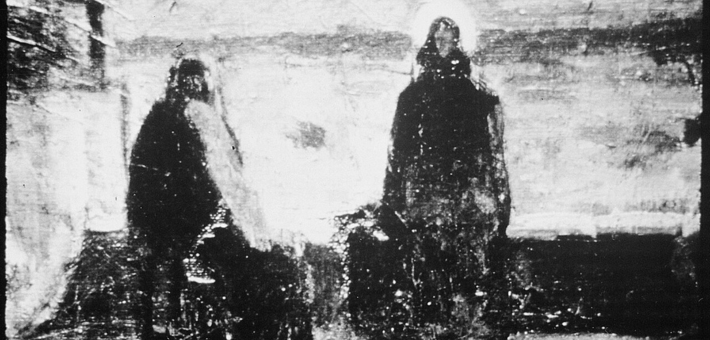
The encounter between Jesus and Nicodemus may be the beating heart of irony in John’s gospel. Here, many of the themes introduced in the prologue resurface, Jesus gives his first “passion prediction,” and the author sets up a dramatic contrast that will lead us into the story of the Samaritan woman whom Jesus will encounter shortly at Jacob’s well.
We are warned about Nicodemus twice before this meeting takes place. We have been told that Jesus will not entrust himself to those who believe because they have seen the signs he is doing (John 2:23–25), and the first thing Nicodemus says to Jesus is that he and his “we” (Nicodemus is representing the Pharisees) know that Jesus is from God because of the signs he has performed (d3:2). Also, Nicodemus comes at night. Darkness, in the Fourth Gospel, can signal both lack of understanding and the power of evil. Lack of understanding seems at the fore here. The author is giving us a strong signal that Nicodemus is not to be trusted, at least not yet.
Jesus and Nicodemus are at cross purposes from the start. Part of the problem comes from a feature of the Greek language. The adverb anothen carries meanings of both “again” and “from above.” Nicodemus chooses the first, while it becomes increasingly clear that Jesus intends the second. While Nicodemus struggles to imagine returning to the womb, Jesus talks about the Spirit and moves the conversation away from sight to hearing.
Here, the sharp point of irony becomes most apparent—Nicodemus is “a teacher of Israel” (3:9), and yet he cannot comprehend what the One sent from God is saying.
Jesus then declares that the testimony of his “we” (the community of Christ-followers) is not received by “the Jews,” and that it is impossible to understand the works of God if one is focused on earthly things. Testimony, earthly versus heavenly, as well as above and below, are all recurring themes as John’s story of Jesus proceeds.
The author of this gospel bends time here: Jesus speaks of his ascension as something that has already happened (“no one has ascended,” 3:13). The reader, who is coming to be “in the know” through irony and foreshadowing, sees that Jesus is the one who has ascended and is entirely trustworthy, while Nicodemus is enmeshed in earthly things.
Next, Jesus alludes to the story told in Numbers 21:4b–9: the story of Moses, the people of Israel, and the serpents in the wilderness. The image of Moses’ bronze serpent becomes a powerful echo throughout the Gospel of John, occurring here (3:14), again in 8:28, and finally in 12:32. Many scholars liken these three “lifted up” statements to Jesus’ passion predictions in the Synoptic Gospels. The story of the bronze serpent, along with the repeated references to Passover, identifies the story of the exodus as a primary lens for understanding John’s gospel.
Here in John 3, the “lifted up” statement recalls Numbers 21 and also Isaiah 52:13, one of the Servant Songs. The verb hypsóo in the Greek carries a double meaning, referring both to the spatial lifting up of Jesus from the earth on the cross and to his exaltation through his resurrection and ascension: the revelation that he is indeed all those things he claims to be—the Son of Man; the Son of God; the One sent from God; the Messiah; the prophet like Moses, yet greater than Moses; the Son of Abraham, yet greater than Abraham; the list could go on.
This first “lifted up” statement implies that in Jesus’ crucifixion, God is providing the world with the opportunity to turn away from earthly things and return to God for eternal life in Jesus. What follows this “lifted up” statement is a discourse on the meaning of the Christ event. Discourses in John are crafted from tightly woven themes. There is so much to reflect on here that one can become almost as bewildered as Nicodemus, but prominent themes here include God’s love for the world, belief, eternal life, judgment, light/darkness, and truth versus evil.
There is an embarrassment of riches in ideas for preaching this week.
We are invited to reflect on what “belief” means. Because coming to authentic belief is the subject of the whole section of John 2–4, this passage adds to the understanding of belief already highlighted in the story of the wedding at Cana. The question is: What does “belief” mean in John’s gospel and for us? Is it cognitive assent, or is it something deeper? The narrative throughout the gospel indicates that true belief is a life-changing trust in Jesus’ words. The Samaritan woman (John 4:1–45), the royal official (John 4:46–54), and the man born blind (John 9) will all illustrate what belief means as John’s story continues. Nicodemus is not numbered among these, though his story doesn’t end here.
John 3:14–21 also invites us to reflect on the cross and what God accomplishes there. The story of Moses and the bronze serpent shows that God’s justice is restorative, not punitive. The cross (like the bronze serpent) calls for communal reflection and provides a way for people to turn away from trust in their own understanding and back to reliance on God. By echoing the themes of Passover, the cross is revealed as God’s providence of strength for the journey and the water of life.
The prominent theme of judgment is introduced here. Judgment is an ongoing process in John’s gospel, repeated moments of calling out a wrong and indicating that turning back toward God is needed. Judgment creates a liminal space, revealing a posture in opposition to God. People tend to move in and out of this space as they see, hear, and either trust or reject God in Christ Jesus.
Many scholars note trial scenes in John, where witnesses are called, and Jesus either is accused or accuses. John 12:32 indicates that the cross is God’s final judgment of the world and the defeat of Satan, the ruler of this world. The result of the “lifting up” of Jesus is that God draws all things into God’s self. How might this view of judgment affect how we treat those we see as falling short? How does it help us think about our own justice systems?
PRAYER OF THE DAY
Birthing God,
You gave us new life when we were born of water and Spirit. Help us live into that new life, refreshed and renewed for your work. Amen.
HYMNS
Borning Cry ELW 732
The church of Christ, in every age ELW 729, UMH 589, NCH 306
God loved the world ELW 323
CHORAL
God so loved the world, John Stainer



January 25, 2026