

Commentary on John 19:31-42

Today, on Good Friday, we hear John’s Passion narrative continue as it tells the story of the immediate aftermath of Jesus’s death, including his burial. In many ways, the first scene, the piercing of Jesus’s side, represents the climax of John’s crucifixion story. Here we see hanging on the cross the one who is the Lamb of God, as John the Baptist declares at the beginning of the Gospel.
Jesus is portrayed here as the Passover Lamb, the one whose shed blood signifies God’s covenant with Israel, God’s promise of liberation from slavery. It seems a simple title for Christ but is actually quite intricate. John the Baptist speaks of this Lamb as the one “who takes away the sin of the world” (1:29). This takes us beyond Passover and has other overtones from the Old Testament that are, unlike the Passover lamb, explicitly associated with sin. The animals that are slaughtered in the temple, for example, serve as sin offerings, signs of repentance from sin and restoration to God’s holy covenant.
But there are two other, wider associations. There are overtones of the scapegoat who, once a year on the Day of Atonement, is sent out into the wilderness bearing the sins of the people. The Lamb also suggests the story in Genesis 22 of the sacrifice of Isaac, where the ram replaces the boy Isaac for Abraham’s sacrifice.
The Gospel’s understanding of Jesus as the Lamb of God is, therefore, a rich and complex one, presenting him as the fulfilment of the covenant between God and God’s people. The Lamb represents liberation from the slavery of sin and death, bearing the suffering on our behalf and bringing about cleansing from sin and guilt.
Yet there is also a profound irony happening in John’s Passion story. The religious authorities are eager to maintain ritual purity in order to eat the Passover meal in the evening. For that reason they do not wish the dead bodies of the condemned to be left on the crosses, polluting the land. Their “piety” contrasts with the gross act of injustice in crucifying the one who is himself the Lamb of God.
The story of the piercing of Jesus’s side is unique to John’s Gospel. At one level, it signifies a sublime indifference to suffering on the part of the Roman soldiers and, on the part of the temple authorities, a distorted religious faith. In addition, and at a deeper level, it expresses most powerfully the central paradox of this story: that life is given through death, through the death of the Son of God.
The flow of blood and water from the side of Jesus can be seen also as a birth symbol, like the breaking of the amniotic sac that is the prelude to birth. In the ancient world, giving birth was a dangerous experience, exposing both mother and infant to death in the hope of producing life, a new life. Nicodemus makes his third appearance in the Gospel here, aiding Joseph of Arimathea in the burial of Jesus. Interestingly, on Nicodemus’s first appearance in John, Jesus speaks to him about “birth from above,” birth from the Spirit (3:5), and here, in a sense, he is indeed “born from above” in his decision to honor the body of Jesus. In this sense, as later Christians would say, Jesus is our divine Mother who brings us to birth: from the darkness of the womb into the light of life.
Both blood and water are also sacramental symbols throughout this Gospel: of baptism, which is about cleansing from sin, and of the Eucharist, which is about union with Christ. Both sacraments speak of abiding in Christ, in the community of faith. They bring about communion with God in Christ, through the incarnation and through his life-giving, self-sacrificing death.
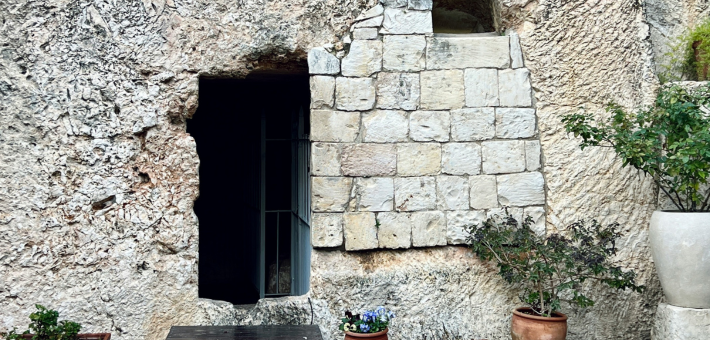
The second part of our story is the burial of Jesus, which has unique Johannine features, different from the other Gospels. These two powerful and wealthy men take a great risk in coming into the open about their faith and in ensuring that this “condemned criminal” is not simply thrown into a pit along with other victims of the same violence. On the contrary, Jesus is buried like a king, with a mountain of costly spices. Even here, in the humiliation of crucifixion, death, and burial, Jesus’s divine sovereignty and goodness shine forth at every turn. What appears to speak of shame and death speaks instead triumphantly of life and glory.
Today, on Good Friday, we celebrate the means of our redemption. In the vulnerable figure of the Lamb we come face-to-face with the astonishing vulnerability of God. John speaks of the event of the cross not as an experience of humiliation and disgrace, of agonizing suffering that leads to an utterly demeaning death but, in all its gruesome reality, as an event that radiates the glory of God.
We see the cross not just as a symbol of colonial violence and shame—which it is—but also, and primarily, as the expression of divine grace stooping down to raise us up and rescue us from sin, suffering, violence, evil, and death. We see here the full extent of God’s glorious self-giving love for the world, for each one of us, for the whole creation: all welcome, all invited into the divine arms as they open on the cross to draw all things to God.
This Good Friday, we are invited to stay for a moment within the radiant reality of the cross, in all its vulnerability and paradoxical beauty. Here we experience again the embracing glory of God’s great, self-giving love. This love is incarnated above all in the Lamb of God who conquers death and takes away, once and for all, every aspect of the world’s sin. This is the source of our hope and joy and life, the one reason we can call this dreadful day of suffering “good.”
PRAYER OF THE DAY
Jesus our Passover Lamb,
We give thanks for the unswerving love you showed in your death and burial. Forgive and strengthen us so that we can rise with you, restored by your grace. Amen.
HYMNS
Ah, holy Jesus ELW 349, H82 158, UMH 289, NCH 218
Were you there ELW 353, UMH 288, H82 172, NCH 229
CHORAL
Were you there, Richard Proulx

April 3, 2026