

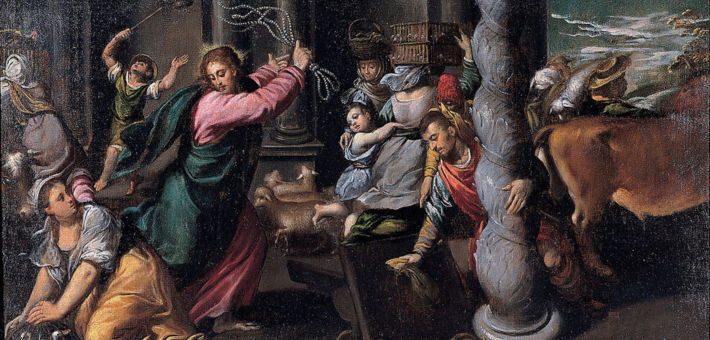
Commentary on John 2:13-25

The question that springs to mind immediately upon reading this text is, “Why is this here?” Many of us are familiar with the story of Jesus “cleansing the temple,” but in the synoptic tradition (Matthew, Mark, and Luke), Jesus’ temporary shutting down of temple functions is the final straw that leads to his arrest, trial, crucifixion, and ultimately resurrection and ascension. In the Gospel of John, this event happens in chapter 2.
Jesus’ prophetic act in the temple immediately follows the revelation of his glory when he changed water into wine at a wedding in Cana. It occurs roughly three years earlier than the raising of Lazarus, the final sign that convinces the chief priests and Pharisees that “everyone will believe in [Jesus] and the Romans will come and destroy both our holy place and our nation” (John 11:48) and prompts Caiaphas’s prophecy “that Jesus was about to die for the nation” (11:51)
Two ideas are worth wrestling with in this regard: Both the chronology of Jesus’ ministry and the details of this event are quite different in John than in the Synoptics. Exploring these ideas may help us discern something about what the author of this gospel is trying to say about Jesus.
Chronology
An exhaustive tally of what is different in the chronology of John would take up too much space, but a short list includes:
- a prologue that echoes Genesis 1 describing the Word, who co-creates with God in the beginning, becoming flesh (rather than a birth narrative or Jesus’ baptism);
- the sign in the temple, described in John 2:13–25, as noted above;
- the description of three separate Passover festivals in John, versus one in the Synoptics;
- the fact that Jesus is crucified at the same time as the Passover lambs are sacrificed on the Day of Preparation, rather than following the Passover meal as in the Synoptics (John 19:14, 31).
All these differences can seem problematic, but they remind us that all four gospels are theological accounts of the Christ event and not “just the facts, ma’am” (to echo Sergeant Joe Friday of the 1950s TV series Dragnet). Once we get our heads around this, John’s portrait of Jesus comes into better focus.
The temple event
The description of Jesus’ action in the Temple is quite similar across the Synoptics, with small variations in the details. All are quite a bit shorter than John’s account, are less specific about what Jesus encounters in the Temple, and quote slight variations on a mashup of Isaiah 56:7 and Jeremiah 7:11.
John’s version, by far the longest, ties the sign in the temple specifically to Passover. It lists the sacrificial animals used in temple worship: sheep, cattle, and doves. It also includes the interesting detail of Jesus making a whip out of cords. The author quotes Zechariah 14:21, an eschatological passage about all of Jerusalem becoming holy so that there is no longer a need for buying and selling in the temple, as sacrifice can be offered anywhere.
There are also two “backward looks” by the disciples (a feature that occurs throughout the Gospel of John). The first is associated with a quote from Psalm 69:9, “Zeal for your house will consume me” (2:17). “The Jews” ask Jesus to perform a sign for them so they can understand his authority, but their hostility to him is not emphasized—yet. The sign Jesus offers is “Destroy this temple and in three days I will raise it up again” (2:19). This is followed by a misunderstanding about what temple is being spoken of—the building or Jesus’ body. The second backward look by the disciples involves their realization that Jesus means that he will raise up his body in three days.
So, what do we learn about Jesus here that can support preaching this week?
First, a note of caution. We always need to be careful when interpreting John—along with Matthew, the two most Jewish of the gospels—neither to read “the Jews” as monolithic villains nor to read this text as Christianity superseding Judaism. Jesus’ first followers didn’t see following Christ as replacing Jewish worship of the God of Israel, though the forms of their worship diverged over time, particularly after the destruction of the Jerusalem temple in 70 CE.
John’s story of Jesus is a complexly woven tapestry of themes. Here, immediately following the revelation of Jesus’ glory (God’s presence or “God-ness” in him) at the wedding in Cana, we discover themes of the liberation celebrated at Passover, of Jesus’ body in some sense being God’s temple, and of the profane becoming holy in Jesus. This whole section of the gospel, from chapters 2 to 4, begins an exploration of authentic belief in Jesus. Eternal life, in John’s gospel, is knowing God through knowing Jesus. Becoming children of God will mean that true worship happens in the community of Christ-followers.
Perhaps this is a good week to talk about worship. Jesus is concerned throughout the story about exclusivity—how the keepers of the temple use economics unjustly and exclude women, disabled people, and gentiles from the presence of God. Are there ways we also exclude?
This might also be a time to talk about vocation, and about the sacred versus the profane. The expansion of worship indicated here—that the temple will be Christ’s body—as well as the stories throughout John’s gospel that expand inclusion in Christ may encourage us to reexamine the distinctions between who and what are “set apart” for certain church functions and who may lead worship and offer their gifts.
The Passover is also a prominent theme throughout John’s gospel. Passover recalls liberation and a journey from slavery to freedom. What might God in Christ be liberating us from today? To what new place might God be leading us in Christ? Finally, authentic belief and how it comes about are examined throughout this section. Perhaps this is a good theme to explore throughout these weeks in John 2–4.
The text ends with a warning that leads us into Jesus’ encounter with the Pharisee Nicodemus. Jesus knew not to entrust himself to those who believed in him based on seeing the signs that he was doing (2:23–25). It will be worth noting how Nicodemus begins his conversation with Jesus in John 3.
PRAYER OF THE DAY
Patient God,
Your son, Jesus, expressed anger at abuses and injustice. Help us to show concern, not apathy, for injustice in our world, and teach us to make right all that may be wrong. Amen.
HYMNS
Wash, O God, our sons and daughters ELW 445, UMH 605
In his temple now behold him ELW 417
Built on a rock ELW 652
CHORAL
My song shall be alway, Gerald Near



January 18, 2026