

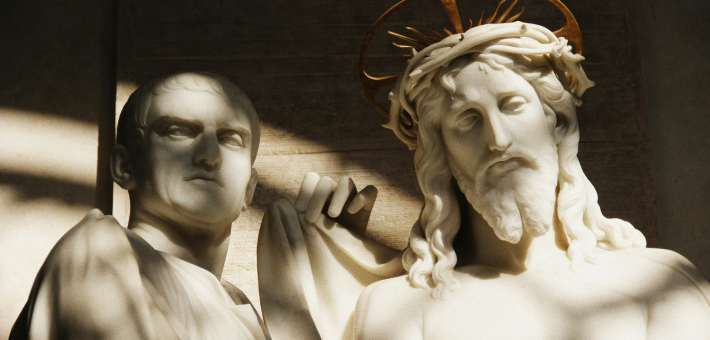
Commentary on John 18:28-40

Pilate begins his encounter with the high priests of Jerusalem by making a concession. Although the Jewish leaders have traveled to his residence, they refuse to enter the palace, fearing ritual defilement before Passover. Rather than forcing them to violate their law, Pilate goes out to meet them. This decision is significant. It suggests that Pilate has become accustomed to the particularities of Jewish practice. As a Roman governor, he has learned to make room for the customs of the people he governs. In this moment, he does not require the priests to conform to Roman expectations; instead, he bends to the unique demands of the situation.
After a brief legal exchange—during which the priests present a culprit but no clear charge—Pilate agrees to see Jesus. This, too, is a concession. He does not yet know what Jesus has done, but he agrees to hear the case anyway, accommodating the Jewish way of handling the matter.
The conversation between Pilate and Jesus is maddening. Pilate opens with a strange question: “Are you the King of the Jews?” Up to this point, this title has not played a central role in John’s Gospel. Jesus never claims it explicitly, and the priests do not explain to Pilate that such a claim lies behind their actions. Others in John’s Gospel do refer to Jesus as king (John 1:49; 6:15; 12:13, 15), but here the question seems to come from nowhere. Perhaps Pilate has inferred it on his own, or perhaps he is testing a charge that would alarm the Jewish leaders and Roman authorities alike.
Jesus responds to Pilate’s question with one of his own: “Do you ask this on your own, or did others tell you about me?” There is a genuine curiosity in Jesus’s reply. Pilate is a new character in the story, and Jesus, ever the rabbi, recognizes a possible opening for teaching. A sincere question is the beginning of learning, and Jesus has shown himself willing to teach both the weak and the powerful. Pilate, however, responds like an overworked bureaucrat: “Just tell me why you are here.” He is not interested in deep truth or divine mission. He wants closure—a box to check, a form to complete, a reason to move on.
At this point, Jesus becomes frustratingly opaque. Once again, he sets his face toward the cross, recognizing that there will be no safe harbor for him here. He tells Pilate that his authority does not come from the world. Neither Rome, nor the temple, nor even the Jewish people grant him legitimacy. His authority comes from beyond earthly power, and therefore his kingdom cannot be secured or lost by earthly means. It cannot be seized by force or handed down by inheritance. As John’s Gospel unfolds, the reader begins to see that this kingdom is won through sacrifice. The one who is worthy is the one willing to endure humiliation—even submission to Pilate’s interrogation. The king’s calling is to bear witness to the truth, a calling that will cost him his life.
This is the terrible irony of the scene. Jesus’s commitment to truth is the real answer to Pilate’s unspoken question about why Jesus has been brought before him. And yet Pilate responds with a question that exposes his own blindness: “What is truth?”
This question has haunted the church. It is devastatingly ironic. Truth is standing directly in front of Pilate, yet he cannot see it. His universalizing question prevents him from recognizing the particular form truth has taken. Pilate embodies the tension introduced in the opening of John’s Gospel, where we are told that “the Word became flesh and lived among us” (1:14). The ordering principle of the universe—the universal truth—has become particular.
Universal principles, however, are often prone to erase or ignore particular lives. Pilate asks a question meant to help him adjudicate the case, but he asks it in abstraction. He fails to see that justice is not found in principle alone, but in the face of the one standing before him. Once Jesus becomes a problem to solve, a case to manage, or a form to complete, Pilate loses access to the truth embodied in this person.
Pilate’s words also cannot be separated from the context of empire. His question “What is truth?” is shaped by an unspoken companion question: “What does the Roman Empire count as truth?” Or more pointedly, “What truth is acceptable to those who hold power?” Throughout the exchange, Pilate demonstrates acute awareness of the political stakes. To recognize the truth of Jesus would be to undermine his own authority—and, by extension, Rome’s authority. This is the danger hidden within so many universal questions: They conceal our vested interests. To truly see Jesus in his particularity would require Pilate to reckon with the imperial system that rewards his loyalty and secures his power.
And yet Pilate is conflicted. The particularity of Jesus has unsettled him. He finds no clear grounds for condemnation, and so he searches for a loophole. Remembering a Passover custom, Pilate attempts to preserve both his authority and Jesus’s life. He offers the crowd a path toward mercy. But the crowd has learned well from their Roman rulers. Though Pilate finds no reason to punish Jesus, the people demand that he exercise his power, not defer to mercy. They reject the loophole. And so Pilate is sent back into the palace for a final confrontation—caught between the truth he cannot fully face and the power he cannot afford to lose.
PRAYER OF THE DAY
God of truth,
Too often we bend truth to fit our needs. Show us how to recognize and follow your truth, shown to us by the love and life of your son, Jesus. Amen.
HYMNS
Jesus calls us; o’er the tumult ELW 696, H82 549, 550, UMH 398, NCH 171, 172
Change my heart, O God ELW 801
Come to the table ELW 481
CHORAL
Lead on, O King Eternal, Diane Bish


March 15, 2026