

Commentary on Acts 1:1-11

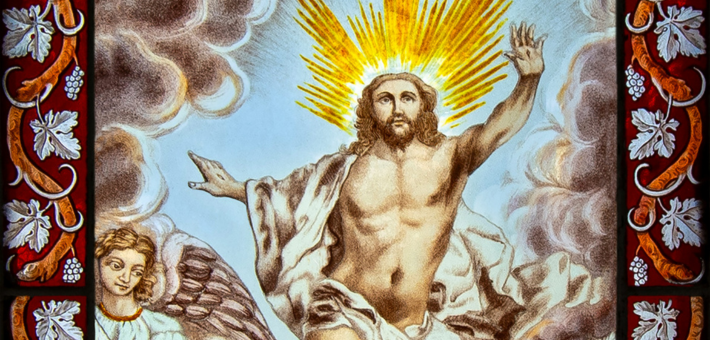
The book of Acts begins with a recap: a summary of what was narrated in the Gospel of Luke, followed by a retelling of the final story of that earlier volume—the ascension of Jesus. This is not a word-for-word repetition of the earlier account, and any attempt to map the Acts version neatly onto that of the Gospel would meet some challenges, not least in the addition, here, of a 40-day period during which the resurrected (but not yet ascended) Jesus appears among the apostles.
The end of one story, the beginning of another, and at the same time the midpoint of Luke’s two-volume masterpiece—it is clear that, for the author of Luke-Acts, the ascension is an extremely significant event. What is equally apparent, however, is the way in which it has been downplayed or ignored by many modern commentators. In his book on the subject, theologian Douglas Farrow writes:
Once it was seen as the climax of the mystery of Christ. … Today it is something of an embarrassment. Both exegetically and theologically the ascension is quickly assimilated to the resurrection. Its festival is commonly passed over as a redundant marker on the road to Pentecost, allowing it little or no impact on the shape of Christian life and thought.1
Certainly, questions over the plausibility and/or historicity of Jesus’s disappearance into the clouds have generated discomfort on all sides, and the practical challenges surrounding the timing of the festival within the liturgical calendar have, arguably, also contributed to its neglect.
Turning our attention to the ascension, however, need not demand a deep dive into questions of what really happened or what might be possible, nor, necessarily, a detailed analysis of its theological significance. Part of the way in which we can take scripture seriously is simply by noticing those places where an author invites us to pause, rest, or dwell—regardless of whether we do so in delight or in puzzlement. This is precisely one such location, not only because of the aforementioned repetition of the event, but also because of the effect that the ascension has upon the momentum of the wider narrative.
The first instruction that Jesus gives to the apostles within this account is that they must wait in Jerusalem for the coming of the Holy Spirit (1:4–5). Already, this disrupts the forward movement of the story. As they are gathered, the apostles ask Jesus: “Lord, is this the time when you will restore the kingdom to Israel?” (1:6). As can happen so often when we are invited to pause, the apostles immediately turn their attention to what might come next, and in so doing, they are influenced by a desire for restoration of what has gone before.
They look behind them to try to imagine what might lie ahead. Although Jesus’s response (1:7–8) reorients the apostles toward a radically different future, far broader and more astonishing than what they had imagined, it is also a future in which they are required to take on a new role as leaders rather than followers.
The question posed by the apostles is likely also shaped by their geographical location. Waiting in place invites attentiveness to place, another thread of biblical interpretation that has, arguably, been neglected by many modern interpreters.2 The apostles are confronted with troubling realities in Jerusalem, not least the ongoing Roman occupation and their conflict with some of the Jewish authorities. Individuals and church communities might usefully respond to this passage by giving attention to the challenges and opportunities to be found in their own locale.
The risk and the reward of waiting can be found in a fuller recognition of reality, and this is often uncomfortable. Here, the apostles must face a future in which Christ is no longer present in the way that he once was, a transition that involves loss and challenge. Perhaps, therefore, discomfort is to be found within the biblical account of the ascension itself, not solely among its modern interpreters. Indeed, such discomfort may not be a mark of “failure” or “misunderstanding” but, rather, a sign of stepping into a new and unfamiliar way of seeing and experiencing the world.
A pause at this point may invite reflection on new chapters and midlife transitions for individuals and institutions alike. The familiar notion of “midlife crisis” often entails a desire to resist stepping into the responsibilities of the next chapter of life and to return to the past. Healthy navigation of change invites the integration of what has gone before with what will come.3 The story of the ascension hints at precisely this weaving together of past and future.
Where the apostles have been (literally and symbolically) is not necessarily where they are going, yet both form part of the ongoing story. Jesus’s astonishing departure into the clouds initiates a new way of seeing that retains its relevance for the 21st-century church. Where are we currently being invited to direct our gaze? What are we being invited to notice, to sit with, even to wrestle with in the places we find ourselves today?
Notes
- Douglas Farrow, Ascension and Ecclesia: On the Significance of the Doctrine of the Ascension for Ecclesiology and Christian Cosmology (Grand Rapids, MI: Eerdmans, 1999), 9.
- For more on attentiveness to space and place, especially in relation to the ascension story, see Matthew Sleeman, Geography and the Ascension Narrative in Acts (Cambridge University Press, 2010).
- Those who are interested in journeying further with this train of thought may appreciate Frank Tallis’s book: Wise: Finding Purpose, Wisdom, and Meaning Beyond the Midpoint of Life (Abacus, 2026).


May 14, 2026