

Commentary on John 20:19-31
The risen Jesus appears to the gathered disciples in the first part of our reading today, offering them the gift of peace (twice), showing his wounds as signs of recognition, and giving them their commission for mission: to bring about reconciliation and to confront and name what is destructive and evil. Although we are more used to Luke’s chronology, where the descent of the Spirit occurs some weeks after the resurrection at the Jewish Feast of Pentecost, in John’s reckoning everything of significance happens on Easter Day, including the commission for mission and the giving of the Holy Spirit.
In locating everything on Easter Day, John is making a theological point rather than a description of how the church’s calendar should run. All the events of the cross, resurrection, ascension, and giving of the Holy Spirit belong together theologically. They are all part of the one redemptive reality in Christ, who reveals himself to us in eternal union with the Father and the Holy Spirit.
The day being Sunday is of particular import. In the creation story of Genesis 1, Sunday is the first day of the week, the day in which God creates light, before even the sun, moon, and stars are formed. In some Jewish and Christian thinking, Sunday becomes the “eighth day,” the day of God’s new creation, the day in which God will establish the kingdom and transform the created world. For Christians it is the primary day for celebrating the Lord’s resurrection; it is “the Lord’s Day.” This is different from the Jewish Sabbath, which is the last day of the week, the day of rest—not the first, the day of new creation.
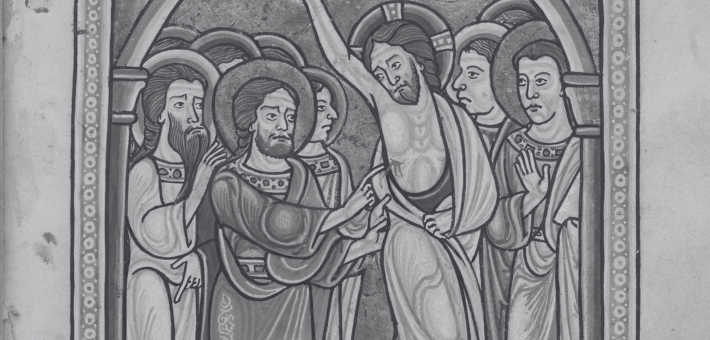
Jesus’s wounds are of the greatest significance in his appearance here. Given that Jesus’s body has been transformed so that it is no longer bound by death or any mortal limits, it is surprising that the wounds are still visible on his body. We would not expect that of a risen, transfigured body. But the marks are of great theological and spiritual import. They are signs, in the first place, of colonial and imperial violence; signs of crucifixion, which was the favorite Roman method of dealing with rebels and people of no worth. The wounds show Jesus’s solidarity with all those who have suffered similar violence, in whatever context and by whatever means, whether political, social, or domestic.
At the same time, Jesus’s wounds are also, paradoxically, emblems of life. From these very wounds blood and water flowed following his death on the cross. In a symbolic sense, though not literally, the wounds remain, in a sense, open. Access to life and salvation is always available when we meet the risen Christ, especially on the Lord’s Day, the day of resurrection.
The church traditionally reads the second part of our reading, the story of Thomas, on Easter 2, the Sunday after Easter Day. That is because, in John’s Gospel, the story of Thomas occurs on the second Sunday following the resurrection. It is often a day on which preachers like to focus on doubt and how there is room for it within our understanding of faith. While that may be true, it is not entirely fair to the Thomas story as John recounts it.
We are not told why Thomas is absent on Easter Day, nor is it relevant to speculate. The point is that Thomas demands to experience precisely what the other disciples have experienced the week before. He wants to see the wounds, even to touch them, so that he is on equal status with all the others. In one sense he has no more doubt than Mary Magdalene or Peter or the beloved disciple. They, too, needed to see, to hear, to touch in order to believe. What is unique about Thomas is his focus on the wounds. He is convinced that they are the source of faith. So it is not just a physical resurrection that Thomas wants to believe in but, rather, a resurrection that gives access to Jesus’s redemptive suffering.
In that sense, Thomas is absolutely right. The reason is that Christ always appears with his wounds, always with the marks of his solidarity with the suffering and the violated, always with the sacramental signs of the new life he offers. Thomas demands more than physical proof; he wants the signs of salvation. Therefore, perhaps his doubt, his slowness to believe, also contains a profound insight into the saving significance of Jesus’s wounds.
More than that, in reaching full Easter faith, Thomas makes the most sublime statement of Jesus’s identity. He calls him “my Lord and my God,” the highest confession of faith made by anyone in this Gospel.
What does that mean for us? Mary Magdalene and Thomas are the two key disciples in John 20. Through them, and through their witness, we too can come to know the risen Christ and to experience his life-giving love for us as the sheep of his fold. Through him, we can know God and feel safe as God’s children in solidarity with Christ. Above all, we can gaze on his wounds and discover there his identification with us in our suffering and his unconquerable power over death on our behalf.
Today we, too, can respond with love, like Mary Magdalene, to the divine Shepherd who calls each of us by name. We, too, can stand with Thomas in all our struggles to believe, gazing on the wounds and confessing our faith in him: “My Lord and my God!”
PRAYER OF THE DAY
God of resurrection,
Your son, Jesus, awed his followers by appearing among them. With awe we also celebrate his resurrection and rejoice in eternal life. Amen.
HYMNS
Come down, O Love divine ELW 804, H82 516, UMH 475, NCH 289
We walk by faith ELW 635, H82 209
You satisfy the hungry heart ELW 484
CHORAL
The road to Damascus, Frederick Frahm

_-_KB_76_F_13,_folium_025r.jpg,)
April 12, 2026