

In her graduate studies, Elisabeth R. Jones kept encountering the phrase “referencing the rabbis.” Over time, she came to understand that the rabbinic way of looking at texts felt quite different from how she approached Scripture texts as a Christian theologian. But it was not until she began serving as pastor in her current congregation that a throwaway comment led to a much deeper engagement with the tradition.
“The rabbis have a midrash on that…” she had said.
“What’s a midrash?” someone asked.
And a new (old) method of reading Scripture came into being in that community. Jones describes many people in her congregation as biblically skeptical. Yet underneath the skepticism of those worshipers, Jones recognized a deep curiosity.
Over 10 years, the congregation developed a midrashic process of exploring Scripture together.
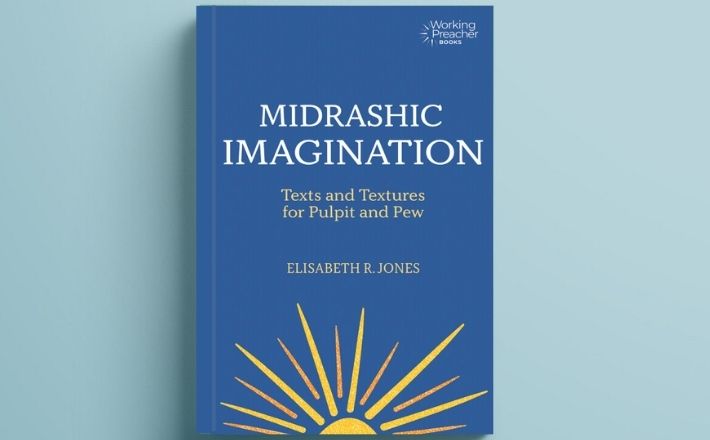
Midrashic Imagination: Texts and Textures for Pulpit and Pew is the record of both the process and some of the results of that process.
What is “midrashic imagination”?
Midrashic imagination—distilled—is a participatory practice of interpreting a biblical text.
Rather than considering a text to be static, with one meaning to be zeroed in on, reading it in this way opens up the text as a living word capable of imparting meaning and a word of God for us today. Theological studies are not known for “imagination,” but midrash privileges questions and acknowledges polyvalence, or the possibility of having multiple meanings.
Midrash has sometimes been described as running your finger over the text and finding a bump, then exploring the bump. Or reading between the lines. It also allows for some humor!
How does this midrashic approach help people to find Scripture transformative? It gives space to honesty. We don’t have to pretend to like a piece of Scripture. We can name the problems we have with the text (not try to fix them). Our honesty about Scripture texts creates a safe space for other people who are bothered by different things in them too. Whether it’s a spiritual gap, or a knowledge gap, or an emotional gap … where is the disconnect for us here? And what are we going to do with it?
God’s honesty at the beginning of creation—admitting “I’m lonely”—gives us all the permission we need to be honest about our realities. Just as lives are transformed in Scripture, maybe our lives, honestly shared, can be transformed too by encountering God!
It can be freeing to read Scripture with imagination. Being “allowed” or “invited” to wrestle with a text enables us to come to the text more closely, and that can be transformative.
What’s the impact?
The midrashic imagination process Jones describes makes interpretation of Scripture always a communal activity, from the beginning and through the preaching moment. It also reinforces that we expect God to show up when we read Scripture together.
Midrash is a Jewish practice, so Christians will want to be conscientious about acknowledging that and treat the method with respect. Yet the concept of “textualized living” is widely applicable to any religion with sacred texts. How does the text become something we share, by how we live? Particularly in North America, Jones says, we’ve veered away from polyvalent interpretation, so that is a gift that Judaism gives to other religions that have sacred texts. Using the term “midrash” is a reference to Jewish tradition that acknowledges that contribution.
We may ask ourselves…
What is the Holy Spirit wanting to say to these particular people, through these particular texts, on this occasion?
How do I get in step with the dance of the Spirit, or invite others into the dance?
For more on this volume in the Working Preacher Books series, Midrashic Imagination: Texts and Textures for Pulpit and Pew, listen to a podcast episode or watch it on YouTube, in which Rolf Jacobson and Karoline Lewis discuss the book with author Elisabeth R. Jones.