



Preaching the Bible on Turtle Island [6 of 6]
Scripture: Matthew 14
When your congregation hosts a Thanksgiving worship service, preachers are invited to reflect on what thanksgiving and appreciation look like in their communities and cultures.1 What if we try to hold together what it means in cultures among us who have experienced different sides of the same story? Truth-telling needs to be part of genuine thanksgiving.
A common theme among Indigenous prayers and ceremonies is this core practice of saying “thank you” to the world around us that takes such good care of us. It is a core part of who we are. Many Indigenous stories, spiritual practices, and ceremonies are told and performed to induce an attitude of gratitude and thankfulness in a person. Oftentimes in Indigenous stories, things go really badly for humans when they forget to honor and say “thank you” to the animals and plants who give their lives to nourish us.
Telling True Stories Around the First Thanksgiving
Most of us are certainly familiar with Charles M. Schulz’s A Charlie Brown Thanksgiving (1973). This special was my first introduction to the mythologized story of Thanksgiving. Of Pilgrims who were starving. Of Natives, like Tisquantum or “Squanto,” who felt pity for them and taught them how to farm. Of a great feast where pilgrims and Indians ate together in harmony. It’s an inspiring story. But its meaning and significance for many Indigenous people can only be understood if you know the stories preceding and following it. It’s important to recognize that Thanksgiving Day represents a national day of mourning for many Indigenous people in New England, especially among the Wampanoag, for whom the true story of Thanksgiving weighs heavily.
To begin with our re-storying of the Charlie Brown Thanksgiving special, do we ever stop to wonder why “Squanto” speaks English to Charlie Brown? Tisquantum’s story is actually quite amazing and tragic. In short, Tisquantum could speak English because in 1614, he was kidnapped by English explorers who intended to sell him into slavery. Spanish friars purchased his freedom and sent him to England to work as a butler. In 1620, he finally returned home, only to discover that his tribe, the Patuxet, had entirely succumbed to an epidemic, likely introduced by English settlers.
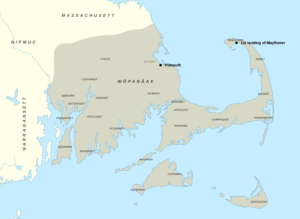
The Wampanoag, who, too, suffered greatly from the epidemic, took Tisquantum in. Given their low numbers, the leader of the Wampanoag, Massasoit Sachem (also known as Osamequin), shrewdly considered how the Pilgrims’ guns could assist them against the neighboring Narragansetts. And so they sent Tisquantum to build bridges between them and the struggling Pilgrims. In the fall of 1621, the Pilgrims hosted the Wampanoag to a three-day celebration, filled with hunting and gamesmanship, in honor of the harvest made possible by what they had learned from Tisquantum and the Wampanoag. While the Charlie Brown special ends here, it is critical that we follow the story onward.
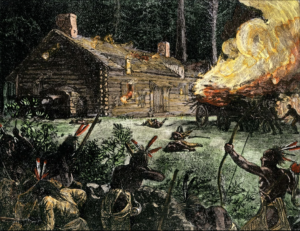
In short, between 1620 and 1640, settlers flooded the East Coast. By the 1660s, the English outnumbered their Indigenous neighbors, seized their lands, and forced them into servitude. In 1675–76, neighboring tribes organized around Massasoit’s son, Metacom (nicknamed “King Philip” by the settlers), to rise up against the colonists. The Wampanoag and their allies would ultimately lose the “King Philip’s War,” suffering heavy casualties. Hundreds of Native survivors were executed or enslaved; the rest were dispossessed of their ancestral homelands. It’s no wonder that today among the Wampanoag, Thanksgiving is recognized as a day of mourning.
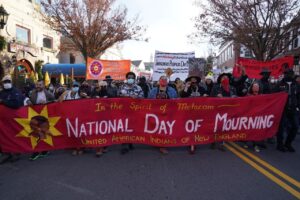
In light of the tragedy and evils of settler colonialism that many Indigenous people recognize and mourn during Native American Heritage Month, a preacher might ask: How do we hold thanksgiving and mourning together? In Matthew 14, this is something that Jesus himself faces, too.
A Tale of Two Meals
When we turn to Matthew 14, we can observe two different feasts, reflecting the values of two different “gospels” juxtaposed: one at the table of Herod (Matthew 14:1–12); the other with Jesus, shoreside with a crowd of 5,000 (Matthew 14:13–21). This is an interpretation that I learned from my friend, the Reverend Dr. Allen Buck (Cherokee).
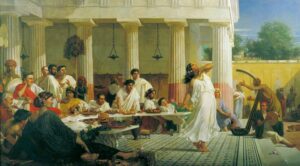
At the feast celebrating Herod’s birthday, which illustrates the “gospel of empire,” there is a meal of taking—in particular, John the Baptizer’s life is taken, when Herod and his wife Herodias’s power and status are threatened. Herod had just arrested John for publicly decrying as unlawful Herod’s marriage to his brother’s wife. Herodias’s daughter, Herod’s biological niece and adopted daughter, dances for Herod, and in appreciation of her performance, he promises her anything, up to half his kingdom. After consulting with her mother, the daughter asks for John’s head on a silver platter: a perverse meal of thanksgiving that reflects what a gospel of empire serves at its feast. The fear of scarcity of power and prestige takes a dark turn that senselessly consumes human life.
Whereas, on the grassy slopes beside the shore, there is a meal of giving and thanksgiving that illustrates the gospel of Jesus. This meal, we should be reminded, comes on the heels of Jesus learning about his cousin John’s murder and his attempt to mourn in solitude. Perhaps Jesus had intended to return to the same place where he had his wilderness vision, which ignited his ministry after his cousin John baptized him at the River Jordan. This is a difficult time for Jesus, certainly not a time when he wants to be around others, let alone teach and heal others. And yet, it doesn’t seem like he gets much time beyond his boat ride to process his grief and trauma before the people come with their sick, pleading for help. What did Jesus think when he first saw the crowd?
Something in Jesus clicks, and his compassion compels him to heal and to teach. Something in the people clicks too or, rather, rumbles in their stomachs as they notice their hunger for not just spiritual sustenance but also a meal. The disciples recommend sending the people home, but Jesus responds that there is always enough among God’s people. Finding five loaves and two fish, Jesus lifts them up to the Lord, gives thanks to Creator for this gift, and shares them with his disciples, who share them with the people, who share with others.
Here, God feeds God’s people in a kind of thanksgiving meal. Moreover, God’s people feed people. No one needs to go anywhere, since Jesus and his people will feed out of the abundance of their generosity. What is available in our wildest imaginations of heaven is already available to us in an overflowing abundance if we will only share with thanksgiving in our hearts.
In contrast to a gospel of taking and empire, Jesus’s gospel gives out of thanksgiving. It is a thanksgiving meal that arises amid tragedy and mourning; it is healing and processing that occurs over a meal. This story illustrates how thanksgiving meals can help move us toward Creator’s harmony and peace amid the chaos and trauma of our histories and lives.
This Thanksgiving, we are invited, even in the midst of mourning, to give thanks and to sit with our thanksgiving stories. We are called to remember, to appreciate, and to honor all our relations and treaties/covenants that maintain harmony and all the good things we enjoy in common.
Notes
- This article is part of the six-part series, Preaching the Bible on Turtle Island.


_-_Herod%27s_Birthday_Feast_-_587_-_Guildhall_Art_Gallery.jpg#/media/File:Edward_Armitage_(1817-1896)_-_Herod's_Birthday_Feast_-_587_-_Guildhall_Art_Gallery.jpg)