

Commentary on John 19:16b-22

[NOTE: If you are looking for material with connections to John 12, Jesus’s Triumphal Entry, please see this April 10, 2022, commentary by Lindsey Scott.]
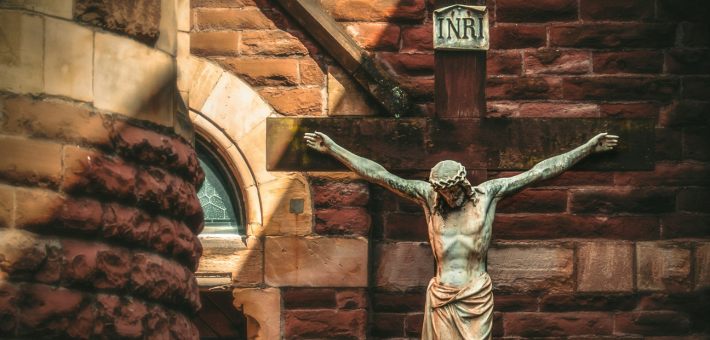
While all four Gospels mention that Jesus is crucified beneath a sign designating him “King of the Jews,” John’s Gospel gives special attention to this detail. Pilate dismisses the concerns of the chief priests who object to the inscription, insisting that he will have the last word on the matter. In John’s telling, Pilate ensures that the sign is written in Greek, Latin, and Hebrew—the three languages most common to the region. It is particularly galling that after a night of such craven concession to the demands of priests and crowds, Pilate finally finds his backbone here.
The text is unclear about why he insists on this sign. Perhaps it is one last way to exert his authority over the troublesome priests, or perhaps he wants to ensure that the dissuasive power of crucifixion reaches its maximum impact: This is what happens to those who claim kingship in the Roman Empire. Let no one mistake the consequences of this claim.
More important than Pilate’s motives, however, are the Gospel writer’s intentions. Pilate is portrayed as one caught between the demands of competing political constituents and therefore forced to make an agonizing decision. But the reader already knows the decision Pilate will make. The political tension Pilate feels does not translate into narrative tension. Jesus has already told everyone that he will be “lifted up.” The reader has come to understand that the cross is an inevitability. Pilate’s agonizing decision, then, creates the conditions for a rich theological irony.
Neither Pilate nor the priests believe that Jesus is the “King of the Jews,” but for John, this is exactly what he is. And this message is translated into three languages so that the whole world might know this truth.
In his groundbreaking work Mimesis, literary theorist Eric Auerbach discusses the ways in which the passion narratives undermine classical literary expectations. Using Homer as his classical archetype, Auerbach argues that meaning among the Greeks and Romans was hierarchically distributed. Gods and heroes were worthy of elevated poetry, while the common experience of the peasant or the day laborer was reserved for trivial modes of speech.
The passion narrative of Jesus, then, is a scandal to expected literary conventions of the ancient Near East. Jesus is sentenced to die like a slave; he is beaten and mocked and crucified between two criminals whom John barely mentions. The story is told plainly. The narration is restrained, and there is no spectacular speech that points to the meaning of the moment. All we get is bureaucratic bickering about the sign placed above the man unjustly killed.
In John’s Gospel, the voice that spoke the universe into being dies a degrading and painful death, and the narrative provides only an oblique reference to the truth of the moment: “Jesus of Nazareth, the King of the Jews.” There is no attempt to transform suffering into aesthetic pleasure, and no effort to give the events a noble or elevated tone. John’s Gospel dignifies the ignored and mundane lives of the lowly by pointing to this terrible moment as an instance of the sublime. Christ’s death then assures us that the degradation of human life is never a trivial matter. It is, instead, precisely the place where God’s truth and grace find their fullest voice.
In Flannery O’Connor’s short story “A Good Man Is Hard to Find,” Bailey decides to take his family on a road trip south from Georgia to Florida. Bailey’s mother—always called “the grandmother” in the story—tries to convince him to go to Tennessee instead. She tells him that a convict called the Misfit has escaped from prison and is headed to Florida. Bailey ignores her, and the family sets off on their trip. The grandmother takes her place in the back seat, wearing her best clothing so that if she is killed, she will be recognized as a Southern lady.
As the story unfolds, the grandmother reveals herself to be vain, racist, and manipulative. She is obsessed with class and status and holds only self-interested religious ideas. In a cruel twist of fate, Bailey crashes the car into a ditch down a country road. The crash is witnessed by three strange men, one of whom is the escaped convict, the Misfit. After being recognized by the grandmother, the Misfit instructs the other men to execute the family. Bailey and his family are led into the woods, where moments later, gunshots are heard. The Misfit is left alone with the grandmother.
Their ensuing conversation is among the most important in American literature. They speak about the nature of justice and the power of Christ. And in a moment of clarity, the grandmother reaches out to him and says, “Why, you’re one of my babies, one of my own children.” As she touches the Misfit’s shoulder, he recoils and shoots her three times. After the two men return from the woods, the Misfit remarks, “She would have been a good woman … if it had been somebody there to shoot her every minute of her life.”
O’Connor’s genius is born from the genius of the Gospel writers. The highest meaning is found in a moment of terrible, depraved tragedy. The grandmother’s one moment of theological clarity occurs in a ditch and in front of a gun. This is not an epic moment of insight or an aesthetically attractive display of grace. O’Connor does not sentimentalize the moment. And yet, in this scene we witness a radical rupture of grace and meaning, nonetheless. Grace erupts into the world from the site of a terrible wound.
This is the scandal of the Gospel. Grace is ultimately more powerful than sentimentalized stories that occlude the true reality of those close to death. In his direct way, John is signaling that through Jesus, the divine breaks through even the most degrading and horrible moments. God is not found in spectacle, but in moments of radical vulnerability. For John, even Pilate, unbeknownst to himself, can find a way to speak the truth in history’s bleakest moment.
PRAYER OF THE DAY
God of honor and celebration,
Together we cry, “Hosanna!” to your son, who rode willingly and bravely into Jerusalem. Hear us as we celebrate your anointed one, Jesus Christ. Amen.
HYMNS
My song is love unknown ELW 343, H82 458, NCH 222
All glory, laud, and honor ELW 344, H82 154, 155, UMH 280, NCH 216, 217
At the name of Jesus ELW 416, H82 435, UMH 168
CHORAL
Hosanna to the Son of David, Luc Jakobs

March 29, 2026