

Commentary on Ruth 1:1-22

Series Overview
This sermon series explores the two biblical books named for women: Ruth and Esther. Though very different in setting and tone, the two books have this in common: Each highlights the courage of strong women, illustrates the ways in which human love and loyalty effect change, and hints at a hidden divine faithfulness that works behind the scenes to create hope and new life.
Ruth is a story set primarily in the village of Bethlehem, where two widows and a farmer go about their ordinary lives, while exhibiting a kind of devoted human love that reflects God’s love. It is a rich text for a sermon series, particularly in the early summer, when farm fields and gardens are sprouting with the promise of an abundant harvest. Themes of emptiness and fullness abound in this little book: famine turning to abundant food, loss turning to love, bitterness turning to joy, barrenness giving way to birth. And the improbable catalyst for all this is Ruth, neither king nor prophet, but only a widow and a foreigner. This little domestic tale is a story of God’s hesed, God’s covenant love, lived out in the lives of everyday, ordinary human beings.
The book of Esther, by contrast, is a story set hundreds of years later in the royal city and court of Susa, the capital of imperial Persia (modern-day Iran). The people who populate this story are the king of Persia and his courtiers, as well as his Jewish queen, the beautiful Esther. The tone of this tale is over-the-top farcical humor—the king is a buffoon who is played by those around him. And yet, this buffoonish ruler holds absolute power over his subjects, which is bad news for those on the margins: in this case, Esther’s people, Jews living in diaspora across the vast Persian Empire.
Despite their differences, the two stories have a few things in common: God does not speak to anyone in either book. In fact, in the book of Esther, God is never mentioned at all.1 And yet, in both books, God’s hand in events can be discerned by those with eyes to see. In both stories, too, the namesake of the book is called to act with courage in order to preserve her family (in the case of Ruth) and her people (in the case of Esther).
We suggest that the first four weeks of the sermon series be devoted to the book of Ruth. It is a story in four acts, and lends itself well to a four-part sermon series. (For an example of such a sermon series on Ruth, see the Spring 2013 issue of Luther Seminary’s journal Word and World.) The book of Esther could easily take up more than two weeks, but the two portions chosen for this series highlight some important themes in the book: the call and the courage to act, and the reversal of fortune brought about by the hand of hidden providence.
We wish you blessings as you embark on this sermon series that explores two lesser-known but rich gems of the biblical canon.
Week 1 (5/31/26): Loss and Loyalty
Preaching text: Ruth 1:1–22; accompanying text: Matthew 5:3–9
The first chapter of Ruth sets up the story that follows. “In the days when the judges ruled” (1:1) refers back to the time of the judges, a time of chaos and disobedience in Israel. In fact, the verse just previous to this (the last verse of the book of Judges) reads, “In those days there was no king in Israel; all the people did what was right in their own eyes” (Judges 21:25). Doing what is right in your own eyes is never a good thing in the Bible, and indeed, the book of Judges traces a story of decline and anarchy in Israel.
Set against this backdrop of national calamity, a more personal calamity comes upon Naomi and her family. Famine in the “house of bread” (the literal meaning of “Bethlehem”) forces them to migrate to Moab. There, the deaths of her husband and two sons leave Naomi bereft, empty. The preacher may choose to focus this week on Naomi, who is one of the main characters in the book. No doubt there will be many in the congregation who can relate to Naomi’s loss and disappointment, her grief and bitterness. She speaks honestly, and the preacher would do well to acknowledge her loss.
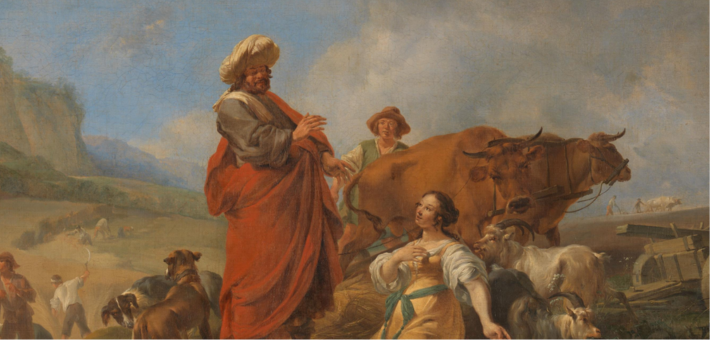
Here in Ruth 1, of course, is the most famous passage in Ruth: “Do not press me to leave you or to turn back from following you! Where you go, I will go; where you lodge, I will lodge; your people shall be my people, and your God my God” (1:16). The bitterness of Naomi is not the whole of the story. Ruth’s loyalty, Ruth’s love for her mother-in-law holds the promise of something more, as does the final verse of this chapter: “They came to Bethlehem at the beginning of the barley harvest” (1:22). Naomi is empty (1:21), but faithful Ruth is right beside her, and the harvest is coming.
Week 2 (6/7/26): Gleaning and Hope
Preaching text: Ruth 2:1–23; accompanying text: Luke 6:36–38
In the second act of this play, Ruth goes out to glean barley to sustain herself and Naomi, and “as it happened, she came to the part of the field belonging to Boaz” (2:3). “As it happened” could be interpreted here to mean that God is at work behind the scenes. Boaz is a pillar of the community (whose name is also used for one of the pillars of the Temple) who just happens to be related to Naomi’s dead husband.
God does not speak from burning bushes in this book; nor does God divide the sea. Instead, God acts through circumstance, and through the faithfulness of ordinary human beings. God’s hesed is embodied in human action. Boaz praises Ruth for her loyalty to her mother-in-law (2:11) and then enacts through his generosity the blessings of God that he calls down upon her: “May the LORD reward you for your deeds, and may you have a full reward from the LORD, the God of Israel, under whose wings you have come for refuge” (Ruth 2:11–12).
Naomi sees the astonishing amount of barley that Ruth has gleaned (something like 30 pounds) and finds out that it is Boaz who has helped Ruth. And it is only then that Naomi begins to move from despair to hope. She recognizes in this turn of events the hand of God, and she is quick to name God as the source of blessing: “Blessed be [Boaz] by the LORD, whose kindness (hesed) has not forsaken the living or the dead!” (Ruth 2:20).
The tide is turning. Emptiness is being filled. Hope is born. And it is an old widow—one who has seen more than her share of sorrow—who recognizes the hand of God in these seemingly happenstance circumstances. Perhaps it is often thus: Those who have had long experience of seeing God at work can recognize and name those times in our own lives when miracles begin to happen.
Week 3 (6/14/26): Daring to Act
Preaching text: Ruth 3:1–18; accompanying text: Matthew 7:7–8
Some time later, Naomi takes matters into her own hands. She instructs Ruth, “Now wash and anoint yourself, and put on your best clothes and go down to the threshing floor; but do not make yourself known to the man until he has finished eating and drinking. When he lies down, observe the place where he lies; then, go and uncover his feet and lie down; and he will tell you what to do” (Ruth 3:3–4).
A few things to note about this chapter:
- Yes, “feet” sometimes is a euphemism in the Bible. But “feet” are also sometimes just feet, and there’s no way to know for sure what’s meant in this passage. In any case, there are obviously some sexual overtones to this chapter. Ruth comes to Boaz by night at the threshing floor. She lies down beside him, uncovering some part of his body. She spends the night there and leaves before dawn. On the other hand, it must be noted, there’s no explicit mention of sexual relations here (as there is, for instance, in 4:13). Some things are best left to mystery.
- The more important matter has to do with the boldness and integrity exhibited by both Ruth and Boaz.2 Naomi says, “Uncover his feet and lie down; and he will tell you what to do” (insert knowing laughter here). But, in fact, when Boaz wakes up in surprise to discover a woman lying beside him, it is she who tells him what to do: “I am Ruth, your servant; spread your cloak over your servant, for you are next-of-kin (goel)” (3:9). To “spread one’s cloak” over a woman is to marry her. Ruth, in other words, proposes to Boaz! And she calls him to fulfill his duty as the goel. A goel is a close male relative who is obligated in Israelite law to redeem his kin who have fallen onto hard times (Leviticus 25:25, 35–38, 47–49).3
- Boaz promises that he will do all that Ruth asks. Her faithfulness to her mother-in-law is matched by Boaz’s own faithfulness. And, it is worth noting, this foreign widow mirrors God’s own faithful love, God’s hesed. Boaz says, “May you be blessed by the LORD, my daughter; this last instance of your loyalty (hesed) is better than the first; you have not gone after young men, whether poor or rich” (3:10). Ruth has chosen (apparently older) Boaz, and they find new life in each other.
Love and faithfulness abound, as much as the piles of grain at the threshing floor, and blessings overflow into the lives of those who once were empty.
Week 4 (6/21/26): New Life
Preaching text: Ruth 4:1–22; accompanying text: Luke 1:46–55
The scene at the city gate (where legal proceedings are conducted) is a humorous one. The nearer relative, the potential goel with whom Boaz speaks, is never named, which is entirely appropriate since he refuses to carry on the name of Mahlon (Ruth’s dead husband). Boaz calls him “paloni alimoni” (not, as the English text says, “friend”), which is the Hebrew equivalent of “Joe Schmo” (4:1). He is enthusiastic about acquiring more land but suddenly remembers a previous appointment and makes himself scarce when Boaz says that marrying Ruth is part of the bargain. So, having fulfilled all righteousness, Boaz receives the community’s blessing on his marriage to Ruth.
Ruth conceives and bears a son. Where there was famine, now there is a plentiful harvest. Where there was barrenness (in her marriage to Mahlon), now there is birth. The women of the village interpret this blessing for Naomi: “He shall be to you a restorer of life and a nourisher of your old age; for your daughter-in-law who loves you, who is more to you than seven sons, has borne him” (4:15). It is a remarkable statement in a patriarchal culture—Ruth is Naomi’s greatest blessing.
“Then Naomi took the child and laid him in her bosom, and she became his nurse” (4:16). The rabbis, noting that the Hebrew word translated here often means “wet nurse,” said that a miracle happened, that Naomi’s old and withered breasts were suddenly plump and round with milk, and that she nursed the child herself.
Abundant harvest, overflowing blessings, new life where before there was only emptiness—all of it is made possible through the hesed of God, enacted by Ruth and Boaz: everyday, ordinary people who demonstrate extraordinary love and faithfulness.
One last note: The book of Ruth ends with a genealogy. This child, Obed, will be the grandfather of David, Israel’s most beloved king. Here is where the story of Ruth leaves us, with the promise of God’s faithful love, God’s hesed, overflowing not just into the ordinary, everyday lives of two widows and a farmer, but into the lives of all Israel and, through David’s greater Son, into even our own lives as well. Blessing upon blessing, heaped up, overflowing. Thanks be to God!
Week 5 (6/28/26): For a Moment Like This
Preaching text: Esther 4:1–17; accompanying text: Luke 9:23–24
The fourth chapter of the book of Esther is, arguably, the turning point of the book, but the preacher would be well advised to summarize the story up to this point in order to put the passage in its context.4
The book opens with a portrait of a foolish and hedonistic king of Persia, Ahasuerus, who throws a party that lasts six months. When his queen, Vashti, refuses to parade herself before his drunken guests, this foolish and impulsive king is persuaded by his officials to banish her and do an empire-wide search for a new queen. Esther, a beautiful Jewish orphan raised by her cousin Mordecai, is chosen, but Mordecai advises Esther not to reveal her Jewish identity.
Enter Haman, the real villain of the story, who is appointed the king’s right-hand man. Angered because Mordecai refuses to bow down to him, Haman determines to annihilate all the Jews. He persuades the king to sign a decree to that effect, and the decree is sent throughout the whole Persian Empire, designating a particular day, the 13th of Adar, “to destroy, to kill, and to annihilate all Jews, young and old, women and children … and to plunder their goods” (Esther 3:13).
This is where the passage for this week comes in. Mordecai sends word to Esther about the decree. At first, Esther is hesitant to intercede with the king. No one is allowed in the throne room uninvited, on penalty of death, and the queen is no exception. Mordecai then calls on Esther to take up her cross, in a manner of speaking:
Do not imagine that because you are in the king’s palace, you alone of all the Jews will escape with your life. For if you indeed keep silent at this time, relief and deliverance for the Jews will arise from another place, but you and your father’s house will perish. Who knows? Perhaps you have come to royal power for just such a time as this. (Esther 4:13–14)
Many commentators, ancient and modern, have interpreted the phrase “another place” as an oblique reference to God. How can Mordecai be so sure that the Jews will be saved? Because they, like Esther herself, seem to attract a kind of mysterious divine favor, unexplained but indisputable.
A sermon on this story could build on this insight to talk about the ways in which God’s activity in our daily lives looks more like God’s activity in Esther than in Genesis or Exodus. Not many of us encounter angels coming to dinner or a burning bush, but eyes of faith can see God’s hand at work in the seemingly happenstance circumstances of life. Esther, out of all the women in the empire, just happens to become queen at a time when her people need her.
The preacher might also highlight the way in which Esther’s privileged position comes with great responsibility. Like her ancestors Abraham and Sarah, called out of obscurity into God’s saving work, Esther is blessed not for her own sake but in order to be a blessing (Genesis 12:1–3). She is called to risk her own life for the sake of her people, and she answers that call by taking charge of the situation and accepting the danger that her action entails: “I will go to the king, though it is against the law; and if I perish, I perish” (4:16). In their baptisms, Christians, too, are called to be a blessing in the world, even (or especially) when that call is risky.
Week 6 (7/5/26): From Sadness to Joy
Preaching text: Esther 7:1–10; 9:1–2, 20–22, 29–32; accompanying text: Luke 1:68–72
This week, the preacher should, again, fill in the details of the story. Esther invites King Ahasuerus and Haman to two banquets. On the night between the banquets, the king has insomnia. He asks for the annals of the kingdom to be read to him, and as it happens, the record he hears is about a time when Mordecai saved his life. He decides to reward Mordecai and asks Haman (who has come to the royal residence to ask for permission to kill Mordecai) how he should reward a man “whom the king wishes to honor.” Haman thinks to himself, “Whom would the king wish to honor more than me?” (6:6). He tells the king to throw a parade for the honoree, and then, humiliated, he is made to do that very thing for Mordecai, his sworn enemy.
The second banquet, then, is where Esther reveals herself as a Jew and Haman as the enemy of the Jews (chapter 7). The king is enraged and has Haman impaled on the ludicrously tall stake (75 feet tall) that he had built to kill Mordecai.5
The end of the book (chapters 8–10) describes a great reversal. At Esther’s urging, the king has another decree made that on the very day marked for the Jews’ annihilation, the Jews are to defend themselves against their enemies. They do so, killing 75,000 of those who hate them. This massacre is ethically troubling to moderns but seems to be a part of the hyperbole of the book, like the six-month feast and the 75-foot-tall stake. The humor of the book relies in great part on hyperbole and coincidence.
Coincidence is also important to the issue of divine absence in the book. God is never mentioned in the book of Esther. But out of all the women in the empire, Esther is chosen as queen. And out of all the annals that could be read to the king, the one chosen contains the story of Mordecai saving the king’s life. And when the king seeks advice on what should be done for Mordecai, Haman just happens to be present. And on the very day that the Jews were marked for slaughter, “the opposite happened” and they decisively defeat their enemies, turning that day “from sorrow to joy and from mourning to a holiday” (9:1, 22).
Jon Levenson, reflecting on the coincidences in the book of Esther, puts it this way: “It is … reasonable to assume that the author [of Esther] endorsed the old saw that ‘a coincidence is a miracle in which God prefers to remain anonymous.’”6
A coincidence is a miracle in which God prefers to remain anonymous. Beneath the humor of the book of Esther, there runs a kind of hopeful certainty—a certainty that against the odds, and by the hand of hidden providence, the Jews as a people will survive.
At the end of the book, a new holiday is established, Purim (9:18–32), which is still celebrated today. It is a time of revelry, celebrating the fact that in the face of genocidal hate, “the opposite happened” and the Jews survived. Eugene Peterson writes movingly about Purim:
Life together is celebrated as a joyous gift, snatched unbelievably from the gates of death and hell. A people who had faced the possibility of not being are emphatically alive. Community is not explained in historical terms, it is not analyzed in sociological terms, it is enjoyed in the language and rituals and food and laughter of a festival. …
The fact is that, decimated and dispersed as [Jewish communities] were, they were not swallowed up in the ocean of pagan power and culture and religion. They survived. By grace. The empire did not.7
The pharaohs and the Assyrians are no more. The Babylonian and Persian empires are no more. Czarist Russia and the Third Reich are the stuff of history. But the Jews have survived, and that sheer historical fact testifies to God’s faithfulness to God’s people. That divine faithfulness, hidden though it may be, is what undergirds the story of Esther and continues to inspire faith in those who read it—Jew and Christian alike.
Notes
- This is true in the canonical Hebrew book of Esther. In the Septuagint Greek version of the book, God sends dreams and hears prayers.
- Note that both Ruth and Boaz are referred to as people of integrity. Boaz is introduced in the narrative as an esh gibor hayil (a strong man of integrity) in 2:1, and he pronounces the community’s opinion of Ruth as an eshat hayil (a woman of integrity, a worthy woman) in 3:11. The latter phrase is also used of the ideal woman/wife in Proverbs 31:10, which in the Jewish ordering of the Hebrew Bible immediately precedes the story of Ruth.
- The law of levirate marriage is also being evoked here, the law that instructs a man to marry his brother’s widow if the dead brother had no children, and so to carry on the name of the dead man (Deuteronomy 25:5–6).
- For a much fuller treatment of the book of Esther than is possible here, see my article “Interpreting Divine Absence in the Book of Esther” in Word & World 46:1 (Winter, 2026): https://wordandworld.luthersem.edu/. Some of this brief commentary on Esther has been drawn from that article.
- Many English translations understand the Hebrew word describing the means of execution as a “gallows” rather than a “stake.” The word can be translated either way.
- Jon D. Levenson, Esther: A Commentary (Louisville, KY: Westminster John Knox Press, 1997), 19.
- Eugene Peterson, Five Smooth Stones for Pastoral Work (Grand Rapids: Eerdmans, 1980), 199, 214.


May 31, 2026