

Commentary on Esther 4:1-17

Week 5: June 28, 2026
Preaching text: Esther 4:1-17; accompanying text: Luke 9:23-24
The fourth chapter of the book of Esther is, arguably, the turning point of the book, but the preacher would be well advised to summarize the story up to this point in order to put the passage in its context.1
The book opens with a portrait of a foolish and hedonistic king of Persia, Ahasuerus, who throws a party that lasts six months. When his queen, Vashti, refuses to parade herself before his drunken guests, this foolish and impulsive king is persuaded by his officials to banish her and do an empire-wide search for a new queen. Esther, a beautiful Jewish orphan raised by her cousin Mordecai, is chosen, but Mordecai advises Esther not to reveal her Jewish identity.
Enter Haman, the real villain of the story, who is appointed the king’s right-hand man. Angered because Mordecai refuses to bow down to him, Haman determines to annihilate all the Jews. He persuades the king to sign a decree to that effect, and the decree is sent throughout the whole Persian Empire, designating a particular day, the 13th of Adar, “to destroy, to kill, and to annihilate all Jews, young and old, women and children … and to plunder their goods” (Esther 3:13).
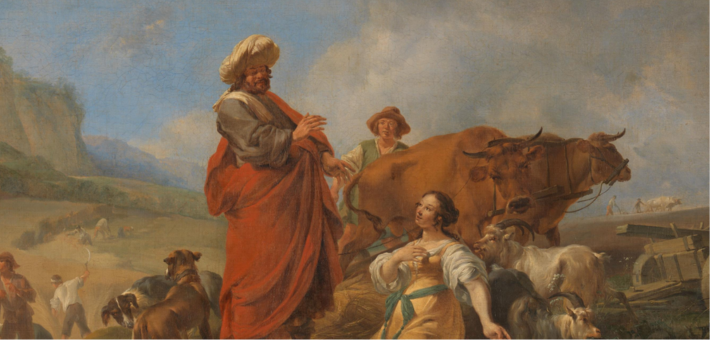
This is where the passage for this week comes in. Mordecai sends word to Esther about the decree. At first, Esther is hesitant to intercede with the king. No one is allowed in the throne room uninvited, on penalty of death, and the queen is no exception. Mordecai then calls on Esther to take up her cross, in a manner of speaking:
Do not imagine that because you are in the king’s palace, you alone of all the Jews will escape with your life. For if you indeed keep silent at this time, relief and deliverance for the Jews will arise from another place, but you and your father’s house will perish. Who knows? Perhaps you have come to royal power for just such a time as this. (Esther 4:13–14)
Many commentators, ancient and modern, have interpreted the phrase “another place” as an oblique reference to God. How can Mordecai be so sure that the Jews will be saved? Because they, like Esther herself, seem to attract a kind of mysterious divine favor, unexplained but indisputable.
A sermon on this story could build on this insight to talk about the ways in which God’s activity in our daily lives looks more like God’s activity in Esther than in Genesis or Exodus. Not many of us encounter angels coming to dinner or a burning bush, but eyes of faith can see God’s hand at work in the seemingly happenstance circumstances of life. Esther, out of all the women in the empire, just happens to become queen at a time when her people need her.
The preacher might also highlight the way in which Esther’s privileged position comes with great responsibility. Like her ancestors Abraham and Sarah, called out of obscurity into God’s saving work, Esther is blessed not for her own sake but in order to be a blessing (Genesis 12:1–3). She is called to risk her own life for the sake of her people, and she answers that call by taking charge of the situation and accepting the danger that her action entails: “I will go to the king, though it is against the law; and if I perish, I perish” (4:16). In their baptisms, Christians, too, are called to be a blessing in the world, even (or especially) when that call is risky.
Notes
- For a much fuller treatment of the book of Esther than is possible here, see my article “Interpreting Divine Absence in the Book of Esther” in Word & World 46:1 (Winter, 2026): https://wordandworld.luthersem.edu/. Some of this brief commentary on Esther has been drawn from that article.

June 28, 2026