

Commentary on Genesis 12:1-9

Genesis 12 begins a new set of stories, which differ from ones that came before. Genesis 1–11, called the Primeval Narrative, centers on God’s creation and near destruction of the universe. The rest of the book, Genesis 12–50, known as the Patriarchal (and I would add, Matriarchal) Narratives shifts the focus to God’s fledgling relationship with a particular family.
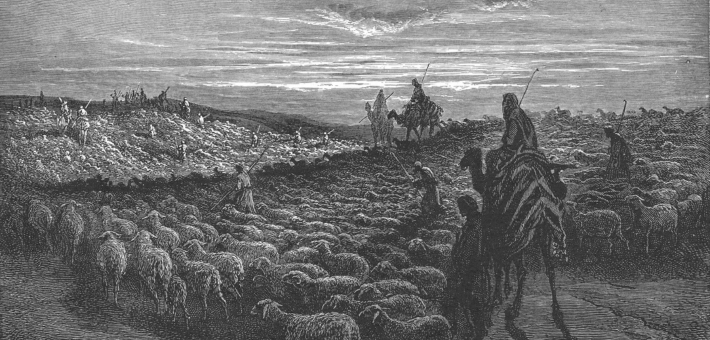
The founder of this family is Abram, whose name will later be changed to Abraham. Abruptly and without warning, God calls on Abram to move from his country, people, and father’s household (in other words, his family)—that is, to make a clean break with everything with which he is familiar.
In this, we can discern a poignant message about moving forward. As with Abram, we need to disentangle ourselves from the sticky pit of nostalgia. Only by doing so can we open ourselves up to the present and future that God has planned for us. To get stuck in the past, as Genesis 12 shows, is to stymie God’s call. It is to act in a manner opposite to Abram, who heeded God’s call to go forward, to head toward the future, toward something new and unknown.
For courageously leaving his past behind, Abram receives much more. By following this call, Abram receives a new country, a new people, and a new family. Or more accurately, through Abram, God will create a new country, a new people, and a new family. From Abram will stem three new religious traditions. Judaism, Islam, and Christianity all claim Abraham (Abram) as their forefather. For everything Abram leaves behind, he gets back exponentially more.
Millions of emigrants today replicate Abram’s call and journey. Like Abram, they move from the familiar to the unknown. They, too, like Abram, feel they are called to go to a new place. They, too, hope they will receive more for their journey: that life will become greater and better as a result of their voyage.
The hostility and danger that Abram and his family face in their path (Genesis 12–23) echo similar dangers faced and endured by emigrants and immigrants today. Though almost every great religious tradition centers on a journey undertaken by its founder, the world still bristles at immigrants and emigrants who mirror their hero’s trek.
In Abram’s voyage, he is not alone. Though Genesis 12 is known as Abram’s call, it should more correctly be known as Abram and Sarai’s call. Largely forgotten is that Abram’s household, especially his wife Sarai (later, Sarah), also makes this journey with him. And they do so even though God seems to prefer to only talk to Abram. Even more unfair is that God’s promises only concern Abram. God tells Abram that he will become a great nation, a great name, and a blessing for heeding God’s call (Genesis 12:2–3). But the blessings are only made to and pertain to Abram. Not until Genesis 17:19 is Sarai promised anything for her actions.
Sarai has to do everything that Abram does—and probably more so, as she is a woman. But unlike Abram, she does not get a conversation with God or any promise of blessings until much later. She does not even get consulted by Abram about the move. Such a journey, however, would have been especially dangerous for the elderly Sarah. She has no male heirs, and her husband is 75 years old. If he were to die on this journey, she would have little protection. Hence, if Abram is courageous and faithful, how much more is Sarai, who does all that God commands Abram to do but with little regard and little promise of reward?
Abram’s call and the journey that follows are also facilitated by a host of invisible characters. There is Sarai, as I just mentioned. There is also a coterie of staff, servants, and slaves, such as Hagar. Most never get a personal phone call from God. They are never consulted about the move from their homeland. And they are not thanked for their sacrifice and effort.
Genesis 12, therefore, raises questions about whose labor is acknowledged and appreciated and whose labor is ignored. Why is Abram lauded for his actions while those of Sarai and the laborers in his family remain ignored and unappreciated? Whose work and labors are similarly discounted and undervalued in today’s society? Despite the lack of acknowledgment and appreciation, Sarai and Abram’s servants do complete their journey. And Sarai, nine dramatic chapters later, will receive some kind of reward when she bears a son as a 90-year-old (Genesis 21).
The Patriarchal and Matriarchal Narratives, hence, begin with characters who are elderly—characters whom our ageist society would disregard and write off. The Bible pushes back at this assumption. According to the Bible, we are never too old to receive a call from God. We are never too old to do something new. We are never too old to change the world. God is not limited by our biases, prejudices, or assumptions.
God’s acts are also mysterious, the story suggests. Or to put it in more practical terms, we don’t know the future. A small act such as a journey to a new place by an elderly Middle Eastern couple ends up spawning three new religious traditions. We don’t know how God will use our small acts to alter the world.
We don’t know the future. And as such, the best we can do, according to Genesis 12, is to try our best. To not get stuck in the past, but to make faithful, kind, and courageous decisions in the present. To trust that, in so doing, we have a part to play in God’s unfolding salvific plan.
PRAYER OF THE DAY
God of covenant, you promised Abraham land, descendants, and blessing
so that he might be a blessing for all. Show us how to honor the covenant,
so that we might be a blessing to others. We pray these things in the name
of Jesus Christ, our Savior and Lord. Amen.
HYMNS
The God of Abraham praise ELW 831
A lamb goes uncomplaining forth ELW340
CHORAL
I give you my hands, Lord, Christopher Tambling



September 20, 2026