

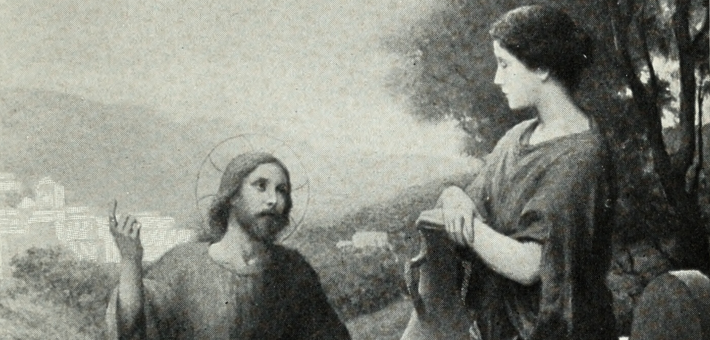
Commentary on John 4:1-42

In a blaze of light, Jesus encounters a woman of Samaria at a well. This story is presented in deliberate contrast to the earlier story of Nicodemus. The leader of the Pharisees comes in darkness, and by the end of his story in John 3, his belief is still suspect. Though he seems the most likely person to understand and receive Jesus, he leaves confused and uncommitted. On the other hand, Jesus encounters the woman at noon, the brightest part of the day, and though she is one of the people least likely to comprehend him, she receives what he offers with joy and becomes one of the first of his apostles by bearing witness to her whole community.
There has been a lot of conversation about the woman’s history, which Jesus knows in that way of knowing things he has in the Gospel of John. Coming to the well at noon is unusual behavior. It is work that would most likely have been done in the early morning or late evening, avoiding the heat of the day. This may well be a factor in the story: With the woman’s history of five husbands and now a live-in relationship, she is likely on the margin of her community.
But there is no reason to understand her, as so many have in the past, as a “loose” woman. Jesus never addresses her as someone who needs to repent from sinful ways. In the context of Scripture, it is much more likely that she has been passed unwillingly from husband to husband, perhaps through Levirate marriage. In first-century Palestine, women generally needed the support of a man to survive, and the law provided for this.
The text reminds us that Jews and Samaritans do not share things in common. There was a long and difficult history between the two nations. The Samaritans were the descendants of the northern 10 tribes of Israel. When they were conquered by the Assyrian Empire in 722 BCE, the elite were scattered in exile, but the common people were left to work the land for the Assyrian overlords sent to run the place. Over time, intermarriages took place. The Judeans (the Jews in John’s Gospel) saw Samaritans as a mixed race, not true descendants of God’s people.
The Samaritans did not understand themselves this way. They had their Scripture, the Samaritan Pentateuch, and they had their house of worship, established on Mount Gerizim when the kingdom of Israel split from the kingdom of Judah following Solomon’s death. Adding insult to injury, the Samaritans had not been supportive of Judah at the time of the Babylonian exile, and the Judeans had annexed territory and destroyed the Samaritan temple during the expansion of the Hasmoneans’ territory after 167 BCE. The two peoples despised one another. But this passage indicates that there was a successful mission of Christ-followers to the Samaritans. This would not have improved their relationship with the Judeans.
There is no other reference in Scripture to Jacob’s well, but its mention here draws a host of interesting echoes into the story. Readers/hearers recall the common ancestry of both the Jews and the Samaritans. We recall the stories of marriages resulting from encounters at wells. We are reminded, too, of the wedding feast at Cana, and just prior to this passage, in John 3:29, John the Baptizer refers to Jesus as the bridegroom. Love is in the air, but in this case, it is God’s love for all of God’s people.
Again, in contrast to Nicodemus, the Samaritan woman carries on a faith-filled conversation with Jesus. Themes of water, Spirit, and worship, which the reader/hearer has already encountered in John 2 and 3, resurface here. This is the first time Jesus uses the name of God (ego eimi) given to Moses at the burning bush, a striking feature of the Johannine narrative. And the woman, unlikely candidate that she is, understands.
She sees no sign, but she hears the words of Jesus and receives the living water—evidenced by her leaving her water jar—as she returns to share the good news with her community. The living water that she has received does gush up into eternal life: In keeping with the Fourth Gospel’s realized eschatology, the woman’s encounter with Jesus reintegrates her into her community as she testifies to him and they respond to her testimony and in turn come to faith in Jesus.
In John 4:4, the narrator tells us that Jesus is traveling from Judea back to Galilee and “had to” go through Samaria. An examination of a map of first-century CE Palestine shows that there were three likely routes between Judea and Galilee. The route through Samaria is the shortest and most direct, but probably not the most common. Since the text gives no indication that time was of the essence, it seems likely that this was a theological necessity, rather than a geographical one. The Greek word (dei) for “it is necessary” is used 10 times throughout the Gospel of John, including in speaking of the crucifixion in John 3:14.
Finally, it is interesting to note the contrast between Nicodemus as a named character and the Samaritan woman as unnamed. There may be lots of reasons for this, some historical, but the primary reason may be literary. A reader/hearer is more likely to identify with unnamed characters. Many literary devices used in John’s Gospel, including irony, lead the reader to be in sympathy with the woman of Samaria, unlikely example that she is, and thus more drawn to see Jesus as she sees him—as more than a prophet and, indeed, as the Messiah, the one sent from God to all of God’s people.
Preaching this week could center on how God uses unlikely messengers, perhaps even ourselves, to share the Gospel; the nature of eternal life as illustrated by living water and integration into community; or what it might mean to be thirsty—thirst is also a recurring theme addressed in the Gospel.
PRAYER OF THE DAY
God of life,
Shower us in your living water, bringing us to new life, fresh and clean. Walk with us as we share the knowledge of your living water with others, so that all might live. Amen.
HYMNS
For all the faithful women ELW 419
Take my life, that I may be ELW 583, 685, H82 707, UMH 399, NCH 448
O sons and daughters ELW 386
CHORAL
Give me Jesus, Larry Fleming

_(14576908547).jpg)
February 1, 2026