

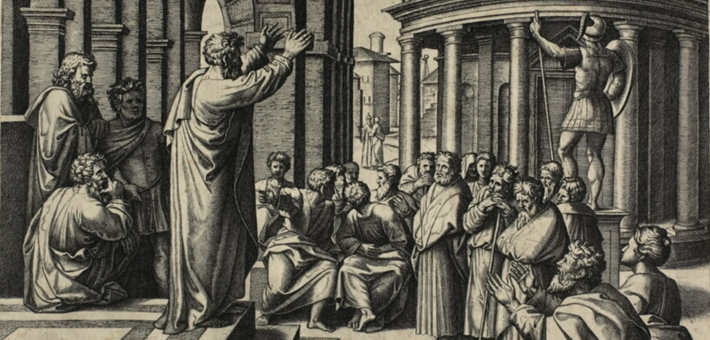
Commentary on Acts 17:16-31

In Acts 17:16–31, Paul arrives in Athens, faithfully proclaims God’s good news about Jesus and his resurrection, and rhetorically tailors his presentation of the gospel to his Athenian context.
Paul’s ministry
In each new location, Paul begins by proclaiming Jesus as the resurrected Messiah among Jewish people. Afterward, Paul turns to the Gentiles (for example, Acts 17:2–3; 17:10–11) and likewise proclaims God’s good news to them. So, like Paul in Romans 9–11, Luke never portrays God (or Paul) as writing off a group of people. Instead, throughout the New Testament, Jesus remains the Savior for everyone who believes and follows him (for example, 2:21; 10:34–43; 16:30–34).
Paul’s so-called “missionary journeys” do not follow precise itineraries or strategies as contemporary “mission trips” might. Instead of brief visits, Paul settles down in a community. Once there, Paul provides a faithful and ongoing witness of words and deeds, until he is compelled to move, frequently due to persecution (for example, 17:1–10a and 17:10b–14).
Arriving in Athens (17:15), Paul initially proclaims the good news among the Jews in the synagogue (17:17a). Luke, however, primarily focuses his readers’ attention on Paul’s reaction to and distinctive ministry among the Greeks in Athens (17:16–17). Although mainly raised and educated in Jerusalem (22:3), Paul was born in Tarsus and ministered in Gentile territories (Acts 13–28). Greek and Roman religious expressions were not new to Paul. Yet, here Paul reacts strongly when he encounters the Athenians’ extraordinary devotion to the gods (17:16).
Many Greeks and Romans believed the entire world belonged to the gods. As a result, humans inevitably trespass in the gods’ domain and run afoul of them, often without realizing it. Yet, Greeks and Romans generally sought to maintain or restore peace with the gods through ritual practices and the offering of gifts, which formed the core of Greek and Roman religion.
Paul is “distressed” by the lengths to which the Athenians have gone to honor their gods. They have invested an inordinate amount of time and money into the hope that the gods would reciprocate their kindness and show them favor. Paul enters the marketplace daily to speak with the Athenians about God’s good and gracious news as opposed to an economy of religious reciprocity (17:17). In the process, he engages with Epicurean and Stoic philosophers while resembling a Greek philosopher himself in his manner and the style of argumentation (17:18, 22–31).
Some listeners think Paul refers to two new gods, both Jesus and Resurrection, and they want to hear more (17:18–21). The Greek philosophers take Paul to the Areopagus, which likely refers to the rocky hill below and to the west of the Acropolis, upon which the Parthenon sits (17:19). However, it may also refer to a council of people in Athens who gather nearby.
When Paul speaks, he first describes what he has observed while living among the Athenians for several days (17:17). Rather than verbally attacking the Athenians, Paul initially seeks common ground with them. By dedicating an altar to an unknown god, the Athenians acknowledge that gods exist whose names they do not know (17:23). Paul wants to supply them with that name.
Paul’s speech to the Athenians differs considerably from his sermon to the Jews in Antioch of Pisidia (13:14–41). When speaking with the Jews, Paul refers to the God of Israel (13:17), recounts Israel’s story (13:17–41), quotes from the Hebrew Scriptures (13:33–35, 41), and emphasizes the idea that Jesus is the Savior and the Davidic Messiah (13:23, 26, 32–38). In Athens, however, when speaking with Greek philosophers, Paul refers to God as Creator (17:24–28), quotes Greek poets (17:28),1 and focuses on a God who acts graciously by overlooking human ignorance and granting forgiveness rather than requiring expensive gifts and acts of reciprocity as recompense (17:24–25, 29–31). In short, Paul adapts his presentation of the gospel to his audience.
Regardless of his rhetorical presentation, Paul adheres to the same gospel wherever he goes. In both speeches, Paul declares that humans are ignorant of God’s ways (13:18, 27–29; 17:23, 29–30), that God rescues and forgives people (13:17, 19–23, 26, 38–39; 17:28), that the resurrection authenticates Jesus’s identity as God’s Son (13:23, 30, 33–37; 17:31), and that belief, baptism, and repentance are the proper responses to this good news (13:24, 39; 17:30, 34).
Theological themes and modern application
- Paul’s differing presentations of the gospel to Jews in Antioch of Pisidia (13:16–41) and Greeks in Athens (17:22–31) remain instructive for Christians today. Paul sought to understand the people and the culture in which he resided. He sought to establish common ground and foster appreciation for others. As a result, he adapted his rhetorical style and his approach to ministry to the prevailing culture around him. Too often, Christians try to provide a witness to Jesus while undervaluing others and their cultures, at times even holding “others” in contempt. At the same time, Paul remained faithful to the central message that God’s salvation, in all its forms, is manifest through Jesus and cemented by Jesus’s resurrection from the dead. Christians are at their best when they cling to the truth of the gospel while embracing those around them.
- Paul’s speech in Acts 17:22–31 provides biblical warrant for the belief that all truth is ultimately God’s truth. Paul is not afraid to read, contemplate, or quote unbelieving Greek authors. Instead, Paul implies that those pagan authors have caught glimpses of God’s revealed truth, even if they do not know God’s name yet (17:27). Some Christians fear education, differing cultures, and dialogue with unbelievers. Paul is more concerned with understanding and proclaiming God’s truth than with isolating himself from the world around him.
- Throughout Acts, Luke highlights a proper human response to God, which includes belief, repentance, baptism, and the descent of the Holy Spirit, in no set order. Yet, the heart of the gospel in Acts 17 revolves around what God does for humans. Unlike the worship of the Greek and Roman gods, where humans seek to establish peace with the gods, Paul proclaims that the God manifest in the resurrected Jesus overlooks human ignorance and seeks to establish peace with all people.
Notes
- Paul appears to cite Epimenides of Crete and Aratus of Cilicia.
PRAYER OF THE DAY
God of the unknown,
Your mysteries are astounding. Give us knowledge where you see fit, and let us sit comfortably with that which we can never understand. Amen.
HYMNS
O Zion, haste ELW 668
He comes to us as one unknown ELW 737
There’s a wideness in God’s mercy ELW 587, 588, H82 469, 470, UMH 121, NCH 23
CHORAL
Make my life a living prayer, Aaron David Miller


May 3, 2026