

Commentary on John 4:46-54
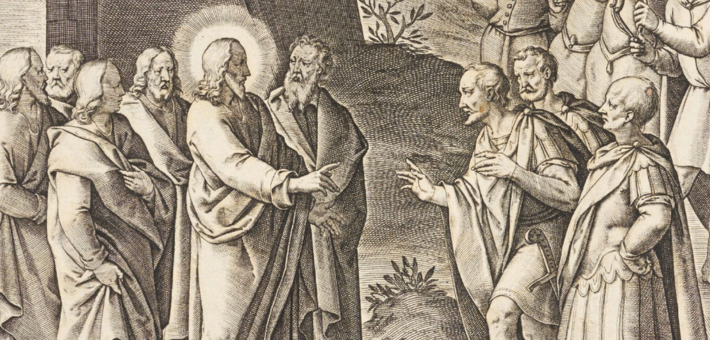
The healing story that follows Jesus’ encounter with the woman of Samaria takes place when he has arrived in Cana in Galilee.
The Narrative Lectionary skips over three short verses that deal with Jesus’ reception in Galilee. These verses suggest that, like Nicodemus, while there is some level of belief among the Galileans, this belief is suspect, based on the signs that the people had seen at the Passover festival (signs that are not detailed in John’s story of Jesus).
In keeping with this, when Jesus encounters the royal official (who many scholars suggest may be a Gentile), his answer seems a bit sharp. Jesus addresses him as one who wants to see more signs. When the man’s response is desperately sincere, Jesus sends him on his way with the promise that his son will live. The man believes, based on hearing the word of Jesus, and starts homeward, receiving confirmation, on the way, that what Jesus has said is true.
This healing story shows an ideal progression of belief, a pattern that will be repeated in the Gospel. Initial faith receives confirmation and becomes life-changing. The royal official shares his faith with his entire household. This long-distance healing appears to be part of healing traditions associated with Jesus, since it is reminiscent of the healing of the centurion’s son in Matthew 8:5–13 and Luke 7:1–20.
John 4:54 mentions that this is the second sign Jesus has performed. This leads some scholars to count the signs in John’s Gospel. This count usually yields seven signs, a number symbolic of completeness. Yet the numbering system does not continue throughout the Gospel, leaving some doubt as to which signs count and which don’t. Alternatively, many scholars note that this is the second sign that Jesus performs in Cana and that this second mention of Cana sets apart a literary section of the Gospel (the so-called “Cana to Cana” section), which spans John 2:1–4:54.
Demarcating this section makes sense when one considers that the encounters in these three chapters explore many of the same themes first introduced in the prologue: light versus darkness, the Spirit, being born from above by water and Spirit, living water gushing up to abundant life, and particularly coming to authentic faith—or failing to do so. In none of the encounters described in this section is there any mention of resistance to Jesus and his ministry, just some questioning. That lack of hostility will change dramatically as we move into chapter 5.
The Narrative Lectionary suggests that the preacher can address this healing story on its own or continue on to include the story told in John 5:1–18. If one wants to address this story alone, the possibilities might include the Gospel’s assertion that true faith responds to hearing Jesus’ words, not to seeing signs, and an exploration of how we hear God’s words today. Perhaps this can lead us to reflect on the enduring line from the film series The Santa Clause: “Seeing isn’t believing; believing is seeing.” We start with the Word of God and allow that to interpret our world, rather than the other way around.
Because the first healing story is part of the literary unit ending with John 4, and the story told in John 5:1–18 begins a new section, it might be best if the stories are taken separately. A sermon addressing both may need to be a study in contrasts.
It is important to notice the many differences between these two stories. The royal official approaches Jesus; the man by the pool of Bethzatha does not. The first healing takes place in Galilee and the second in Jerusalem. The healing in Cana/Capernaum takes place with little or no notice beyond the royal official and his family. The healing of the man by the pool takes place on the Sabbath and sets off a firestorm of opposition from “the Jews” (who can be read here as the Judean leadership, particularly those in charge of the Temple).
John 5:16 and 18 indicate that “the Jews” start to persecute Jesus to the point of wanting to kill him. The hostility comes from his disregard of their interpretation of Sabbath laws as well as his claim to be working on the Sabbath as his Father also works on the Sabbath—a claim that, for first-century Jewish people, can only be made of God.
The characters of the two recipients of the healing (the man by the pool and the father on behalf of his child) seem dramatically different. The father is willing to travel the extensive distance from Capernaum to Cana in hopes that Jesus can and will come and heal his son. His care for his child is immediately evident to Jesus, who heals the child in that instant. The man by the pool has not seemed able in 38 years to figure out how to be the first into the pool and, when asked if he wants to be made well, only responds with an excuse.
The father witnesses about Jesus to his family and brings them all to faith. The man by the pool, though we are not told his motivations, turns Jesus in to the Temple authorities and provokes the first of many trial scenes that take place between Jesus and his various opponents (John 5:18–46).
A sermon covering both healings might address the wideness of God’s generous love. Jesus heals the father’s son even though the father might not be one of God’s people. Jesus heals the man by the pool though he has done nothing to deserve it and, perhaps, some things that indicate he doesn’t. When Jesus encounters the man again in the Temple, he says, “Do not sin any more so that nothing worse happens to you” (John 5:14). What the man’s sin was is not indicated in the text. Was the Pool of Bethzatha a Gentile place, and the healing that occurred there magic? Was it the man’s lackluster attempts at getting into the pool and his contentment with being an invalid for 38 years? Or was it something else?
Regardless of the disparate circumstances and risks to himself, Jesus provides healing to both.
PRAYER OF THE DAY
God of miracles,
Sometimes we are slow to believe in your power, even when your miracles occur all around us each and every day. Open our eyes to see and our hearts to believe. Amen.
HYMNS
I’ve just come from the fountain (trad.)
On my heart imprint your image ELW 811
Go, my children, with my blessing ELW 543
CHORAL
There is a balm, trad.


February 8, 2026