

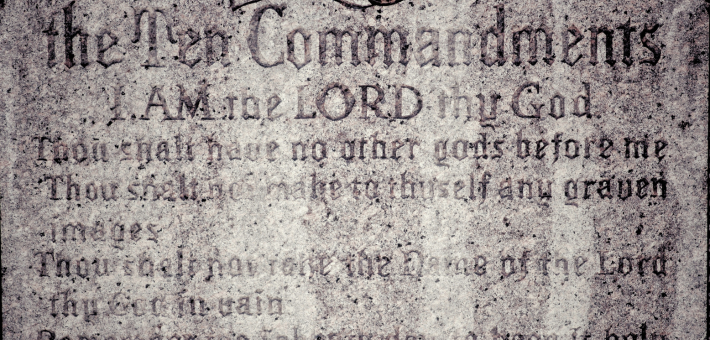
Commentary on Exodus 19:3-7; 20:1-17

Three aspects of God’s recurring promises to Israel’s ancestors in Genesis (for example, Genesis 12:1–3; 13:14–17; 15:5–6; 28:13–15) begin to be fulfilled in the book of Exodus.
1) Israel experiences significant population growth in Egypt (Exodus 1:1–3; 12:37).
2) The Lord rescues the Israelites from slavery in Egypt so they are freed to travel back to the promised land of Canaan (Exodus 3:7–10; 12:29–51; 13:3–5; 23:23–33; 33: 34:11).
3) The Lord makes a formal covenant relationship with Israel with instructions and promises (Exodus 19–24), including the promise to be visibly present but veiled in a “pillar of cloud by day” and “a pillar of fire” by night in the midst of the Israelites on their journey into the future (Exodus 13:20–22; 29:46).
God’s Covenant People—Holy and Priestly (Exodus 19:3–7)
After having rescued Israel out of Egypt and leading them through the wilderness for three months (Exodus 19:1), God brings the Israelites and their leader Moses to Mount Sinai (elsewhere known as Mount Horeb or the “mountain of God”—Exodus 3:1; 4:27; 18:5; 24:13). This was the same mountain at which God initially called Moses from the burning bush to lead Israel out of Egypt (Exodus 3:1–10). Mountains in the ancient world were often depicted as divine dwelling places. From atop Mount Sinai, God mediates to Moses a formal covenant with the people of Israel. Covenants establish committed relationships of promises and obligations, gifts and duties.
God reminds the Israelites of what God has already done as a gift to them. God freed them from “the Egyptians,” bore them safely “on eagles’ wings” through the wilderness, and brought them “to myself” here at Mount Sinai (Exodus 19:4). If Israel “obeys” God’s voice and keeps God’s “covenant” out of thanksgiving for what God has already done for them, then Israel will be God’s “treasured possession out of all the peoples.” Of course, God tells Israel, you need to remember that “the whole earth” is God’s! What God is doing with God’s people is ultimately for the blessing of “all the families of the earth” (Genesis 12:1–3).
In order to accomplish that goal, however, God has chosen the Israelites to be “a priestly kingdom and a holy nation” (Exodus 19:6). For Israel, to be “holy” is to be set apart and dedicated by God to a particular function or vocation. To be “priestly” is to mediate blessings from God to others. Those blessings are for God’s own people but also for the “whole earth,” an earth that also belongs to God. As the people of God, we must recognize that our mission field is not just “us” but also “them,” not just our own “nation” but the “whole earth.” It is this image of God’s people as a “holy priesthood” and a “kingdom of priests” that is later applied to the Christian community (1 Peter 2:5; Revelation 1:6).
The Ten Commandments (Exodus 20:1–17)
God’s covenant has two sides—what God does for the people, and what God’s people are expected to do in response. God lists the Ten Commandments as the first and most important set of expectations (20:1–17). God adds more specific instructions and laws in the Book of the Covenant (20:22–23:19). Many other laws occur elsewhere in Exodus, Leviticus, Numbers, and Deuteronomy. In fact, Judaism traditionally counts a grand total of 613 laws in the Pentateuch or Torah (Genesis–Deuteronomy).
The Ten Commandments, however, are the first and most important of all the instructions that God gives at Mount Sinai. They are the only commandments that God speaks directly to the people; all other laws are mediated through Moses to the people (20:1, 18–20). The form of the Ten Commandments is unique from the other biblical laws: a list of 10 short, direct commands. The commandments are the only laws “written with the finger of God” (Exodus 31:18) on two stone tablets (Exodus 24:4, 12; 34:1, 28; Deuteronomy 4:13; 5:22; 10:4). The Ten Commandments are repeated prominently in Deuteronomy 5:6–21. The stone tablets with the Ten Commandments are placed in a special wooden chest or ark (Deuteronomy 10:1–3).
The Essential Prelude to the Commandments (Exodus 20:2)
Before any commandments are given, the Ten Commandments begin with God providing an essential first word: “I am the LORD your God, who brought you out of the land of Egypt, out of the house of slavery” (Exodus 20:2). God declares that God is already Israel’s God—and Israel is already God’s people!—even before the commandments are given. The Ten Commandments are not the pre-condition for the covenant relationship with God. The commandments are the guide to how God’s people will best flourish as a community within their relationship with God that already exists.
Three Categories of Commandments
The Ten Commandments include three groups of laws: obligations to God (verses 3–7), obligations to other human beings (verses 12–17), and one obligation that interweaves obligations to God, other human beings, and nonhuman creation (verses 8–11).
The first set of commandments prohibits the worship of other gods or idols and the “wrongful use of the name of the LORD your God” (20:3–7). While at Mount Sinai, the Israelites worship a golden calf—an act that breaks these first and most important obligations to God (Exodus 32). Moses pleads with God not to destroy the Israelites for their sinful rebellion (32:7–14). Moses also convinces God to pledge that God’s presence will continue to “go with us” (33:12–17).
All of this is possible not primarily because the people repent or change. All of this is possible because of who God is at God’s deepest core. On Mount Sinai, God reveals to Moses a deeper revelation of the name and character of God (33:1–34:28). God is definitively revealed to be a God who is, above all, “merciful and gracious … slow to anger … forgiving iniquity and transgression and sin” (34:5–7). Even so, there will also be consequences to disobedience (34:7).
The second group of commandments involve obligations to other humans (Exodus 20:12–17). The community flourishes when elders are honored, life is enhanced, fidelity is encouraged, truth is told, and property and relationships are protected. The commandments tell us not only what not to do. Each negative commandment (“you shall not…”) also implies a flipside of positive obligations to our neighbors.
The third category of commandments is the Sabbath commandment, which combines obligations to God, to other humans, and to nonhuman creation. The friendly command to rest every Sabbath or seventh day stands at the center of the 10 commands and is the longest of all the commandments (20:8–11).
The Sabbath day is a weekly offering of time dedicated to the worship and praise of God. It is also a regular day of rest for workers and “the alien resident in your towns.” The Sabbath is also a creature-friendly day of rest for “your livestock” (see the sabbatical rest also required for “the land” to replenish itself in a sustainable way in Leviticus 25:1–7). This Sabbath command is grounded in the model of God the Creator, who felt free to take a day off from the work of six days of creation (Exodus 20:11; see Genesis 2:1–3).
PRAYER OF THE DAY
God of the commandments, you gave the Israelites laws so that they might live in harmony with one another. Show us how to live in peace, so that all may know of your love. We pray these things in the name of Jesus Christ, our Savior and Lord. Amen.
HYMNS
Spirit of God, descend upon my heart ELW 800, UMH 500, NCH 290A
On Eagle’s Wings ELW 787/various
CHORAL
Give us the wings of faith, Ernest Bullock

October 11, 2026