

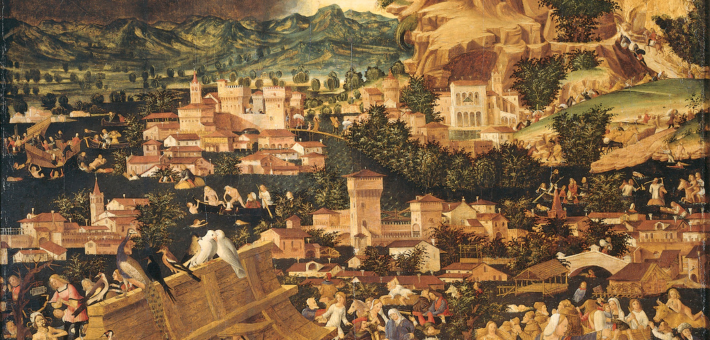
Commentary on Genesis 6:5-22; 8:6-12; 9:8-17

The Bible’s first creation story as prelude to the flood story
The story of Noah, the flood, and the promise of the rainbow in Genesis 6–9 is God’s “do-over” of the first creation of the world back in Genesis 1–2. The Bible’s first creation story had begun with the cosmos in “complete chaos” (Genesis 1:2). Darkness covered the face of “the deep” (deep waters). No light. No order. No life. But then “a wind (Hebrew ruakh: “wind,” “spirit,” “breath”) from God swept over the face of the waters.”
God began directing a symphony of light, order, boundaries, flourishing life, creatures of all kinds, vocations, relationships, co-creative responsibilities, and blessing—a veritable garden of life teeming with possibility, hope, and promise. God’s gracious generosity and hospitality welcomed into existence a whole new creaturely world, a world different from God but a creation in relationship with God.
True relationship requires a degree of freedom and agency on both sides, both human and divine. While God assessed God’s creation at the beginning as “very good” (Genesis 1:31) but not perfect, possibilities existed for wrong choices and negative consequences. Tragically, humans were tempted to become “like God” (3:5). They experienced temptation, fear, distrust, shame, and a tendency to transfer blame to others rather than oneself (3:8–13).
In subsequent generations, one human murdered a brother (4:8). Another human pledged an increasing spiral of violence and revenge against anyone who threatened him (4:23–24). Lesser divine beings called “sons of God” breached the divide between heavenly and earthly realms and had offspring with human women, called the “Nephilim” (Hebrew “fallen ones”). These offspring became legendary warriors leading human communities into war with one another. Hatred and violence expanded to a whole new level among peoples and nations (6:1–4). All of this is the background to the flood story of Noah and the ark.
Human wickedness, God’s sorrowful regret, and God’s new strategy
God had evaluated the first creation in Genesis 1 as “very good.” By the time we reach Genesis 6, however, God has come to see the increasingly “great” wickedness of humankind. Every inclination of their hearts “was only evil continually.” The earth was “filled with violence” (6:5, 11). God’s heart “grieved”; God was “sorry that he had made humans on the earth” (6:6).
Resolved to try another strategy, God chooses a pair of every species of nonhuman creation, along with one “favored” and “righteous” man named Noah and his family (6:8–9). God instructs Noah to build an enormous ark, or boat. The ark will ensure that Noah, his family, and the pairs of other creatures survive the coming deadly flood that will destroy the rest of humanity and all the other land creatures.
The one God who both judges and promises
Other cultures surrounding ancient Israel had their own flood stories in which a hero builds an ark and survives a flood sent by angry gods (Atrahasis, Epic of Gilgamesh). The biblical account adapts some elements of this flood story tradition but also reshapes the tradition to conform to an enduring biblical pattern.
The God of Scripture is one God. This one God holds together both just judgment (consequences that flow from increasing evil) and gracious mercy (God’s forgiveness and faithfulness to divine promises). This recurring pattern is spelled out in a number of God’s self-declarations of God’s character elsewhere in the Bible (for example, Exodus 34:6–7; Deuteronomy 32:39; and Isaiah 45:5–7).
A new creation
In the midst of these realities of suffering and tragedy, the flood story points a hopeful way forward with a new creation, a remarkable promise, and a visual aid. The flood ends when “God made a wind [Hebrew ruakh] blow over the earth” (8:1), just as God had done in the originating creation story (Genesis 1:2). The chaotic flood waters recede to their proper boundaries. Dry land appears (8:2–3; see 1:9–10). Every pair of every species walks, crawls, hops, squiggles, or flies out of the boat onto dry land, safe and sound. God commands them to “be fruitful and multiply and fill the earth” (8:17; 9:1; see 1:22, 28) The flourishing of life on earth begins anew.
A remarkable promise
God made the decision to end the flood when “God remembered Noah and all the wild animals and all the domestic animals that were with him in the ark” (8:1). Divine “remembering” (Hebrew root zkr) involves God looking with tender compassion and acting in support of the vulnerable with whom God has a prior relationship (for example, Abraham—Genesis 19:29; the barren Rachel—Genesis 30:22; Israelite slaves in Egypt—Exodus 6:5; the barren Hannah—1 Samuel 1:19).
This remembering God proceeds to make a covenant—a binding covenant promise given to Noah and to all future generations. This covenant, however, is made not only with humans but also with “every living creature” of every species. The covenant promise is this: “Never again shall there be a flood to destroy the earth” (Genesis 9:10–11). From here on out, God is in a covenant relationship with all humans and with all nonhuman creatures (see Psalm 104; 148; Job 38–40) for all generations to come.
God promises ultimately to work for creation’s flourishing and not its destruction, even though God knows that “the inclination of the human heart” will continue to remain “evil from youth” (8:21). Yes, judgment and consequences will follow from such human corruption and violence. But God will also be mercifully restrained and will work to ensure that the story of humans and creation continues in spite of human wickedness.
That has been the way of God already in the earlier stories in Genesis. Adam and Eve should have died “on that day” when they ate of the forbidden fruit (2:17). But they did not die (3:20–24). Cain should have been killed as punishment for murdering his brother (9:5–6), but God protected Cain’s life from revenge with a mark (4:15).
The flood was a whole-earth attempt by God to deal with the corruption and violence of God’s good creation by destroying nearly all of it and starting over again. The experiment, however, failed. God pledges never to send such a flood again. Instead, God initiates the world’s new creation through saving the family of Noah and all the other animals on the ark so that creation and the world (even though still flawed) can continue.
A visual aid
The words of God’s covenant promise are joined to a colorful visible sign, a rainbow that often appears at the end of a thunderstorm or shower (Genesis 9:12–17). The rainbow in the ancient imagination was sometimes associated with the image of a divine bow and arrow, with streaks of lightning imagined as arrows shot by God using a rainbow as a bow (Psalm 7:12–13). Thus, for God to hang up the rainbow in the sky symbolized peace, a cessation of hostilities between God and creation.
Wholesale destruction is not the primary way forward. The rainbow signals that God will seek another way. That new way will continue to have something to do with God’s ruakh (“wind,” “spirit,” “breath”) moving over the waters and creating new worlds (Genesis 1:2; 8:1) and new possibilities for God’s people (Exodus 14:21; Acts 2:1–4, 37–41).
PRAYER OF THE DAY
God of promise, you set a bow in the sky to remind us that you will never
again forsake your creation. Make us ever mindful of your promise, so that
we might honor our covenant with you. We pray these things in the name
of Jesus Christ, our Savior and Lord. Amen.
HYMNS
Come, thou fount of every blessing ELW 807, H82 686, UMH 400, NCH 459
Creating God, your fingers trace ELW 684, H82 394, 395, NCH 462, UMH 109
Lord, dismiss us with your blessing ELW 545, H82 344,UMH 671, NCH 7
CHORAL
God of tempest, God of whirlwind, Carolyn Jennings

September 13, 2026